

Supreme Court Orders Release Of Russian National; Sets Aside Concurrent Conviction In NDPS Case
The Supreme Court did not find the search and seizure to be in accordance with the mandatory prescriptions.

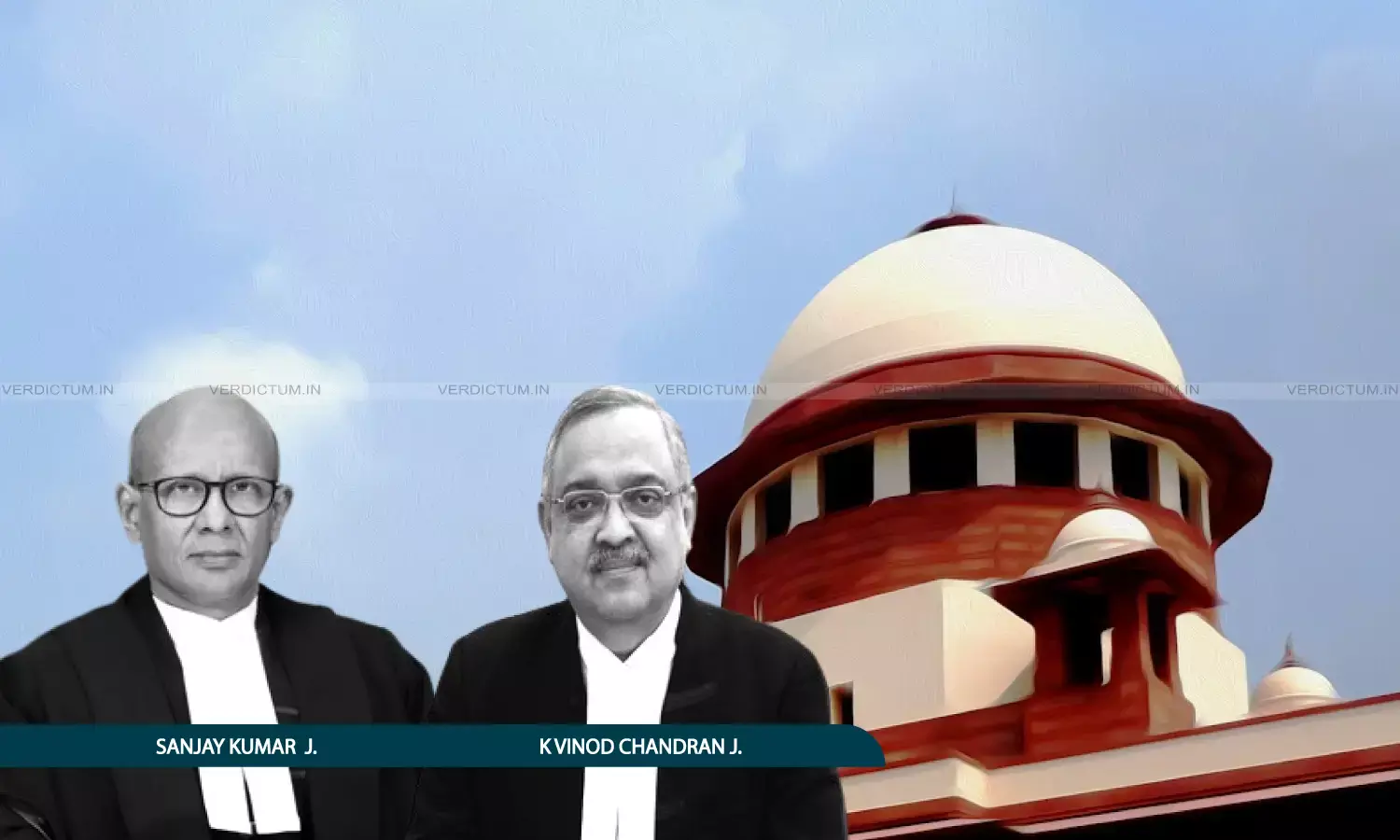
The Supreme Court has set aside the conviction of a Russian national in an NDPS case after noting that the mandatory stipulation for search and seizure as per the Act was not carried out in its true letter and spirit. The High Court, on an appeal, had affirmed the conviction handed down by the Trial Court.
The Apex Court did not find the search and seizure to be in accordance with the mandatory prescriptions.
The Division Bench of Justice Sanjay Kumar and Justice K. Vinod Chandran held, “The sequence of events as spoken of by PW1 to PW3 clearly indicate that immediately on interception the bag of the accused was searched and the contraband detected. The consent letter was signed after the detection was made and then the confession was alleged to have been made. The attempt is to say that the detection was separate from actual seizure. However, the contraband being inside the bag of the accused, there was no possibility of detection without a search having been carried out. Obviously, the mandatory stipulation for search and seizure as per the NDPS Act was not carried out in its true letter and spirit.”
Factual Background
A search was conducted on the Indo-Nepal Border, which led to the recovery and seizure of 1.9 kg of charas from a Russian National, who was arrested and later put on trial. The Sessions Court convicted and sentenced the accused to ten years rigorous imprisonment for the offences punishable under Sections 8, 20 and 23 of the Narcotic Drugs and Psychotropic Substances Act, 1985 and a fine of Rs 1 lakh with a default sentence of six months. The prosecution alleged that after entering the territory of India, 15 meters from the Border Pillar No.517/2 (Sub Pillar), the appellant was accosted and searched by a team of Sashastra Seema Bal (SSB). On detection of the contraband in his bag, a police team was summoned, after which the recovery was made, and the criminal law was put into motion.
The accused, on the contrary, claimed that he was taken into custody on the previous day at the no man’s land and on his refusal to bribe the police, a false case was registered against him. The High Court, on an appeal, affirmed the conviction and sentence handed down by the Trial Court against which the appeal was filed before the Apex Court.
Reasoning
On a perusal of the facts of the case, the Bench noted that both the Trial Court and the High Court had noted discrepancies in the evidence led by the prosecution but upheld the conviction, finding those to be minor.
The Bench found that it was the Sub Inspector with the SSB (PW3), who first confronted the accused and, after having detected the contraband in his bag, called the police team led by PW1, who was also a Sub Inspector attached to the Sonauli Police Station. Pursuant to this, a search was conducted. It was also asserted by these witnesses that before the search was conducted, they had searched all the members of the team to ensure that no contraband was kept in their possession. The Bench noted that the detection of the contraband was done even before the information of rights.
As per the Bench, even if the accused was arrested before he reached the Immigration Counter, it was the bounden duty of the police who took him into custody to get his entry marked in the passport at the Immigration Counter. “The fact of his exit from Nepal on 05.11.2016 and the absence of an endorsement of his entry into Indian territory raises yet another reasonable doubt, insofar as his interception at 7 A.M. on 06.11.2016”, it added.
The Bench further stated, “We cannot but notice that even the recovery Mahazar does not indicate a bag in which the contraband is said to have been smuggled into India. We cannot but notice that the inconsistencies in the evidence of PW1 to PW3 are not minor and are glaring enough to raise a reasonable doubt as to the complicity of the accused in the alleged smuggling of the contraband into India. We are unable to find the search and seizure to be in accordance with the mandatory prescriptions and hence the foundation of the case charged against the appellant falls apart.”
The Bench thus held that the prosecution failed to establish beyond all reasonable doubt that the accused was guilty of bringing in charas from Nepal to India. Thus, allowing the appeal and setting aside of the Trial Court as well as the High Court, the Bench ordred the release of the accused. “The Original Passport of the accused available in the records shall be returned to the learned counsel for the appellant, by the Registry with due acknowledgment taken”, it ordered.
Cause Title: Doniyar Vildanov v. The State of U.P. (Neutral Citation: 2026 INSC 95)