

Liability To Be Borne By State & Not Private Insurer In Case Of Accident When Vehicle Was Requisitioned For Public Functions: Supreme Court
The Supreme Court was considering an appeal challenging the determination of liability in connection with the accident that took place between a bus and a motorcycle, killing the rider of the latter.

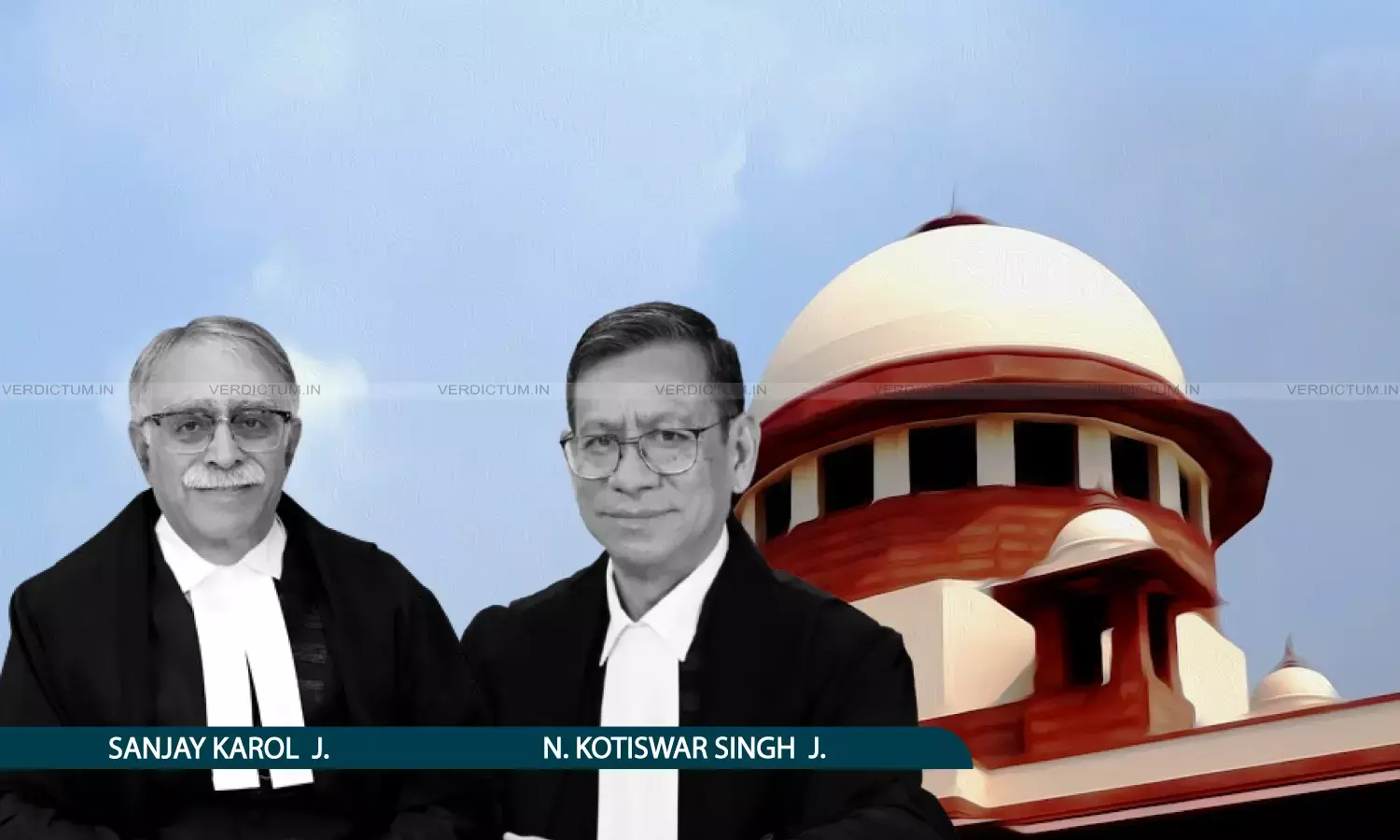
Justice Sanjay Karol, Justice N. Kotiswar Singh, Supreme Court
While dismissing an appeal filed by the District Magistrate/District Election Officer in a case of a motor accident, the Supreme Court has held that where a vehicle is requisitioned for public functions and an incident occurs during the period of such requisition, liability has to be borne by the requisitioning authority, and not by the insurer engaged by the owner for the vehicle’s regular use.
The Apex Court was considering an appeal challenging the determination of liability in connection with the accident that took place between a bus and a motorcycle, killing the rider of the latter.
The Division Bench of Justice Sanjay Karol and Justice Nongmeikapam Kotiswar Singh held, "Where control is assumed by the State, the legal consequences arising from that control cannot, in fairness, be shifted back to a private insurer whose contractual engagement was premised on a wholly different footing. It is equally important to recognize that a requisition is not a voluntary arrangement, instead it is a command issued under statutory authority..."
“Here, as is abundantly clear, it was a requisition by the authority under a special statute. Accordingly, it is held that where a vehicle is requisitioned for public functions and an incident occurs during the period of such requisition, liability ought properly to be borne by the requisitioning authority, and not by the insurer engaged by the owner for the vehicle’s regular and voluntary use", it added.
Advocate Neelesh Yadav represented the Appellant, while Advocate Manu Luv Shahalia represented the Respondent.
Factual Background
The bus, under the ownership of Kidzee Corner School, Gwalior, was requisitioned under the orders of the appellant for the Gram Panchayat Elections. It had, while being under the orders and command of the relevant election authorities, dashed into the motorcycle of the deceased. The Fifth Additional Motor Accident Claims Tribunal allowed the claim of the legal representatives of the deceased and awarded compensation of Rs 5,13,500 along with interest.
Aggrieved by such a determination, two Miscellaneous Appeals came to be filed before the Madhya Pradesh High Court, one by the Insurance Company (first respondent) and one by the legal representatives of the deceased, who took objection to the conservative estimation of the deceased’s income and sought the enhancement of the compensation so awarded. The Insurance Company’s appeal was allowed insofar as liability originally fastened upon them was instead shifted to the appellant. The Appeal by Respondents was allowed by enhancing the compensation to Rs 27,01,556. The appellant, by way of the appeal, questioned the shifting of liability upon him.
Arguments
It was the appellant’s case that the High Court’s determination was erroneous since at the relevant point in time the offending vehicle was under the coverage of an insurance policy. It was further submitted that when the bus was being used for a public purpose and if the liability is fastened upon public authorities, it would send a wrong message since the authorities do not have either ownership of the vehicle or any insurable interest.
Reasoning
The Bench found that the bus in question was requisitioned by the appellant for the Gram Panchayat elections. The Bench noted that the word requisition is defined by the Cambridge Dictionary as follows: “to officially request or take something”.
The Bench relied upon the judgment in National Insurance Co. Ltd. v. Deepa Dev (2008), wherein it was observed that for the period the vehicle remains under the control of the State and/or its officers, the owner is only entitled to payment of compensation therefor in terms of the Act, but he cannot exercise any control thereupon.
The Bench also held, “When a public authority requisitions a privately owned vehicle for public purposes, the nature of possession and control changes entirely. The owner is divested of custody and decisionmaking power, and the vehicle is placed at the disposal of the State for governmental functions. During this period, the owner neither directs its use nor derives any benefit from it. It only stands to reason that in such circumstances, if an untoward incident occurs, responsibility would properly to rest with the requisitioning authority and not with the insurer engaged by the owner for ordinary, private or commercial use, as the case may be. Once requisitioned, the vehicle is operated under official directions.”
The Bench further explained that Section 160 of the Representation of the People's Act, 1950 grants power to the State to requisition premises as well as vehicles, but the same does not expressly authorise the requisition of manpower, such as a driver. Considering that the Authority in the said case made a conscious decision to requisition the vehicle with the driver instead of exercising its power to request staff for the purpose of carrying out duties in connection with the election, the Bench held that the liability would rest with the requisitioning authority, and thereby with the State.
Thus, finding no error in the impugned judgment, the Bench dismissed the appeal.
Cause Title: District Magistrate and District Election Officer and Collector, Gwalior, M.P. v. National Insurance Company Limited (Neutral Citation: 2026 INSC 279)
Appearance
Appellant: Advocates Neelesh Yadav, AOR Shashank Singh
Respondent: Advocate Manu Luv Shahalia, AOR Manjeet Chawla, Advocates Usha Pant Kukreti, Jyoti