

No Exhumation Of Buried Bodies Shall Be Permitted: Supreme Court Directs In Plea Challenging Digging Up Of Tribal Christians' Dead Bodies In Chhattisgarh
The petition alleged that the Chhattisgarh police and administration often "ferment trouble" by intervening even when there is no local objection, forcibly removing bodies under the guise of maintaining order.

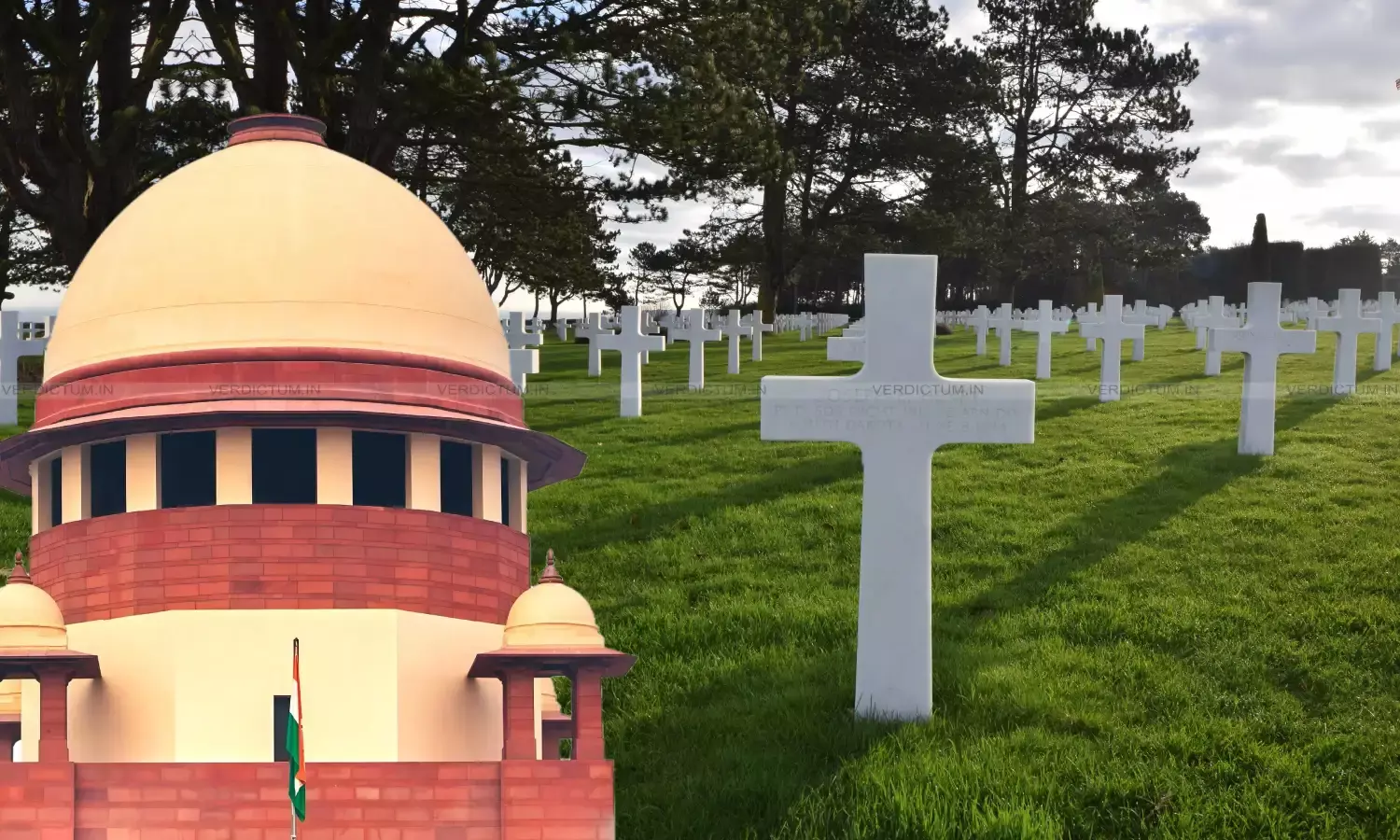
The Supreme Court, while issuing notice, passed an interim order halting the forcible exhumation of tribal Christians' bodies in Chhattisgarh.
The Court was hearing a writ petition filed under Article 32 of the Constitution of India is in respect of Tribal Christians who are being forcibly prevented from burying their deceased in the burial places within the boundaries of their villages, as is done for all other communities.
The Bench of Justice Vikram Nath, Justice Sandeep Mehta and Justice NV Anjaria ordered, "Issue notice. In the meantime, it is provided that no further exhumation of buried bodies shall be permitted."
Senior Advocate Colin Gonsalves appeared on behalf of the Petitioners.
The petition represented a sample of 143 families who were forcibly prevented from burying their deceased in village graveyards—a right granted to all other communities. These families, primarily from districts like Bastar, Kanker, and Dantewada, have lived in these villages for generations. Despite this, their dead are being exhumed by police and local administrations and moved to "designated places" as far as 76 kilometers away.
Gonsalves submitted, "My Lords, we have direct victims here. Petitioner No. 7’s mother was buried, then exhumed and re-buried without his knowledge. Petitioner No. 9’s husband’s body was exhumed and moved to an undisclosed location. I have annexed photographic evidence of these sites...These families have lived and buried their dead in these villages since independence. Now, those already laid to rest are being forcibly removed."
Justice Vikram Nath asked, "Who are the respondents in this matter?"
Gonsalves replied, "The State of Chhattisgarh only. It is our submission that the State is actively supporting these removals...I pray for an immediate stay on any further forcible removal of bodies from their graves."
The Plea, filed by AOR Satya Mitra, submitted that the petitioners in this case are a sample of those who were not allowed to bury their deceased loved ones in the village graveyards, though all other communities are permitted to do so.
The Petition said, "A number of villages samples of which are given below have recently experienced communal elements digging up and causing to be dug up by threat of force, a number of corpses which were dug up by the police or in presence of the police and the dead bodies were sent 50 kms away for re-burial."
The plea also attached various documentary evidence, such as photographs and video clips, showing that the corpses were being dug up under force for involuntary relocation.
The Petitioner, while referring to the judgment of the Supreme Court in Ramesh Bhaghel vs State of Chhattisgarh (2025), said, "The first incorrect and misleading statement made to this Hon'ble Court concerned the distance from the village to the designated burial site. In the case of Ramesh Baghel, the direction to bury the deceased in village Karkapal imposed an unduly harsh burden on the Christian tribal community...The State's counsel informed the Court that village Karkapal was only 20-25 kilometers away. This statement was made malafide and was persisted with, despite the petitioner's counsel clarifying that the actual distance is 55-60 kilometers...The judgment delivered by this Hon'ble Court in tbcRamesh Baghelcase andis being used by the ChhattisgarhPolice to prevent the burial of tribal Christians in their own villages, even in places where there is no local dispute."
It added that the Court was informed that village Karkapal was a designated site. "There is no such thing as a designated site.There is no such notification under the rules...The petitioner submitted 3 RTI applications for each of the 26 districts, against this, the RTI authorities had sent the petitioners 36 replies, 3 in each of the 12 districts. The state replied that there is no designated for burial on the basis of caste and religion", the plea said.
With regards to the communal role of the Chhattisgarh police, the plea said, "The role of the Chhattisgarh police is very communal. The order is Ramesh Bhagel's case arose out of a situation where a group of people objected to the Burial of the body. This did not mean that even in the cases where there was no objection at all that the police would intervene and ferment trouble and insist that the Supreme Court order above mentioned made it illegal to bury the body within the same village graveyards...Incidents after the judgement/order In Ramesh Baghel case in the Hon'ble Supreme Court: While in many cases there was the possibility of peaceful burial in the village itself as per the tradition followed for generations, the body was forcibly taken out of the villages to a so-called designated place by the police and administrations."
It was also submitted that many of the pastors who buried the bodies in the village at the request of the families of the deceased were arrested and sent to police lock-up and thereafter to jail.
The Petitioners have prayed, "For a Writ, Order or Direction restraining the State and individuals from interfering with the burial of the deceased and declaring that all persons irrespective of Caste, Religion and SC/ST/OBC status are permitted to bury their deceased in the village where they live...b. For a Writ, Order or direction to all gram panchayats in the state too demarcate specific areas within each village for the burial of all communities irrespective of Caste. Religion and SC/ST/OBC state, and to all gram panchayats to permit all families to bury their deceased in the village where they live...c. For a Writ, Order or Direction in cases where by custom and tradition all communities are biirring their dead within the village, for an order directing the state government and gram panchayat not to interfere with this practice...d. For an order directing the states to promote secularism and fraternity by promoting to the extent possible common graveyards of all communities within the village."
Accordingly, the Court has issued notice in the matter along with the above-mentioned interim directions.
Previously, the Chhattisgarh High Court had refused permission to a man to carry out his dead father’s last rites in the common graveyard of the village as per Christian Religious Customs by observing that if the relief was granted, then the same would cause unrest and disharmony in the public at large. The High Court made such an observation in view of the fact that a burial ground/graveyard of the Christian community was available in the nearby area where the petitioner could perform the funeral rites of his deceased father.
Cause Title: Chhattisgarh Association for Justice and Equality & Ors. v. State of Chhattisgarh [Diary No. 54722 of 2025]