

Ensure Admission Of Atleast 25% Of Class Strength In Unaided Schools With Children Of Disadvantaged Groups: Supreme Court Directs Preparation Of Rules For Implementing Sec.12(1)(C) RTE Act
The Supreme Court also stated that the obligation of a “neighbourhood school” to admit children belonging to weaker and disadvantaged sections of society has the extraordinary capacity to transform the social structure of the society

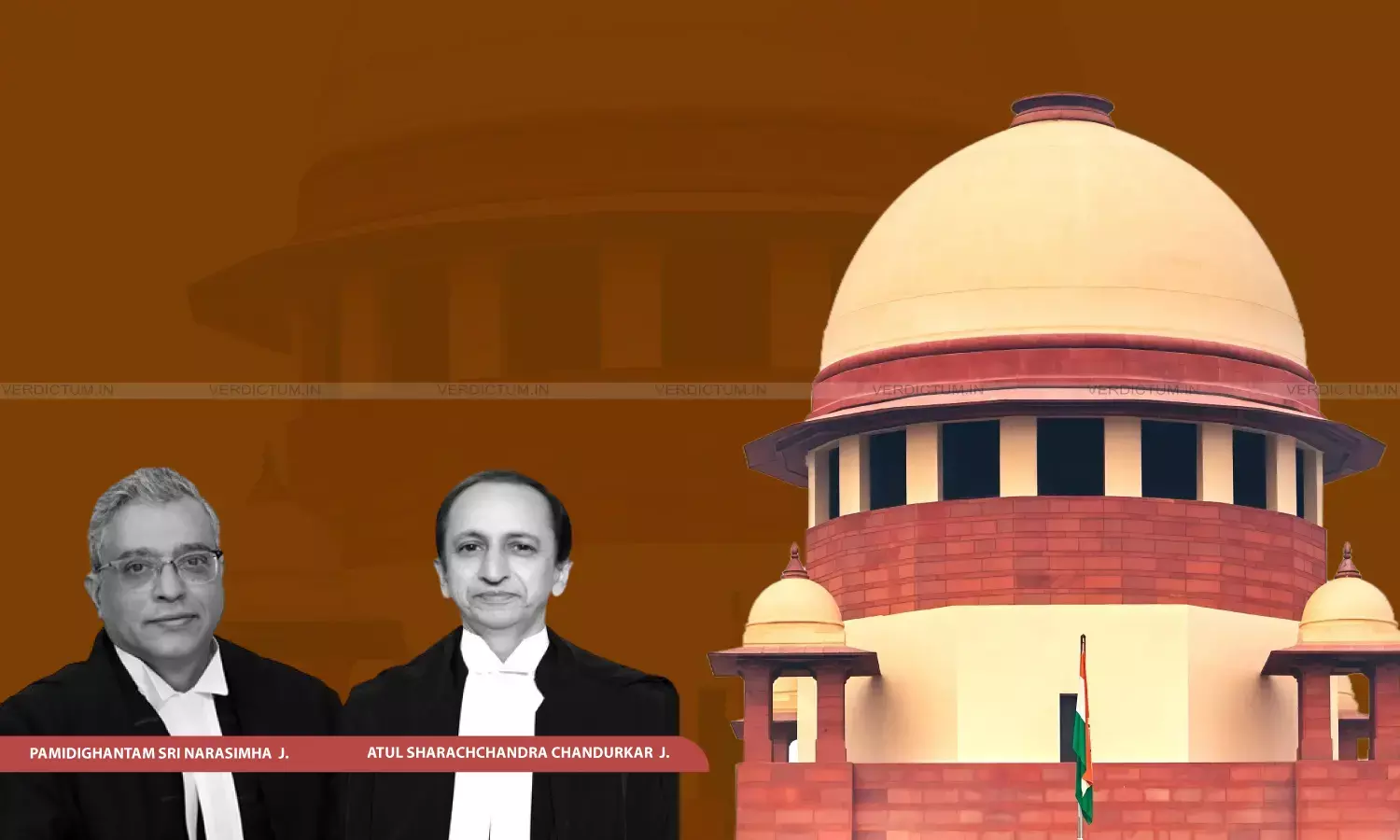
Justice Pamidighantam Sri Narasimha, Justice Atul S. Chandurkar, Supreme Court
While observing that ensuring admission of at least 25% of class strength in unaided schools with children of weaker and disadvantaged groups is a national mission, the Supreme Court has directed the appropriate authorities to prepare and issue, in consultation with the NCPCR and SCPCRs, as well as the National and State Advisory Councils, necessary rules and regulations under Section 38 of the Right of Children to Free and Compulsory Education Act, 2009, for implementing the mandate of Section 12(1)(c).
The Apex Court also stated that the obligation of a “neighbourhood school” to admit children belonging to weaker and disadvantaged sections of the society, to the extent of twenty five percent of the class strength, under Section 12 has the extraordinary capacity to transform the social structure of the society
The Division Bench of Justice Pamidighantam Sri Narasimha and Justice Atul S. Chandurkar held, “Our concern is about the effective, rather, the ineffective implementation of the mandate under Section 12 of the Act. We have to ensure admission of at least twenty-five percent of class strength in unaided schools with children of weaker and disadvantaged groups. This is certainly a national mission. Effective implementation of the statutory policy will be transformative and, in this regard, each one of us, be it the institution or an individual, be it the Central or the State Governments, Advisory Councils or Commissions are duty bearers.”
“In view of the above, we direct the appropriate authorities to prepare and issue, in consultation with the NCPCR and SCPCRs, as the case may be, as well as the National and State Advisory Councils, necessary rules and regulations under Section 38 of the Act for implementing the mandate of Section 12(1)(c) of the Act”, it ordered.
AOR Varinder Kumar Sharma represented the Petitioner, while ASG Aishwarya Bhati represented the Respondent.
Factual Background
The petitioner had approached a ‘neighbourhood school’ for admitting his children for free and compulsory elementary education in 2016. It was his case that, even though information through RTI indicated that seats were available, the neighbourhood school did not respond. Therefore, he was compelled to approach the High Court by filing a writ petition under Article 226 of the Constitution. However, the High Court turned back the petitioner on the ground that the petitioner had failed to take up appropriate steps to admit his kids in the free education quota.
The “appropriate steps” that the High Court was referring to pertained to the alleged failure to apply as per the online procedure for filling up the 25% seats for children of weaker and disadvantaged sections. The primary education officer of the Zila Parishad had addressed a letter to the Deputy Education Officer to admit the petitioner’s children, though the online procedure had not been followed, as his house was within 3 kms of the neighbourhood school and he came from a very poor family. The Special Leave Petition against the High Court’s order was pending for a long time without appropriate orders. In order to ensure that this situation does not revisit parents like the petitioner again, the Apex Court considered it appropriate to take up the case for precedent-making and decided to examine the efficiency and effectiveness of the procedures for complying with the mandate of Section 12.
Reasoning
The Bench explained that the Constitution declares elementary education as a fundamental right, as against many other liberties, which are in the nature of fundamental freedoms. “The consequence of identifying the right to elementary education as a positive right is the recognition of corelative duties and identification of five duty bearers, being (i) the appropriate government, (ii) the local authority, (iii) the neighbourhood schools, (iv) the parents/guardians, and (v) the primary school teachers”, it stated.
Referring to section 12 of the Right of Children to Free and Compulsory Education Act, 2009 (RTE Act), the Bench stated that this provision mandates that not less than twenty-five percent of the strength of an entry-level class shall be reserved for and filled by children belonging to “weaker sections” and “disadvantaged groups”, who are thereby guaranteed access to free elementary education. The second is that such children are to be admitted to unaided schools in their neighbourhood, thereby embedding within the statutory framework the principle that the constitutional promise of education under Article 21A is to be realised through common local schools rather than segregated or parallel systems. “In this sense, the 25% inclusion under Section 12, in unaided neighbourhood schools, is not an isolated welfare measure but a vehicle through which the constitutional commitment to fraternity and the “development of the child” as recognised in Article 21A and Article 39(f) is sought to be realised”, the order read.
The Bench also mentioned that the neighbourhood common school system under the RTE Act envisages that each child must have access to a neighbourhood school, and such a system is central to the project of democratising schooling and reducing entrenched social inequalities. It was further noticed that the Parliament has assigned the task of reviewing, monitoring and redressing the grievances arising under the Act to the National and State Commissions for Protection of Child Rights. The Commissions are established under Sections 3 and 17 of the Commission for Protection of Child Rights Act, 2005. In exercise of its statutory duty, NCPCR issued Standard Operating Procedure (SOP) for implementation of Section 12(1)(c) of the Act.
The Bench noted that NCPCR’s SOP is structured in three stages, the first relating to the preparatory stage, the second stage relating to processing applications, selection and admission and the third stage relating to procedure after completion of admission. To ensure a smooth and transparent admission process and in order to enable eligible children to access the right of admission under Section 12(1)(c), the Bench enumerated some steps, including finalisation of seats, advertisement, schedule of admission, setting up of Help-desks, per-Child Expenditure reimbursement, etc.
“The above referred procedure, as indicated in the SOP issued by NCPCR, is only in the nature of guidelines. These guidelines do not partake the character of enforceable rules, violation of which would render the duty bearers answerable to the reviewing or controlling authority. Uncertainty about the obligation to comply with the requirements would also make judicial review complicated”, the Bench clarified.
The Special Leave Petition has now been listed for further hearing on April 6, 2026.
Cause Title: Dinesh Biwaji Ashtikar v. State of Maharashtra (Neutral Citation: 2026 INSC 56)
Appearance
Petitioner: AOR Varinder Kumar Sharma
Respondent: ASG Aishwarya Bhati, Advocates Shreya Jain, Poonam Singh, Bhuvan Kapoor, Mili Baxi, Rajesh Singh Chauhan, Padmesh Mishra, Neelakshi Bhadauria, AOR Sudarshan Lamba, AOR Aaditya Aniruddha Pande, Advocates Amit Gupta, Muskan Nagpal, Prannv Dhawan, AOR Mitter & Mitter Co.