

Can’t Expect Minor To Respond To Public Notice Independently: Supreme Court Quashes Ex Parte Order Granting Succession Certificate
The Supreme Court was considering an appeal challenging the rejection of an application filed under Order IX Rule XIII of the Code of Civil Procedure by the appellant.

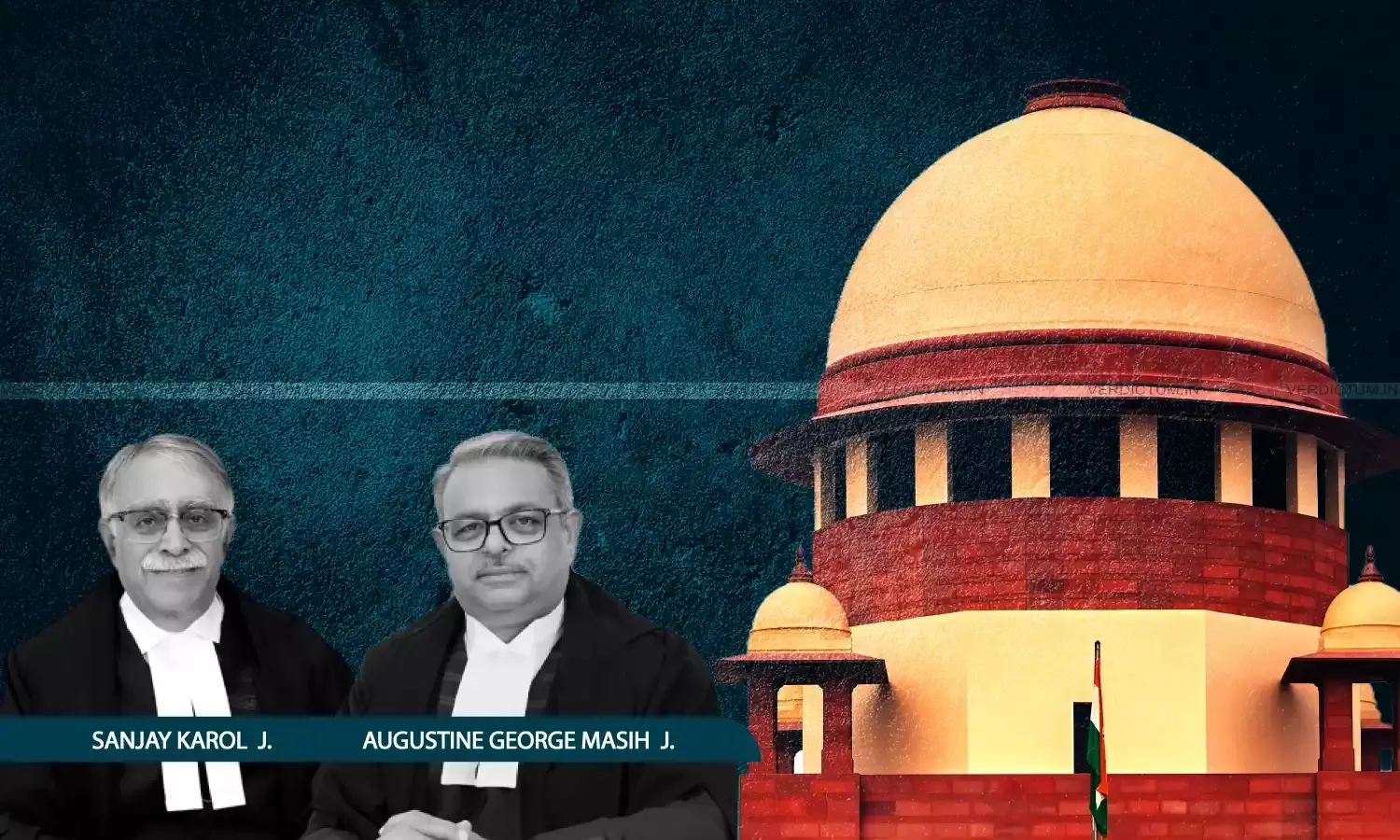
While quashing an ex parte order granting the succession certificate where a minor was never impleaded as a party in the succession proceedings, the Supreme Court has held that a minor cannot be expected to respond to a public notice or initiate legal proceedings independently.
The Apex Court was considering an appeal challenging the rejection of an application under Order IX Rule XIII of the Code of Civil Procedure, 1908, filed by the appellant.
The Division Bench of Justice Sanjay Karol and Justice Augustine George Masih held, “In the present case, the appellant filed an application under Order IX Rule XIII CPC after dismissal of the appeal. In view of the facts and circumstances discussed hereinabove, the application deserves to be allowed. The High Court erred in concluding that the minor had not asserted any right through Late Mr. Omprakash Maheshwari, and further erred in holding that she was neither a necessary nor a proper party. The finding that no prejudice was caused to the minor is unsustainable in law. Further, the High Court also failed to appreciate that a minor cannot be expected to respond to a public notice or initiate legal proceedings independently. The conclusions drawn by the courts below suffer from serious legal infirmities.”
AOR Pratibha Jain represented the Appellant while AOR Arvind Gupta represented the Respondent.
Factual Background
The first and second respondents filed an application under Section 372 of the Indian Succession Act, 19252 seeking retiral benefits of their late father Omprakash Maheshwari, who passed away in 2011, from Madhya Pradesh Central Electricity Distribution Company (third Respondent), where the deceased had superannuated after working as a lineman. It was their contention that they were the daughters of the deceased and that their mother (his wife) namely Asha Maheswari, had predeceased him in 2006. The Company opposed this on the ground that in the official records the name of his wife was one Malti Maheswari and therefore, only she was entitled to the benefits as may be payable by them. The Court, having considered evidence, granted the Succession Certificate.
An application under Order IX Rule XIII CPC was filed to set aside this Certificate since, did not appear before the concerned court. The First Civil Judge rejected the application. On appeal, the District Judge, upheld the order observing that the evidence on record clearly showed that Malti, was duly served. In terms of the impugned judgment, the High Court dismissed the civil revision directed against the above orders and held that once the applicant had not claimed any right in the estate of late Om Prakash Maheswari, then it could not be said that either he was a necessary party or any prejudice had been caused to him because of lapse in the public notice. It was in such circumstances that the appellant approached the Apex Court.
Reasoning
The Bench, at the outset, explained that under Order IX Rule XIII CPC an application is made to set aside an ex parte decree and primary requirements of an application under Order IX Rule XIII CPC is whether the summons were duly served and whether there is sufficient cause that prevented the party from appearing in Court. Reference was made to the judgments in Neerja Realtors Pvt. Ltd. vs. Janglu (2018) and Parimal vs. Veena (2011).
The Bench noted that the first appellant was a minor, aged about 12 years, at the time when the respondents initiated proceedings for the grant of a Succession Certificate. A public notice was issued pursuant to the orders of the Additional District Judge; however, the said notice did not clearly specify that the proceedings were initiated on account of the death of Late Omprakash Maheshwari.
The Bench further stated, “The observation of the learned Additional District Judge, vide order dated 10.01.2019, to the effect that the minor could have, upon publication of the public notice, impleaded himself as a party and raised objections, is wholly erroneous and perverse. Being a minor at the relevant time, appellant no. 1 was legally incapacitated from taking such steps.” The Bench held that the respondents were fully aware of the existence of appellant as one of the legal heirs but despite such knowledge, no steps were taken to ensure the appointment of a lawful guardian to represent the minor in the proceedings. “It is only upon attaining majority that appellant no. 1 acquired the legal capacity to challenge the said proceedings and accordingly initiated the present action. There is nothing on record to suggest any collusion between the minor and his mother”, it added.
Referring to the provisions of the Indian Succession Act, the Bench explained,“Where an application is defective or material facts have been suppressed or misstated, the certificate issued pursuant thereto is liable to be revoked under Section 383 of the Act. The factual matrix of the present case squarely justifies invocation of the said provision.” It was further noticed that the minor was never impleaded as a party in the succession proceedings, thereby depriving her of an opportunity to be heard. Referring to the judgment in Bhanu Kumar Jain v. Archana Kumar (2005), the Bench reiterated that Order IX Rule XIII CPC confers a wider jurisdiction, enabling the applicant to demonstrate sufficient cause for non-appearance and seek setting aside of an ex parte decree.
Thus, allwoing the appeal, the Bench quashed the impugned order as well as the ex parte order granting the Succession Certificate. The Bench concluded the matter by directing the parties to appear before the competent court dealing with the succession certificate proceedings on a date to be fixed by the court.
Cause Title: Deepesh Maheswari v. Renu Maheswari (Neutral Citation: 2026 INSC 306)
Appearance
Appellant: Senior Advocate Puneet Jain, AOR Pratibha Jain, Advocates Christi Jain, Om Sudhir Vidyarthi, Akriti Sharma, Aditya Jain, Siddharth Jain, Yogit Kamat, Ritvik Bharadwaj
Respondent: AOR Arvind Gupta