

Issuance Of Notice U/S 10(5) ULC Act Is Mandatory & Must Be Issued To Person Actually In Possession Of Land: Supreme Court
The Supreme Court reiterated that mere vesting of the vacant land with the State Government by operation of law, without actual possession, is not sufficient.
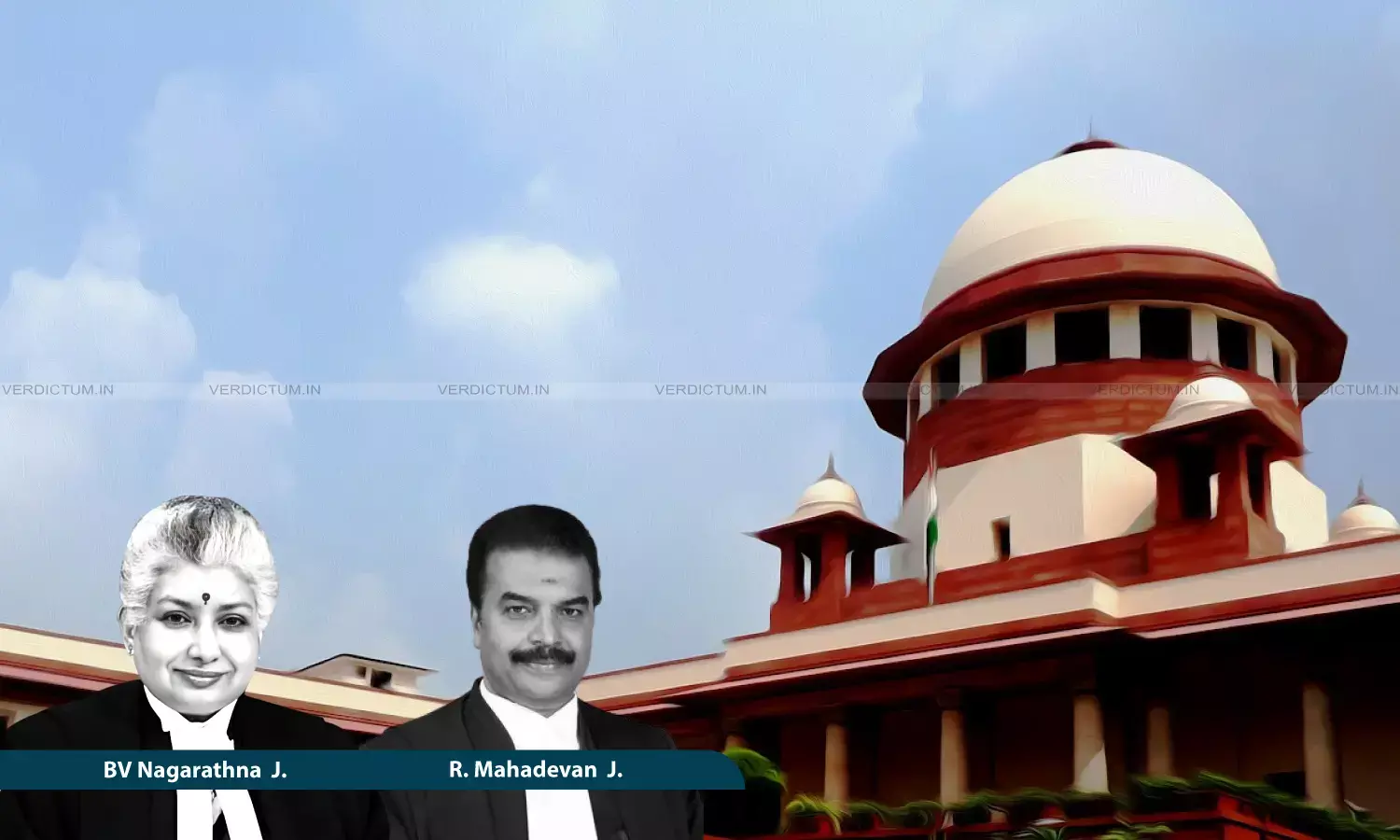
Justice B.V. Nagarathna, Justice R. Mahadevan, Supreme Court
The Supreme Court emphasized that the requirement of issuance of notice under Section 10(5) of the Urban Land (Ceiling and Regulation) Act, 1976 (ULC Act) is mandatory and must be issued to the person(s) actually in possession of the concerned land.
The Court emphasized thus in a Civil Appeal filed against the Judgment of the Gujarat High Court by which it dismissed an Appeal.
The two-Judge Bench comprising Justice B.V. Nagarathna and Justice R. Mahadevan observed, “We, therefore, see that the requirement of issuance of notice under Section 10(5) is mandatory and must be issued to the person(s) actually in possession of the concerned land. This is clear from the wording of the statute (“order any person who may be in possession of it”), which are interpreted by this Court in Hari Ram. This Court opined that the importance of delivering notice lay in avoiding a situation where a person is “dispossessed” without notice which would be in violation of the principles of natural justice, thereby clearly envisioning that the possessor must be served with notice.”
The Bench reiterated that mere vesting of the vacant land with the State Government by operation of law, without actual possession, is not sufficient.
AOR Rabin Majumder represented the Appellants, while AOR Deepanwita Priyanka represented the Respondents.
Facts of the Case
According to the Appellants, the subject land belonged to one Nathubhai Ranchhodbhai, upon whose death in the year 1933, his heir Kuberbhai Nathubhai became its true owner and occupier. In 1976, the ULC Act came into force and Section 6(1) of the said Act directed every person holding vacant land in excess of the ceiling limit to file a statement specifying the location, extent, value, and such other particulars of all vacant lands held by him. Resultantly, Kuberbhai filed a Form under Section 6(1) of the ULC Act. Thereafter, the Competent Authority passed an order holding that lands were exempt under Section 21 of the ULC Act, which stated that excess vacant land shall not be treated as excess in certain cases. The Respondents contended that the form filled earlier under Section 6(1) was not processed and was kept pending.
Subsequently, one Khodidas Kanjibhai Patel, the organiser of Sardar Hira Udhyog Sahakari Mandali Ltd. purchased lands at a public auction held by the Special Recovery Officer in 1981. The said officer confirmed the auction and directed that the name of the society be entered in the records of rights. Hence, Khodidas obtained Construction Permission from the Surat Municipal Corporation. However, in 1984, the Assistant Collector passed an order cancelling Mutation Entry inter alia on the basis that the public auction was not conducted according to the provisions of the ULC Act. This order was challenged, and the Collector upheld the same. Thereafter, the Assistant Secretary, Revenue Department dismissed the Revision and upheld the Collector’s order.
In 1988, the Gujarat Government set aside the competent authority’s order and remanded the matter to the Competent Authority & Additional Collector, ULC. In 1989, the Competent Authority-II passed an order declaring that 662.18 square metres out of the total area of 9303 square metres of the subject land in Survey No.339 – Final Plot Nos. 9A and 9B was ‘excess land’. The Appellants claimed that they were not served with any notice by the Competent Authority-II, though they were the unit holders. The Competent Authority-II refused to grant No Objection Certificates (NOCs) for the subsequent sale. Being aggrieved, the Appellants approached the High Court, however, it dismissed both Writ Petitions. Their Letters Patent Appeals were also dismissed. Hence, they were before the Apex Court.
Reasoning
The Supreme Court in the above regard, said, “… landowner/holder of land may claim the benefit of Section 4 of the Repealing Act (abatement of proceedings) if de facto possession has not yet been transferred either through voluntary surrender, peaceful transfer under Section 10(5) (which, as observed earlier, requires notice to the possessor) or forceful dispossession under Section 10(6) of the ULC Act.”
The Court noted that the delivery of notice to the person in possession was unequivocally held to be mandatory and the emphasis was on the service of notice on the possessor, as opposed to mere issuance of the same.
“In the absence of such service of notice, any attempt at forced dispossession was held to be contrary to the statute and hence illegal. … This Court reiterated the conclusion in Hari Ram, i.e., that if possession has not been taken over by the State Government, then the proceedings under the Act would abate under Section 4 of the Repealing Act”, it added.
The Court enunciated that a situation in which possession was not actually transferred to the State Government under the provisions of Section 10 of the ULC Act, was deemed to be ‘paper possession’, and incapable of preventing proceedings from abating under Section 4 of the Repealing Act.
“Therefore, as per the provisions of Sections 10(3) and 10(5) of the ULC Act, the subject land, despite having ‘vested’ (along with acquisition of title or interests) in the State Government, was not in the possession of the Government. Further, possession was not taken by any of the three possible means, i.e., voluntary transfer by the appellants, issuance of notice under Section 10(5) to the appellants followed by peaceful transfer or forceful acquisition of possession under Section 10(6) of the ULC Act. The possession of the land continues with the appellants herein till date”, it observed.
The Court was of the view that mere recording of the lands in the name of the State Government by entry does not demonstrate transfer of possession and rather, the same only denotes de jure possession with the de facto possession remaining in the hands of the Appellants herein.
“Similarly, we are unable to agree with the contention of the respondents that the appellants cannot claim a right to receive notice under Section 10(5) of the ULC Act. The propriety of the sale deed executed in favour of the appellants is immaterial. Section 10(5) mandates the delivery of notice to the person(s) in possession of the concerned lands. On the date of issuance of notice (22.11.1990), the appellants as possessors did not receive the same. It was sent to the erstwhile owner of the subject land. This also implies that the respondents also were aware of the fact that actual possession was not with them and there was a need to issue notice under Section 10(5) of the ULC Act before taking over actual possession”, it remarked.
Conclusion
The Court further said that the Respondents did not ascertain as to in whose name actual possession stood and, therefore, no notice was issued to the Appellants and hence, there being no transfer of possession in accordance with Section 10 of the ULC Act, it continues with the Appellants both in fact as well as in law.
“Hence, they are entitled to the benefit of Section 4 of the Repealing Act as they do not fall within the scope of Section 3 of the said Act which is the savings clause. The omission to issue notice to the appellants violated the mandatory requirement of serving notice under Section 10(5) and meant that the legal process of acquiring possession was still ongoing, leading to abatement of proceedings under Section 4 of the Repealing Act on its enforcement”, it also held.
The Court, therefore, concluded that the Appellants are entitled to all consequential reliefs pursuant to the abatement of the proceedings under Section 4 of the Repealing Act as their case squarely falls within the scope of the provision.
Accordingly, the Apex Court allowed the Appeal and set aside the impugned Judgment.
Cause Title- Dalsukhbhai Bachubhai Satasia & Others v. State of Gujarat & Others (Neutral Citation: 2026 INSC 21)
Appearance:
Appellants: AOR Rabin Majumder, Advocates K Trivedi, and Krishna Yadav.
Respondents: AOR Deepanwita Priyanka
