

Evidence Of Hostile Witness Not To Be Totally Rejected; It Has To Be Subjected To Closer Scrutiny: Supreme Court
The Supreme Court was considering an appeal challenging the judgment of the Madhya Pradesh High Court dismissing the appeal filed by the appellants, who were convicted in a criminal case registered under the Scheduled Castes and Scheduled Tribes (Prevention of Atrocities) Act, 1989.

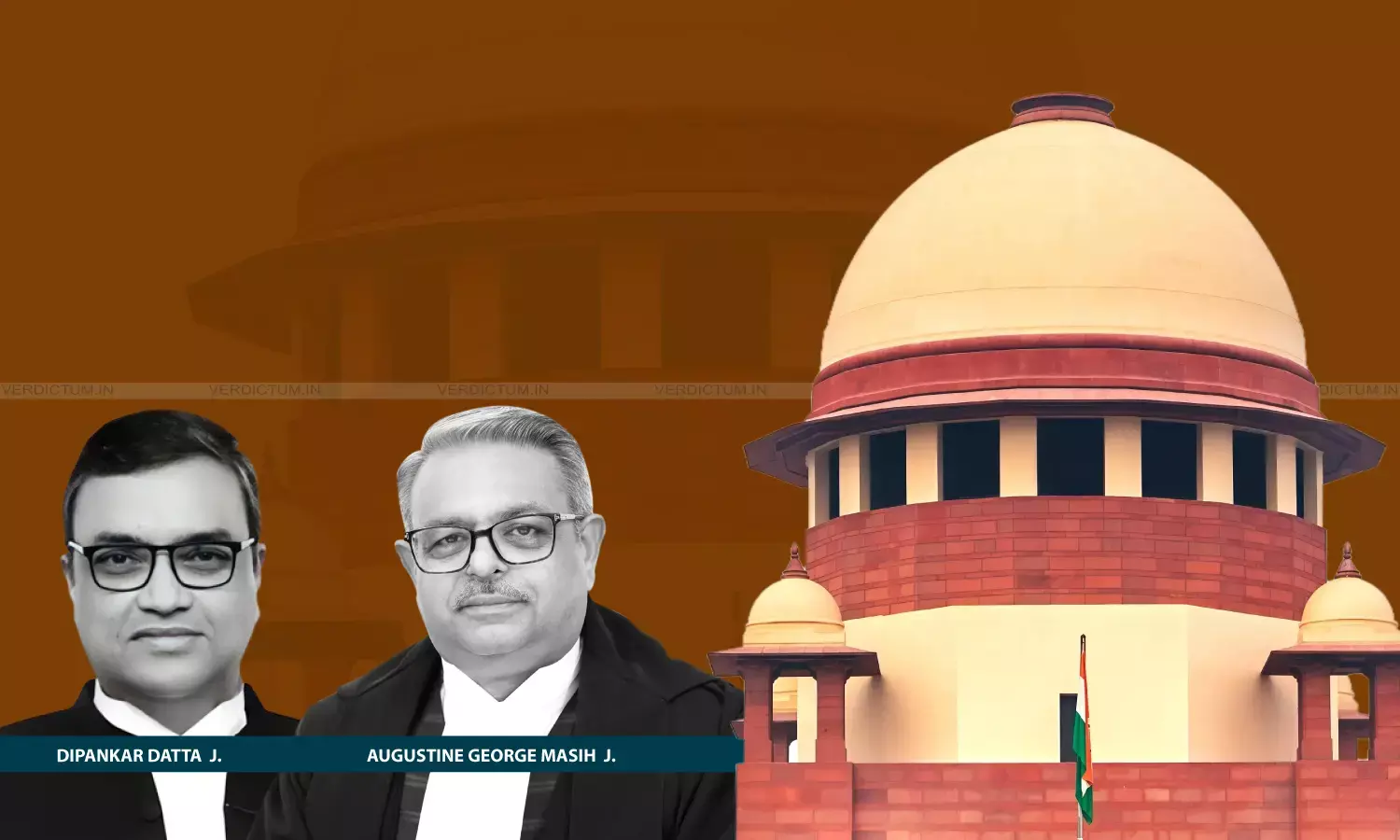
Justice Dipankar Datta, Justice Augustine George Masih, Supreme Court
While acquitting two men in a case pertaining to the SC/ST (Prevention of Atrocities) Act, the Supreme Court has reiterated that the evidence of a hostile witness would not be totally rejected if spoken in favour of either the prosecution or the accused. The Court reaffirmed that the same would have to be subjected to closer scrutiny.
The Apex Court was considering an appeal challenging the judgment of the Madhya Pradesh High Court dismissing the appeal filed by the appellants, who were convicted in a case registered under Sections 354 and 323 of the IPC as well as Section 3(1)(xi) of the Scheduled Castes and Scheduled Tribes (Prevention of Atrocities) Act, 1989.
The Division Bench of Justice Dipankar Datta and Justice Augustine George Masih held, “The High Court did not refer to the evidence of PW-4 simply on the ground that he had turned hostile, in ignorance of the law relating to appreciation of the evidence of a witness who has been declared hostile. A profitable reference may be made to the decision of this Court in State of U.P. v. Ramesh Prasad Misra wherein it was held that it is settled law that the evidence of a hostile witness would not be totally rejected if spoken in favour of either the prosecution or the accused. It would rather have to be subjected to closer scrutiny and that portion of the evidence which is consistent with the case of the prosecution or defence may be accepted. The mere rejection of the evidence of PW4 in the manner aforesaid is contrary to the law laid down by this Court.”
AOR Rajat Sehgal represented the Appellant, while Advocate Aditya Vaibhav Singh represented the Respondent.
Factual Background
In the written complaint lodged by the victim giving rise to the First Information Report, it was alleged that she was in her house and her brother had gone to attend a religious program. At that time, the appellants came there and inquired as to whether there was anybody in the house or not. When the prosecutrix informed that her father had gone to the market, then the second appellant caught hold of her chunni and with evil intention caught hold of her neck. When she tried to run away, the second appellant allegedly scratched her neck. When her brother came running to save her, he was also assaulted and abused filthily. The police lodged the FIR, arrested the appellants, recorded the statements of the witnesses and after completing the investigation, filed the charge-sheet for offence under Sections 354, 294, 323, 34 of IPC and under Section 3 (1) 11 of SC/ST (Prevention of Atrocities) Act.
Reasoning
On a perusal of the evidence led by the prosecution, the Bench noted that there was a discrepancy as to whether the second appellant accompanied the first appellant when the first appellant came to the house of the victim and enquired about the availability of her family members.
The Bench noticed that although the victim had deposed to being injured by the second appellant on her back through a nail mark, the same (nail mark) did not find a mention in the deposition of the Medical Officer (PW-5). “It is also noteworthy that while PW-2 deposed that he was injured on his nose and mouth and there was bleeding, no injury on the nose and mouth appear to have been found by PW5. That PW-2 suffered injury on his nose and mouth is belied by the deposition of the victim, who deposed that PW-2 was bleeding from the head and chest”, it added.
As per the victim’s brother, many people from the locality had come and seen the incident, but the Bench found it strange that none from the locality was produced in the court as a prosecution witness. “While it is within the realm of possibility, the fact that no member of the public rushed to rescue the victim when she was being teased by the appellants is also a circumstance to find the testimony of PW-2 unbelievable. We have, therefore, come to the ineluctable conclusion that PW-2 has not been truthful”, it held. Reference was also made to the deposition of PW-4, who was related to the victim and PW-2. He was declared hostile but was subjected to cross-examination by the Public Prosecutor. The Bench was of the view that mere rejection of his evidence was contrary to the law.
The Bench found no statement to be made in court in the course of the trial by the victim that the second appellant committed the alleged offence only because of the victim was a member of the Scheduled Caste. “No such statement was even made by PW-2. The finding returned by the High Court is, thus, perverse”, it held.
As per the Bench, the defence had been successful in placing a probable and believable account of a scuffle having broken out between PW-2 and the appellants at the Puja pandal, which might have prompted the victim’s brother to set up a false story of the commission of an offence on the victim. “Such scuffle could have resulted in PW-2 falling on the ground and suffering injuries which were ultimately found on his person by PW-5”, it noted.
The Bench also took note of the fact that the victim had not attributed any offensive act to the first appellant. Her version of the second appellant pulling her dupatta and the appellant's beating her brother did not inspire confidence. “We do not see reason to hold, in view of the evidence of PW-5 and our above findings, that A-2 ought to be held guilty of an offence under Section 323, IPC”, the Bench held while allowing the appeal and setting aside the conviction of the appellants.
Cause Title: Dadu @ Ankush v. State of Madhya Pradesh (Neutral Citation: 2025 INSC 1395)
Appearance
Appellant: AOR Rajat Sehgal
Respondent: Advocate Aditya Vaibhav Singh, AOR Sarad Kumar Singhania, Advocate Rashmi Singhania
Click here to read/download Judgment