

TAIT Merit Governs Final Selection; TET Relaxation Doesn’t Bar Migration To Open Category: Supreme Court
The Court noted the guidelines issued by NCTE, where the guidelines themselves permit relaxation in qualifying marks for reserved categories in TET.

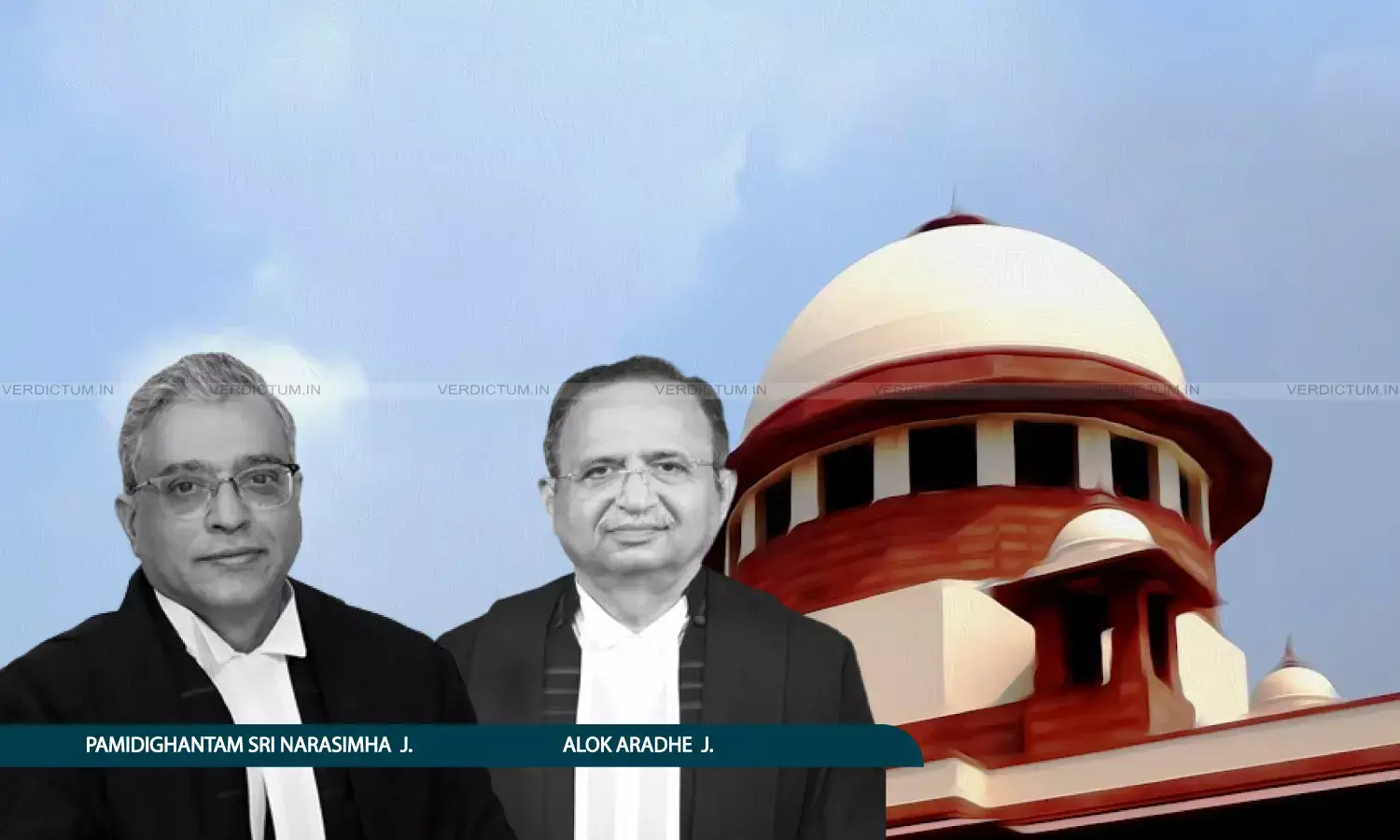
Justice Pamidighantam Sri Narasimha and Justice Alok Aradhe, Supreme Court
The Supreme Court has held that candidates belonging to reserved categories who avail relaxation in the Teacher Eligibility Test (TET) cannot be denied consideration under the open category if they secure higher marks in the Teachers Aptitude and Intelligence Test (TAIT), which forms the basis of final selection.
The Court traced the statutory framework governing teacher recruitment, particularly the guidelines issued by the National Council for Teacher Education (NCTE) on February 11, 2011 under the Right of Children to Free and Compulsory Education Act, 2009. The Court noted that these guidelines themselves permit relaxation in qualifying marks for reserved categories in TET, thereby recognizing such relaxation as a legitimate facet of the eligibility framework.
Justice Pamidighantam Sri Narasimha and Justice Alok Aradhe observed, “…the requirement of obtaining 60% marks in TET is not an essential eligibility condition as the guidelines issued by the NCTE itself permits such relaxation. Such relaxation only enables a candidate belonging to reserved category to participate in TAIT. The inter se merit of the candidates including the respondents has solely been determined on the basis of performance in TAIT. Therefore, the Commissioner (Education), Government of Maharashtra erred in placing reliance on the decision of this Court in Pradeep Kumar (supra) and in issuing the consequential directions for preparation of the merit list”.
“The appellants who admittedly are more meritorious than the last selected candidate under the general category, cannot be excluded from consideration under the general category, in the absence of any express prohibition in the Recruitment Rules/notification. The relaxation in qualifying criteria only affects eligibility and not merit and migration is permissible in the absence of any prohibition… The appellants are entitled to migrate to general category.”, the Bench further noted.
Senior Advocate P.S. Patwalia appeared fort the appellant and Senior Advocate Shyam Mehta appeared for the respondent.
In the matter, the TAIT-2022 recruitment process in Maharashtra was disputed, where several reserved category candidates were excluded from the open category merit list despite outperforming general category candidates. The exclusion was based on the fact that these candidates had availed relaxation in qualifying marks in the TET. The Bombay High Court upheld this exclusion, holding that such candidates could not migrate to the open category.
However, the Supreme Court now emphasised the crucial distinction between eligibility and merit, holding that relaxation in TET marks merely enables candidates to become eligible to participate in the selection process and does not affect the determination of merit, which is based solely on performance in the main examination, i.e., TAIT. Since no relaxation or concession was granted in TAIT, all candidates competed on an equal footing at the stage of merit determination.
The Court referring to precedents further clarified that the open category is not a compartment reserved for general category candidates but a merit-based category open to all. Consequently, if a reserved category candidate secures marks higher than the last selected general category candidate, such a candidate is entitled to be considered in the open category, irrespective of having availed relaxation at the eligibility stage.
Distinguishing its earlier decision in Government of (NCT of Delhi) & Ors. v. Pradeep Kumar & Ors. (2019) 10 SCC 120, the Court observed that the said judgment applies in cases where candidates fail to meet essential eligibility criteria. In the present case, however, the relaxation in TET marks was expressly permitted under the NCTE guidelines and State policy, and therefore did not render the candidates ineligible.
“It is pertinent to note that the decision of this Court in Pradeep Kumar has no application to the obtaining factual matrix for the reason that decision in Pradeep Kumar (supra) is an authority for the proposition that in case candidates belonging to reserved category do not fulfil the essential eligibility condition, they cannot be permitted to be appointed against the general vacancies. In Pradeep Kumar (supra), the respondents neither belonged to the Other Backward Category notified by NCT of Delhi nor fulfilled the essential eligibility condition of securing 60% marks in CTET”, it noted.
The Court also reiterated that the permissibility of migration depends on the recruitment rules or notification governing the process. In the absence of any express prohibition, such migration cannot be denied. It found that no such bar existed in the present recruitment process and that the authorities had erroneously relied on inapplicable precedents to exclude the appellants.
“The Government of Maharashtra by Resolution dated 07.02.2019 has provided that selection list will be based on the marks in TAIT. Therefore, it is axiomatic that relaxation in one of the conditions of securing 60% marks in qualifying examination i.e. TET only enables the reserved category candidates to participate in the main examination i.e. TAIT. Such relaxation only creates a level playing field. The inter se merit for appointment has to be determined solely on the basis of the performance in the main examination i.e. TAIT. No relaxation or concession has been granted to reserved category candidates in the main examination i.e. TAIT and their merit has been evaluated at par with general category candidates”, it noted.
Accordingly, the Court set aside the judgment of the High Court and directed the authorities to revise the merit list by including such candidates in the open category. The appeals were allowed with no order as to costs.
Cause Title: Chaya & Ors. Etc. v. The State Of Maharashtra & Anr. Etc. [Neutral Citation: 2026 INSC 277]
Appearances:
Appellant: P.S. Patwalia, Sr. Adv., R.k. Singh, Neeraj Singh, Tom Joseph, AOR, B. Ravindra Kumar, Kumar Gaurav, Muskan Singh, Advocates.
Respondent: Shyam Mehta, Sr. Adv., Varad Kilor, Siddharth Dharmadhikari, Aaditya Aniruddha Pande, AOR, Shrirang B. Varma, Kuldeep Singh Kuchaliya, Richa Tripathi, Aman Rastogi, Sanjay Rastogi, AOR Dr. Linto K.b., AOR, Praveen Pathak, Duvvada Ramesh, Pankhuri Shrivastava, Neelam Sharma, AOR Alekshendra Sharma, Deepankar Kumar, Geetanjali Mohan, AOR, Saumya Tiwari, Shalini Chandra, AOR, Virag Gupta, Rupali Panwar, U M Tripathi, Vishal Arun Mishra, AOR, Kailas Bajirao Autade, AOR, Advocates.