

Security Deposit Cannot Be Adjusted Towards Pre-CIRP Dues After Moratorium Under IBC: Supreme Court
Court further clarified that Section 14 IBC bars such recovery actions, and the exception relating to guarantees applies only to guarantees in favour of the corporate debtor, not against it.

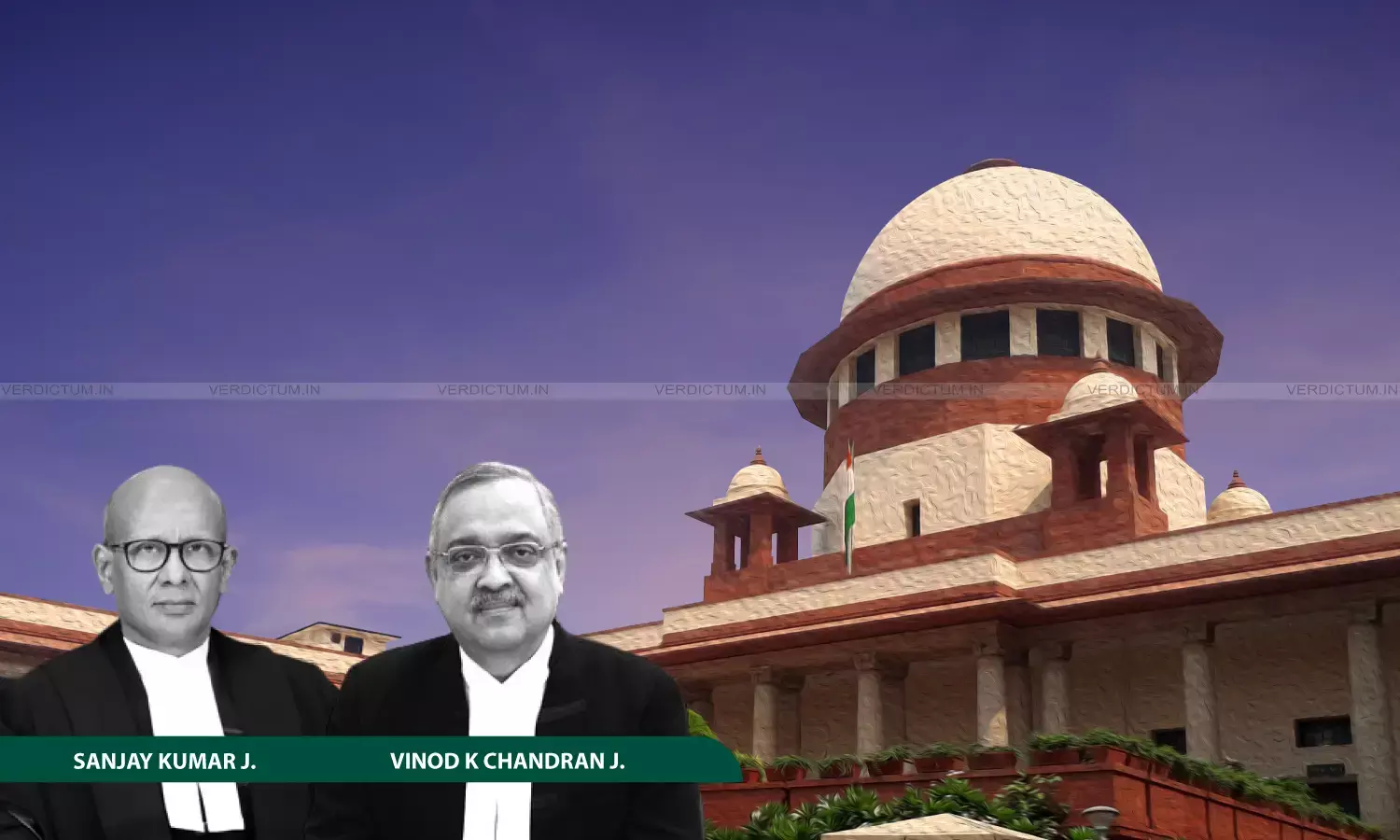
The Supreme Court has held that a security deposit made by a corporate debtor cannot be appropriated towards pre-CIRP dues once the moratorium under the Insolvency and Bankruptcy Code, 2016 (IBC) comes into effect, reaffirming the primacy of the insolvency framework over contractual arrangements.
The Court further held that even if the deposit was made as a security mechanism, it continued to remain an asset of the corporate debtor until lawfully appropriated, and any appropriation towards pre-CIRP dues after the moratorium would be illegal. It further clarified that Section 14 IBC bars such recovery actions, and the exception relating to guarantees applies only to guarantees in favour of the corporate debtor, not against it.
Justice Sanjay Kumar and Justice K. Vinod Chandran observed, “…In the present case, there is no security interest created through pledge or otherwise by the CD to the appellant. The deposit made even if treated as a guarantee for the default in dues remains the property of the CD till it is adjusted towards the defaulted dues and if so adjusted after the moratorium kicks in towards pre-CIRP dues, the adjustment would be rendered illegal. The deposit made is not a debt due to KMPCL, the CD."
In the matter, the Court dismissed appeals arising from a dispute involving adjustment of ₹108.44 crore deposited by KSK Mahanadi Power Company Limited (KMPCL) with Power Grid Corporation’s successor entity, clarifying that such appropriation, particularly ₹85.13 crore admittedly relating to pre-CIRP dues, was impermissible after the insolvency commencement date.
Senior Advocate M.G. Ramachandran and Senior Advocate Navin Pahwa appeared for the respondent.
For the facts, after KMPCL had entered into Transmission Service Agreements (TSAs) and power purchase arrangements, it deposited ₹108.44 crore as a Payment Security Mechanism (PSM) in lieu of a Letter of Credit, pursuant to directions of the Central Electricity Regulatory Commission (CERC).
Following initiation of the Corporate Insolvency Resolution Process (CIRP) on October 3, 2019, the appellant appropriated the deposited amount on March 28, 2020 towards both pre- and post-CIRP dues. The Resolution Professional (RP) challenged this before the NCLT, contending that such adjustment violated the moratorium under Section 14 IBC.
The NCLT held that the appropriation of the security deposit towards pre-CIRP dues after commencement of CIRP was contrary to law and directed that the amount be adjusted only against post-CIRP dues. This view was affirmed by the NCLAT, which emphasised that the deposit remained the property of the corporate debtor until validly appropriated and that recovery of pre-CIRP dues must follow the claims process under the IBC.
Before the Supreme Court, the appellant argued that the deposit was in the nature of a substitute for a Letter of Credit and could have been invoked even after CIRP, akin to enforcement of bank guarantees. It also relied on the doctrine of set-off, citing Bharti Airtel Ltd. v. Aircel Ltd. & Dishnet Wireless Ltd. (Resolution Professional) (2024) 4 SCC 668, to contend that adjustment of dues was permissible.
However, the Court rejected these arguments, holding that the present case did not involve mutual debts necessary for set-off and that the deposit could not be equated with an independent bank guarantee or Letter of Credit.
Distinguishing Bharti Airtel, the Court observed that set-off under the IBC is limited and cannot be used to bypass the moratorium.
“We have also been shown the IM as prepared by the RP which discloses Rs.108.44 crores in the balance sheet under the assets and liabilities of the CD as an asset and later, after information as to its apportionment, as a disputed issue pending before the NCLT. The Resolution Plans were submitted out of which one has turned successful, reckoning Rs.108.44 crores as an asset of the CD. The appellant ought not to have apportioned the claim once the CIRP proceedings commenced. As has been found in Bharti Airtel Ltd.3 set-off would mitigate against the pari passu principle which is apparent from the scheme of the IBC”, it noted.
“The NCLT and the NCLAT has rightly found the apportionment made by the appellant to be violative of the provisions of the IBC and in derogation of the moratorium under Section 14. The direction of the NCLT is also to apportion the entire amounts to the post-CIRP dues, a portion of which by the apportionment itself is to post-CIRP dues. An argument was raised on behalf of the appellant that the amounts apportioned have been disbursed to the ISTS licensees in payment of their defaulted bills and hence, the appellant would be liable to make good the amounts from its own funds. We have no reason to accept the above contention since even the ISTS licensees would be hit by the moratorium under Section 14…”, it further noted.
The Bench also noted that the appellant had already submitted its claims before the Resolution Professional, which were partially admitted and not challenged. In such circumstances, unilateral appropriation of the deposit outside the resolution process was impermissible.
The Court, while upholding the findings of the NCLT and NCLAT, directed that the entire deposit be adjusted towards post-CIRP dues, while pre-CIRP claims must be satisfied strictly in accordance with the resolution plan and the IBC mechanism. The appeals were accordingly dismissed.
Cause Title: Central Transmission Utility of India Limited v. Sumit Binani & Ors. [Neutral Citation: 2026 INSC 284]
Appearances:
Appellant: M.G. Ramachandran, Sr. Adv., Ranjitha Ramachandran, Aneesh Bajaj, Somesh Chandra Jha, AOR, Yashvardhan Singh, Rishit Vimadalal, Advocates.
Respondents: Navin Pahwa, Sr. Adv., S.S. Shroff, AOR, Vaijayant Paliwal, Charu Bansal, Kirti Gupta, Srideepa Bhattachharyya, Neha Shivhare, Vikash Kumar Jha, M/s. Cyril Amarchand Mangaldas, AOR, Advocates.