

Supreme Court Issues Directives On Pending Criminal Cases Under UAPA Like Laws Which Poses Reverse Burden Of Proof On Accused
The Supreme Court remarked that while Article 21 rights must always be protected, but however, in cases where the security or integrity of the nation is called into question, that cannot be the sole ground of consideration.
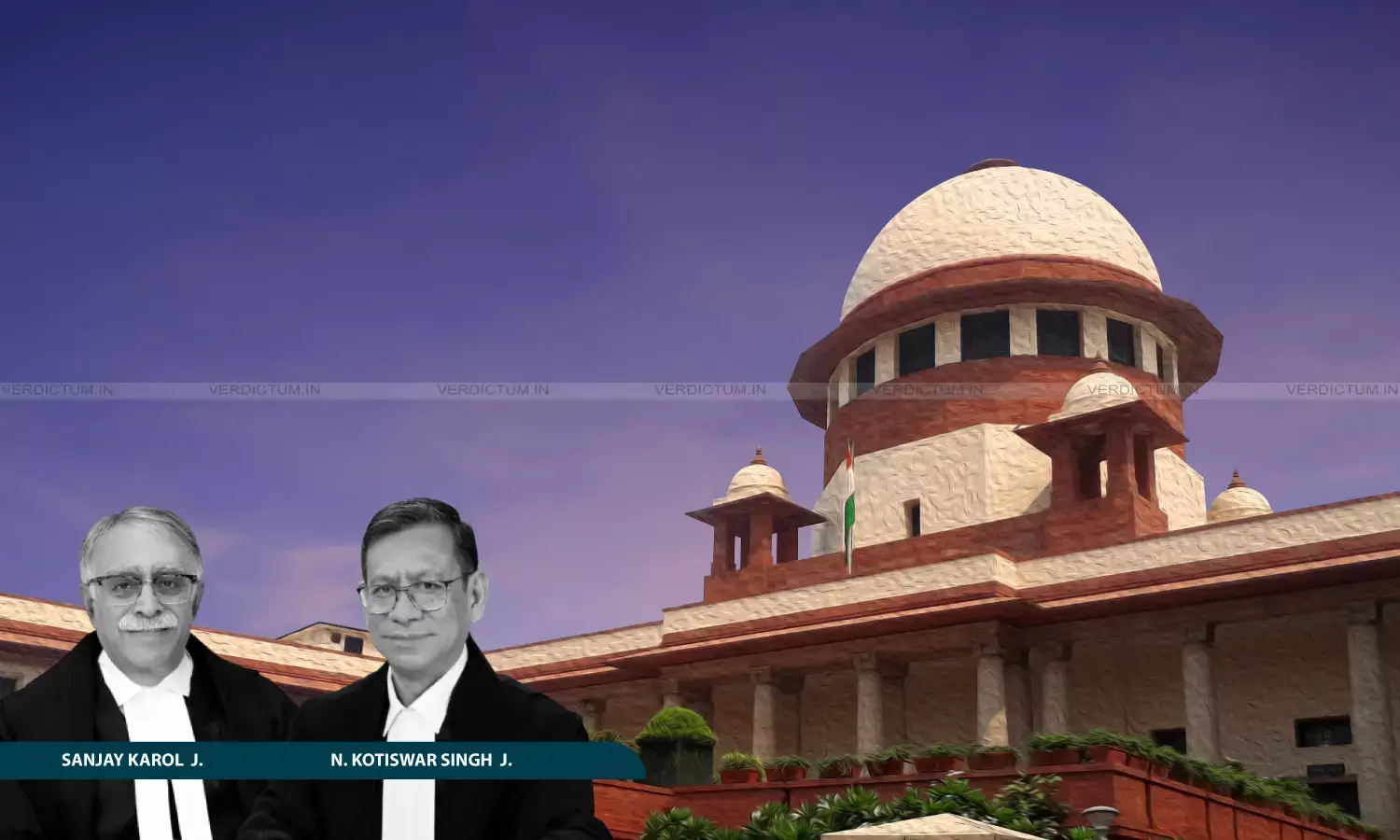
Justice Sanjay Karol, Justice Nongmeikapam Kotiswar Singh, Supreme Court
The Supreme Court has requested Chief Justices of all High Courts to examine the number of cases pending within their States under laws such as the Unlawful Activities Prevention Act, 1967 (UAPA), posing a reverse burden of proof on the accused.
The Court was hearing Criminal Appeals filed by the Central Bureau of Investigation (CBI) against the Judgment of the Calcutta High Court, by which six accused persons were released on bail.
The two-Judge Bench comprising Justice Sanjay Karol and Justice N. Kotiswar Singh said, “The learned Chief Justices of all High Courts are requested:
(a) to examine the number of cases pending within their States under laws such as the UAPA, posing a reverse burden of proof on the accused;
(b) to ascertain the number of special courts designated to try the said offences, and if special courts have not been designated, the number of Sessions courts dealing with matters under these legislations and to take up the matter with the appropriate authority if it is found that they are not sufficient;
(c) to discern, whether posting of judicial officers in these courts as also staffing is sufficient, thereby foreclosing a ground for delay and adjournment, and if not, then suitable order for posting be issued expeditiously”
The Bench directed that the State Legal Services Authority shall take steps to make aware, each undertrial of his right to representation, either by counsel of their own choice or through a legal aid counsel and for those who choose the latter, assignments to their cases to the counsel should be made expeditiously so that the proceedings can start/continue at the earliest.
Additional Solicitor General of India (ASGI) K.M. Nataraj and Senior Advocate Shailesh Madiyal appeared for the Appellant, while AOR N. Sai Vinod and Advocate Archit Krishna appeared for the Respondents.
Facts of the Case
An FIR was registered on June 9, 2010 against unknown persons relating to the unfortunate derailment of Train No. 2102, Jnaneshwari Express, on May 28, 2010 while passing between Khemasuli and Sardiha railway stations, resulting in the untimely death of 148 persons and injury to 170 persons. The motive behind the crime allegedly stemmed from the deployment of a joint force of State Police and Central Paramilitary Force in the jurisdiction of Jhargram Police Station to combat the capture of Rasua village by the Maoists. As per the chargesheet, police investigation revealed that the accused persons with the common intention to pressurize the Government to withdraw the Joint Forces from the Jhargram Police Station area and create terror, hatched a criminal conspiracy and in furtherance thereof, caused damage to the railway tracks near Rajabandh.
It was alleged that the pandral clips of the railway tracks were removed, with the knowledge and intention that grievous hurt would be caused to the passengers of a train. This action caused the derailment of the train, which thereafter collided with an oncoming goods train from the opposite direction, causing widespread loss to life. Along with loss of life and grievous injuries to persons, a loss of 25 crores approx. was caused to the Government due to the destruction of property. Hence, trial commenced all the accused and charges were brought under Sections 120B, 302, 307, 323, 325, 326, 440, and 212 of the Indian Penal Code, 1860 (IPC), Sections 150 and 151 of the Indian Railways Act, 1989, and Sections 16 and 18 of UAPA. As the accused persons were granted bail, the CBI-Appellant approached the Apex Court.
Court’s Observations
The Supreme Court in the above regard, observed, “In this case, the loss of lives and public property has been immense and there is grave impact upon the lives of the people connected to those who have died as a consequence or have been injured because of the ulterior motives in carrying out this alleged offence against the State. It is this grave and serious impact that has to be balanced against the guarantees of Article 21- for these offences by whomsoever committed strike at the nation’s security and are an effort to undermine its sovereign authority. The Courts are duty bound to scrutinise claims for bails in such cases with heightened but fair-minded vigilance. This Court has rich jurisprudence of displaying this fine act of balancing.”
The Court remarked that while Article 21 rights must always be protected, but however, in cases where the security or integrity of the nation is called into question, that cannot be the sole ground of consideration.
“The act of the accused persons must be looked at, on the whole, and all relevant factors must be given due consideration while granting or denying bail. Needless to add, any Court seized of bail application(s) arising out of such offences must record, in their order the reasons and factors that weighed with them in the ultimate outcome”, it added.
Reverse Burden of Proof
The Court reiterated that given the nature of the offence involved, that is, offences against the State and society, bail is a slightly difficult relief to obtain and a necessary consequence thereof, an undertrial in custody faces several difficulties in rebutting the presumption drawn by law, against them.
“An incarcerated accused would have severely limited access to evidence, witnesses and investigative material. This becomes all the more pronounced because the opposite party is the State which has all the means and resources at its disposal. Prolonged incarceration in cases where the accused is socio-economically disadvantaged, amplifies the inequalities for it becomes exceedingly difficult to forward legal/financial/expert assistance that is required to dispel the presumption. There is nearly complete dependence on an otherwise overburdened legal- aid system which struggles with delays, inadequate resources and inconsistent quality”, it noted.
The Court was of the view that in these cases, true it is that the burden of proving innocence is on the accused, a burden is also on the Courts to make it possible for them to do so and it is here that the role of the judiciary becomes significant.
“A constitutional democracy does not legitimise burdens by simply declaring them; it must ensure that those burdened are meaningfully equipped to bear them, even those who are accused of the worst offences imaginable. If the State, in spite of all its might presumes guilt, then the same State must also, with the employment of all the resources at its command, create pathways through which the accused can reclaim their innocence. Needless to say, procedural formalities do not suffice. If it is only those, it falls grossly short of the grandeur of a constitutional democracy. It demands a justice system that is alive to human vulnerability, that recognises that liberty is not a privilege for the powerful but a right inherent in every individual”, it added.
The Court said that delay is an un-ignorable reality of the Indian criminal adjudication system which on its own raises significant issues, but when this delay is in cases such as the UAPA, where a reverse burden of proof is in place, it acquires a qualitatively different, and more insidious, character.
The Court also said that interfering with the liberty of the accused, at this stage, particularly when nothing else holds against them, would not be justified.
“Courts, bound by legislative intent and statutory language, ask for, even before the trial begins, the accused to be able to establish preliminarily, that they will be able to rebut the presumption against them. This doctrinal inversion becomes all the more pernicious on account of procedural delays and very liberty of a person becomes hostage to clogged dockets, overworked judges, a lax prosecution, repeated adjournments by members of the bar and much more”, it further observed.
The Court also remarked that the institutions of justice must act not as passive observers but as active guarantors of fairness: ensuring real access to counsel, enabling effective preparation of defence, and preventing the presumption from hardening into an irreversible verdict long before the trial ends.
“For if the system imposes an extraordinary burden yet denies the tools to discharge it, the promise of constitutionalism fades into symbolism. Ultimately, a democracy is judged not by how it treats the unquestionably innocent, but by how it safeguards the rights of those it suspects. In that moral balance, the justice system must ensure that even under a reverse burden regime, the accused is not abandoned to the weight of presumptive guilt but supported in the pursuit of truth and justice”, it added.
Conclusion and Directions
The Court, therefore, issued the following directions –
1. The Trial Court shall take stock of the matter and record in its order, the status thereof and the reasons for the trial having remained pending for many years, prior to the matter having been taken up after this judgment.
2. From that day forth, the matter shall be taken up on a day-to day basis.
3. The granting of adjournments shall be eschewed unless exceptional circumstances are shown.
4. Administrative Judge of the High Court, as nominated by the learned Chief Justice, to seek a report, every four weeks, from the Trial Judge and ensure that the directions are being complied with.
“The Crimes in India Report, 2023 published by the National Crimes Records Bureau shows total number of cases pending for trial and total number of cases pending for investigation in year 2023 under UAPA to be 394919 and 479420 respectively”, it noted.
Furthermore, the Court directed as under –
(a) that the list prepared in accordance with (a) shall be organised in order of case registered, to the extent possible and permissible, from the earliest to latest. Requisite directions be issued to the special courts/sessions courts to take up the matters registered earliest, first, unless otherwise warranted.
(b) In consultation with the appropriate authority, the High Court to ascertain the position with respect to appointment/allotment of prosecutors/special public prosecutors, as may be applicable, to ensure that the matters, once taken up, are not further delayed on that count;
(c) For those cases that have been pending for more than five years, the concerned court be directed to take stock of the situation as and when they are taken up, record detailed order taking note of the previous reasons for adjournment if available, refrain from granting adjournments on routine requests and take up the matter on a day-to-day basis.
(d) The High Court concerned will periodically, seek reports from the concerned Courts dealing with these matters and take up issues that may be confronting the said courts, on the administrative side so as to ensure smooth functioning.
“The Registrar (Judicial) is directed to transmit electronically, a copy of this judgment to the Registrars General of each of the High Courts who shall then place the same before the learned Chief Justices and solicit requisite orders in accordance with the directions issued hereinabove. Let a copy also be sent to the Chief Secretaries of the States for necessary information/compliance and necessary actions”, it concluded.
Accordingly, the Apex Court allowed the Appeals to an extent and issued necessary directions.
Cause Title- Central Bureau of Investigation v. Dayamoy Mahato Etc. (Neutral Citation: 2025 INSC 1418)
Appearance:
Appellant: ASGI K.M. Nataraj, Senior Advocate Shailesh Madiyal, AORs Arvind Kumar Sharma, Mukesh Kumar Maroria, Advocates Purnendu Bajpai, Sabarish Subramanain, Anukalp Jain, Anuj Srinivas Udupa, and Vatsal Joshi.
Respondents: AOR N. Sai Vinod and Advocate Archit Krishna.
