

Supreme Court: Exclusion Clause Must Be Construed Strictly In Insurance Contracts; Any Ambiguity Between Clauses Must Be Interpreted In Favour Of Insured
The Supreme Court reiterated that if the damage is caused by fire, then the reason by which the fire took place becomes irrelevant.
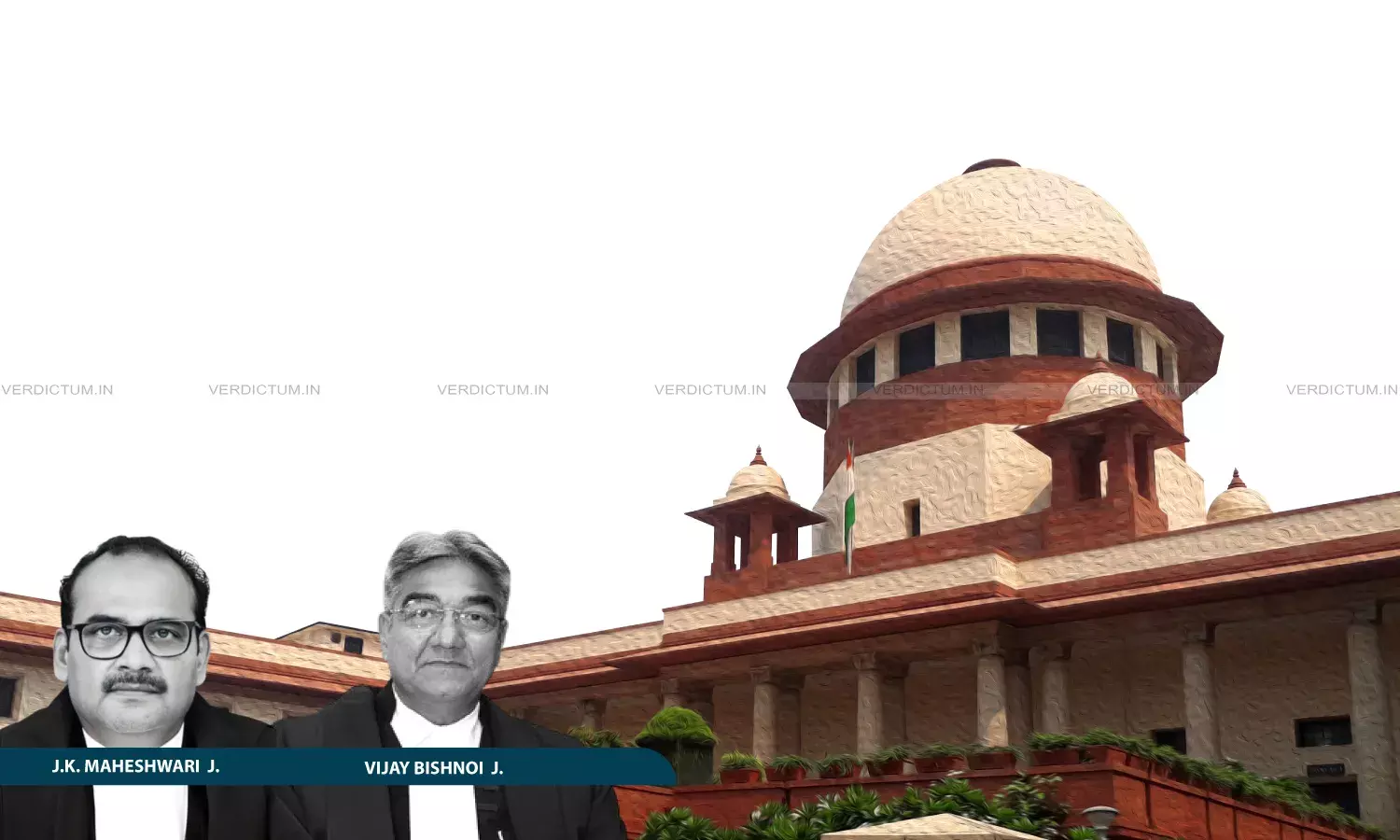
Justice J K Maheshwari, Justice Vijay Bishnoi, Supreme Court
The Supreme Court observed that the exclusion clause must be construed strictly and wherever there is any ambiguity between two or more clauses in the contract, it must be interpreted in favour of the insured.
The Court observed thus in a Civil Appeal preferred by Cement Corporation of India against the Judgment of the National Consumer Disputes Redressal Commission, New Delhi (NCDRC).
The two-Judge Bench comprising Justice J.K. Maheshwari and Justice Vijay Bishnoi emphasised, “Additionally, in case of insurance contracts, the exclusion clause must be construed strictly and wherever there is any ambiguity between two or more clauses in the contract, it must be interpreted in favour of the insured. … In the case at hand, in terms of the policy, the burglary/theft is not an exclusion under the specified peril “Fire”.”
The Bench reiterated that if the damage is caused by fire, then the reason by which the fire took place becomes irrelevant.
AOR Arvind Kumar Gupta represented the Appellant, while Senior Advocate Narender Hooda represented the Respondent.
Facts of the Case
The Appellant, a Government company, invited tender for insurance for its various Units/Dumps/Offices etc., in June 2005. Pursuant to that, the Respondent (ICICI Lombard General Insurance Company Limited) submitted its quote for centralized insurance policy and consequently, on being declared as the successful bidder, it was awarded the contract for Centralised Insurance coverage at the CO Unit and Zonal Units. Resultantly, a contract was entered between the Appellant and the Respondent and Standard Fire and Special Perils Policy (Material Damage) was issued by the Respondent for the Appellant’s unit. In November 2006, a theft and fire incident occurred at the factory of the Appellant where some petty thieves entered the premises of the Appellant company with a blow torch and portable gas cutter-like apparatus.
Although the thieves intended to steal winding copper and transformer oil, using bolt cutters and blow torch, which triggered a fire in the transformer and resulted in a fire in the factory premises. Following this, the Appellant formally notified the Respondent about the incident through a letter and also got registered an FIR. The Appellant calculated the loss and lodged a claim of Rs. 2,20,14,190 with the Respondent. The Respondent acknowledged the same and thereafter, the Surveyor opined that in this situation, insurer’s liability would not attach as the cause falls under the exclusion sub-clause (d) of Clause V in the Policy. The Respondent repudiated and rejected the Appellant’s claim on the grounds that the peril was not covered under the Policy as the cause of the loss was covered under the exclusion clause of Riots Strike, Malicious and Damage (RSMD). Consequently, the Appellant filed a complaint before the NCDRC, which dismissed the same. Being aggrieved, the Appellant approached the Apex Court.
Court’s Observations
The Supreme Court in view of the facts and circumstances of the case, noted, “In Avtar Singh’s Law of Insurance, 2nd Edition 2010, pp. 89, it was observed that the law need not go into the cause of the causes in case of fire as it may result in an infinite process.”
The Court said that a fire insurance policy is essentially a contract entered between the insurer and the insured for indemnification of the loss caused to the insured goods by fire.
“… if there was a fire and something was on fire which ought not to be on fire and such a fire was not caused by the wilful act of the insured, then any loss attributable to fire would be covered under the policy”, it added.
The Court further took note of the fact that the fire took place in the factory of the Appellant which caused a huge loss to the Appellant and the loss occurred on account of the transformer being set ablaze and the fire could not be controlled for about 6 hours.
“It is also an admitted position that, on the intervening night of 01.11.2006, some miscreants entered the factory and committed burglary. It was reported in the FIR that flames were coming out of the transformer and at no stage any defense was taken that the insured caused the fire. Thus, it is now established that the loss caused to the Appellant was due to fire only and the incident of theft/ burglary merely preceded the incident of fire”, it also observed.
Conclusion
Moreover, the Court said that even the general exclusions to the policy do not cover theft which precedes the insured peril as an exclusion and the said exclusion is only provided under the RSMD clause.
“It is a trite law that the exclusions in the contract for insurance must be read strictly and, therefore, the exclusion provided under the RSMD clause would not oust the liability of the insurer when the loss or damage is attributable to the peril of fire which has its independent exclusions. … there is no justification for the Respondent to repudiate the claim of the Appellant and the NCDRC had erred in not rectifying the mistake and to reject the claim”, it concluded.
Accordingly, the Apex Court allowed the Appeal, set aside the impugned Judgment, and remitted back the case to NCDRC to assess the loss pursuant to the claim filed by the Appellant.
Cause Title- Cement Corporation of India v. ICICI Lombard General Insurance Company Limited (Neutral Citation: 2025 INSC 1444)
Appearance:
Appellant: AOR Arvind Kumar Gupta, Advocates Abhiesumat Gupta, and Rishi Bhardwaj.
Respondent: Senior Advocate Narender Hooda, AOR Gautam Jha, Advocates Siddhartha Jha, Shweta Jha, Kartik Jha, Anupama Jha, Yuvraj, and Tannu.
