

Section 7 IBC| Corporate Debtor Cannot Indirectly Raise "Pre-Existing Dispute" Defence Against CIRP Admission: Supreme Court
The Apex Court held that the concept of a “pre-existing dispute”, which may defeat an operational creditor’s application under Section 9 of the Insolvency and Bankruptcy Code, 2016, has no bearing on a financial creditor’s application under Section 7.
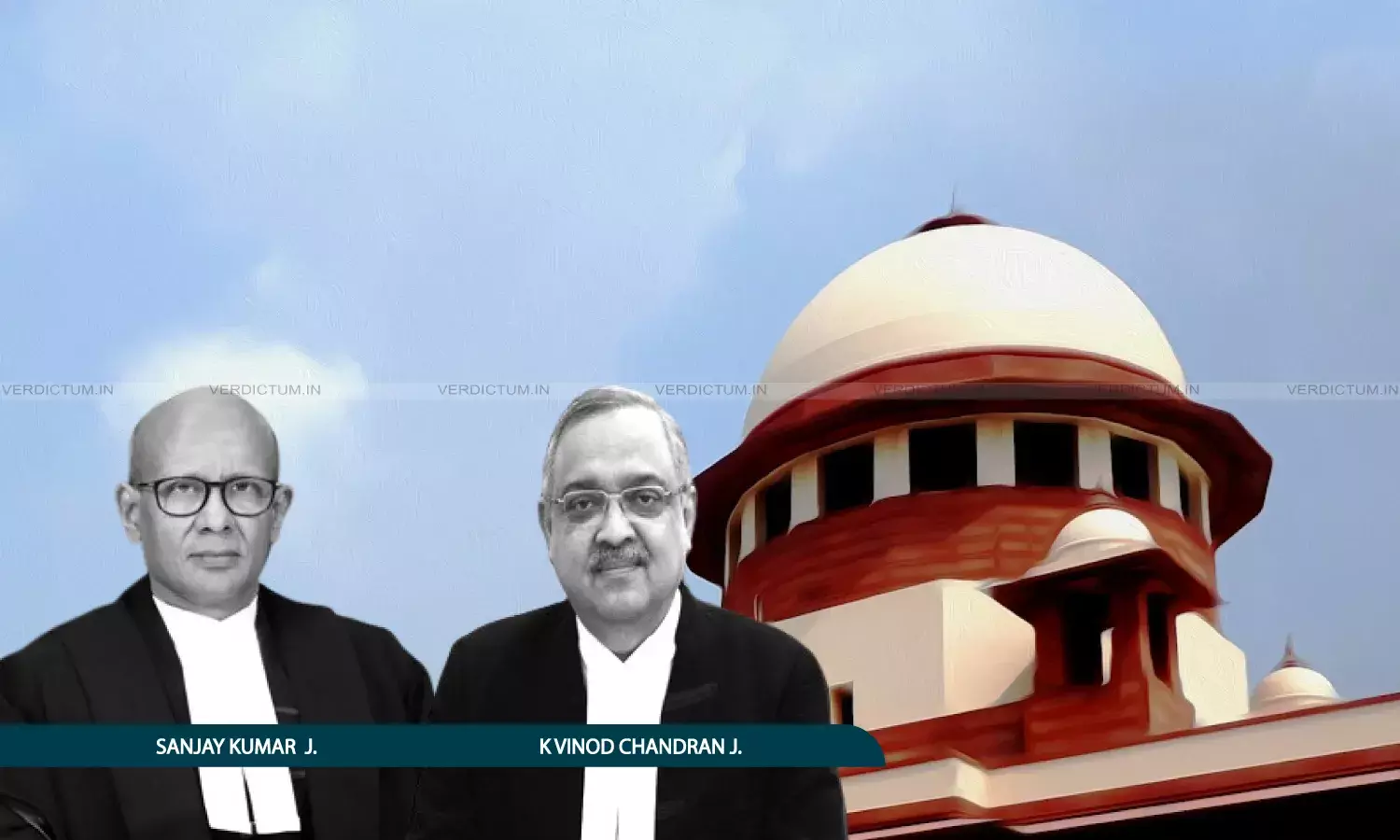
The Supreme Court held that in proceedings initiated by a financial creditor under the Insolvency and Bankruptcy Code 2016, the adjudicating authority is required only to examine the existence of a financial debt and default, and that the defence of a pre-existing dispute is inapplicable.
The Court was hearing a Civil Appeal filed under Section 62 of the Code challenging the dismissal of a Company Petition by the National Company Law Tribunal, Mumbai, and the affirming judgment of the National Company Law Appellate Tribunal, Principal Bench, New Delhi.
A Bench comprising Justice Sanjay Kumar and Justice K. Vinod Chandran, while allowing the appeal, observed that “the concept of a pre-existing dispute, which may be a stumbling block for admission of an application filed under Section 9 of the Code by an operational creditor, has no bearing on an application filed by a financial creditor under Section 7 of the Code.”
The Court further clarified that though a corporate debtor may establish that the financial debt is not due or that no default has occurred, such a defence cannot assume an indirect form of raising a pre-existing dispute
Background
The corporate debtor had issued redeemable non-convertible debentures under a Debenture Trust Deed, pursuant to which a substantial portion of the proposed debentures was fully subscribed and disbursed, while the remaining tranche was not issued.
Thereafter, the corporate debtor entered into correspondence with one of the debenture holders seeking the restructuring of its repayment obligations. The debenture trustee subsequently issued a demand notice in respect of overdue amounts and later recalled the entire outstanding dues along with interest.
The debenture trustee then filed an application under Section 7 of the Insolvency and Bankruptcy Code, 2016, seeking initiation of the Corporate Insolvency Resolution Process.
The adjudicating authority dismissed the application, and the appellate tribunal affirmed the dismissal, inter alia, on the premise that a moratorium pursuant to restructuring discussions was in operation and that the debenture trustee had acted unfairly.
Court’s Observation
The Supreme Court first reiterated the settled legal position governing Section 7 proceedings. Referring to Innoventive Industries Limited v. ICICI Bank (2018), the Court extracted the principle that the adjudicating authority is required only to satisfy itself that a financial debt exists and that a default has occurred.
The Court observed that the concept of a pre-existing dispute, which may be a stumbling block for admission of an application filed under Section 9 of the Code by an operational creditor, has no bearing on an application filed by a financial creditor under Section 7 of the Code.
The Court emphasised that insolvency proceedings under Section 7 are not concerned with disputes in the manner contemplated under Section 9. “…a corporate debtor is entitled to establish that the financial debt is not due and no default had occurred in that regard to defeat a financial creditor’s application for corporate insolvency resolution process under Section 7 of the Code. However, such an exercise cannot assume an indirect way of raising a pre-existing dispute, which would be available only to ward off an operational creditor’s claim under Section 9 of the Code”, the Bench remarked.
Examining the factual matrix, the Court found that the alleged restructuring of the loan facility was never effected in accordance with the procedure prescribed under the Debenture Trust Deed (DTD). The DTD mandated that any modification required prior written consent of the debenture trustee and the debenture holders through approved instructions and by way of a written document.
The Court noted that correspondence regarding restructuring was limited to one debenture holder and that no express authorisation was produced to show that such holder was acting on behalf of the others. The debenture trustee and other debenture holders were not even privy to the restructuring discussions at the relevant time.
The Court further relied upon the order of the Bombay High Court in the commercial suit filed by the respondent company, wherein interim relief was refused on the ground that there was no compliance with the modification procedure prescribed under the DTD. The Supreme Court observed that this order had attained finality and had been brushed aside by the tribunals without justification.
The Court rejected the NCLAT’s inference that the debenture trustee and the debenture holders had, by their conduct, agreed to the restructuring and that an 18-month moratorium had become operative. It held that there was no written modification in terms of the DTD and no crystallised commitment even on the part of the debenture holder with whom correspondence had taken place.
On the issue of novation, the Court referred to Section 62 of the Contract Act, 1872 and held that substitution of a contract requires the consensus of all parties. In the present case, the admitted position was that the debenture trustee and other debenture holders were not consenting parties to any such substitution.
The Court also disapproved of the adverse findings recorded by the NCLAT against the debenture trustee, holding that its duty under the DTD was to protect the interests of the debenture holders and not those of the respondent company.
Ultimately, the Court found that the concurrent findings of the NCLT and NCLAT were perverse, as they ignored the binding terms of the Debenture Trust Deed and reframed its provisions based on assumptions unsupported by the record.
Conclusion
Holding that the existence of financial debt and default had been established, the Supreme Court set aside the orders of the NCLT and NCLAT and restored the Company Petition to the file of the NCLT, Mumbai Bench-I, directing that it be admitted by way of a separate order and that further steps be taken in accordance with law.
The Civil Appeal was accordingly allowed.
Cause Title: Catalyst Trusteeship Ltd. v. Ecstasy Realty Pvt. Ltd. (Neutral Citation: 2026 INSC 186)
Appearances
Appellant: Aryama Sundaram, Sr. Adv.; Akanksha Mehra, AOR and others
Respondent: Ashwani Kumar, Sr. Adv.; Amit Sharma, AOR and others
