

Mere Inadequacy Of Record Won’t Confer Jurisdiction Upon Corporation To Invoke Section 45A ESI Act: Supreme Court
The Supreme Court said that dissatisfaction with the completeness or quality of documents does not convert production into non-production, nor does it permit the corporation to invoke a power meant for exceptional situations.
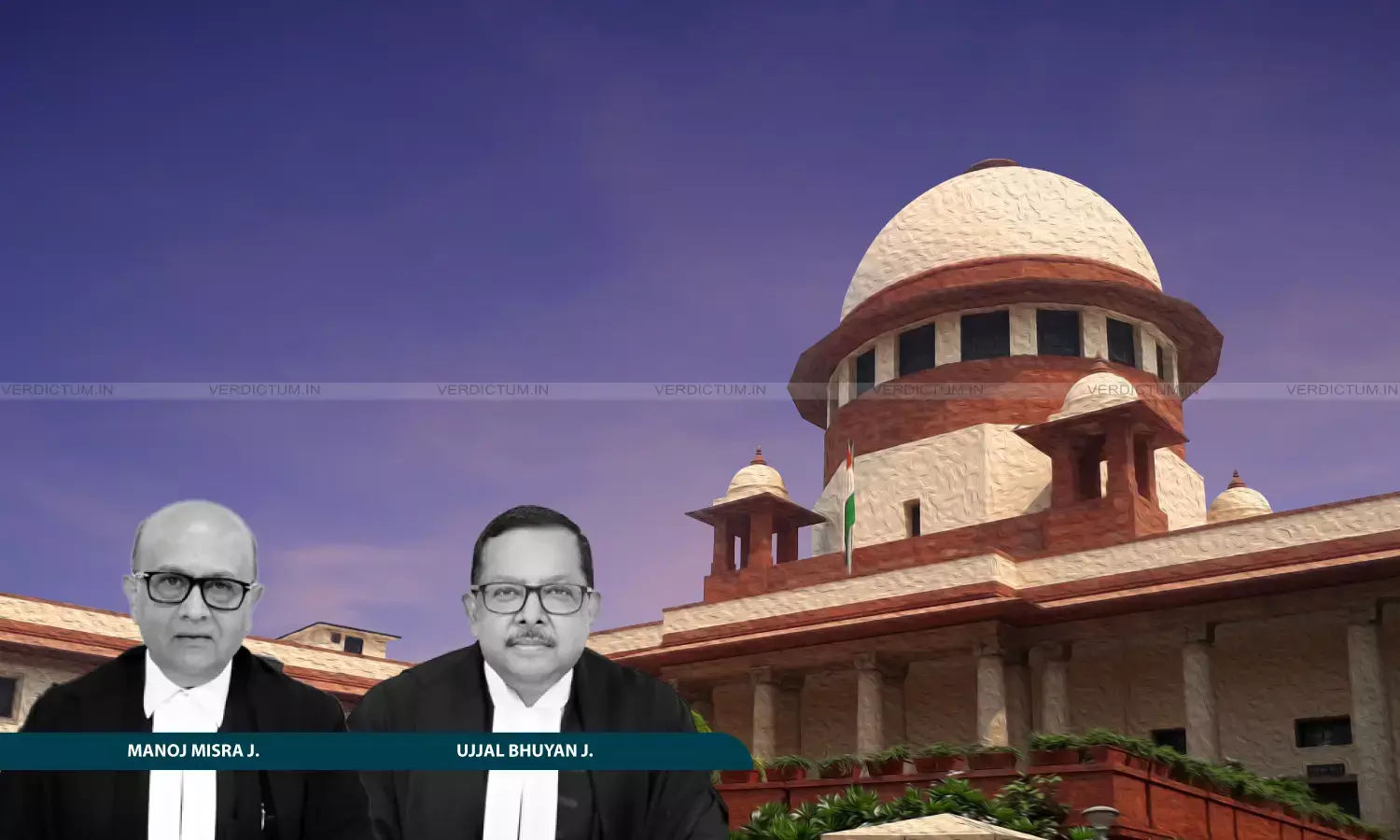
Justice Manoj Misra, Justice Ujjal Bhuyan, Supreme Court
The Supreme Court held that mere inadequacy of the record would not confer jurisdiction upon the Corporation to invoke Section 45A of the Employees State Insurance Act, 1948 (ESI Act).
The Court held thus in a Civil Appeal preferred by M/S. Carborandum Universal Ltd. against the Judgment of the Madras High Court.
The two-Judge Bench comprising Justice Manoj Misra and Justice Ujjal Bhuyan observed, “While it is true that there is no limitation under Section 45A of the Act, it is equally true that invocation of the said provision is dependent upon fulfillment of the aforesaid two conditions which are the functional requirement for invoking Section 45A viz non-production of records or obstruction of inspection. Mere inadequacy of the record would not confer jurisdiction upon the corporation to invoke Section 45A. The legislative intent is clear: summary determination under Section 45A would be permissible only in exceptional situations as alluded to hereinabove. The Act does not contemplate Section 45A as an alternative assessment mechanism available at the option of the corporation whenever the employer’s records are perceived as deficient or inadequate.”
The Bench said that dissatisfaction with the completeness or quality of documents does not convert production into non-production, nor does it permit the corporation to invoke a power meant for exceptional situations.
AOR Kunal Malik represented the Appellant, while AOR Vaibhav Manu Srivastava represented the Respondent.
Brief Facts
The Appellant-Company had filed a related Appeal before the High Court assailing the legality and validity of the Order passed by the Employees Insurance Court (Principal Labour Court), Chennai. The Employees Insurance Court upheld the Order passed by the Regional Office (Tamil Nadu), Employees State Insurance Corporation holding that a sum of Rs. 5,42,575.53 is statutorily due as arrears of contribution and payable by the employer i.e. the Appellant.
The Appellant was directed to pay the aforesaid amount with interest at the rate of 12 percent per annum upto 31.08.1994 and at the rate of 15 percent per annum from 01.09.1994. The said Order was passed under Section 45A of the ESI Act. The Appellant was engaged in the business of manufacturing various products and was covered under the ESI Act. The High Court had held that there is no limitation for initiating proceedings under Section 45A of the ESI Act. The Appellant’s Appeal was dismissed and hence, this was under challenge before the Apex Court.
Reasoning
The Supreme Court in view of the above facts, noted, “Section 45A is designed as a mechanism which the corporation may employ only when there is a default qua Section 44 or when statutory inspection under Section 45 becomes impossible on account of the conduct of the employer. The foundation for exercise of the power under Section 45A, as explained in Santhakumar, is either non-production of records or absence of cooperation or obstruction of inspection. The power is conceived as a best judgment determination akin to similar provisions in taxing statutes.”
The Court reiterated that when records are produced and cooperation is forthcoming, assessment must be carried out under Section 75(2)(a) and not under Section 45A and the distinction drawn is, therefore, fundamental to the statutory architecture.
“Section 45 A is not meant to be an alternative mode of computation at the option of the corporation. It is a residuary power available only when the employer makes a default under Section 44 or disables the corporation from carrying out inspection under Section 45”, it added.
The Court said that the High Court itself recorded that the Appellant had appeared before the corporation through its authorized representative(s) and that relevant records were produced during the course of personal hearings.
“If the records were produced and the appellant had participated in the personal hearings which indicates that there was no non co-operation or obstruction, the conditions precedent for invoking jurisdiction under Section 45A were clearly absent”, it remarked.
The Court observed that invocation of Section 45A ESI Act rested squarely on the statutory pre-conditions.
“If the corporation, after examining the materials produced, believes that the computation made by the employer is incorrect or that further evidence is needed to decide the true nature of particular entries, the proper course is to raise a dispute under Section 75. To enlarge Section 45A so as to cover situations of partial dissatisfaction or perceived inadequacy would tantamount to rewriting the statute in a manner plainly contrary to its text and structure”, it further noted.
The Court was of the view that the statutory threshold is not inadequate production but non-production and the statute does not permit a best judgment determination merely because the record produced is inadequate.
“Appellant was consistent in contending both before the Employees Insurance Court as well as before the High Court that the exercise undertaken by the respondent was beyond the statutory period of limitation and that the respondent sought to overcome the bar under Section 77(1A)(b) by resorting to Section 45A notwithstanding the fact that records were duly produced and that there was cooperation to inspection by the employer i.e. by the appellant. … The Employees Insurance Court and the High Court, in our view, did not advert to this essential jurisdictional requirement”, it also said.
Conclusion
Moreover, the Court remarked that by treating the matter purely as one of limitation, the both Courts overlooked the statutory pre-conditions embedded in Section 45A ESI Act.
“The statutory scheme does not allow the corporation to bypass Section 75 merely because it finds verification inconvenient or time consuming. … The Employees’ Insurance Court and the High Court, in our considered opinion, while affirming the order passed under Section 45A without examining this jurisdictional deficiency, fell into a grave and palpable error”, it concluded.
The Court, therefore, held that invocation of power under Section 45A ESI Act by the Respondent-ESI Corporation was unsustainable in the facts and circumstances of the case rendering the Order passed thereunder by the corporation wholly untenable.
Accordingly, the Apex Court allowed the Appeal and set aside the impugned Judgment.
Cause Title- M/S. Carborandum Universal Ltd. v. ESI Corporation (Neutral Citation: 2025 INSC 1455)
Appearance:
Appellant: AOR Kunal Malik
Respondent: AOR Vaibhav Manu Srivastava, Advocates Mahesh Srivastava, Kaveri Rawal, Saloni Singh, and Gurpreet Singh.
