

Bank's Failure To Present Cheques Within Validity Period Can Constitute Deficiency In Service Under Consumer Protection Act: Supreme Court
The Court modified the NCDRC order and reduced token compensation for indeterminate loss resulting from stale cheques.

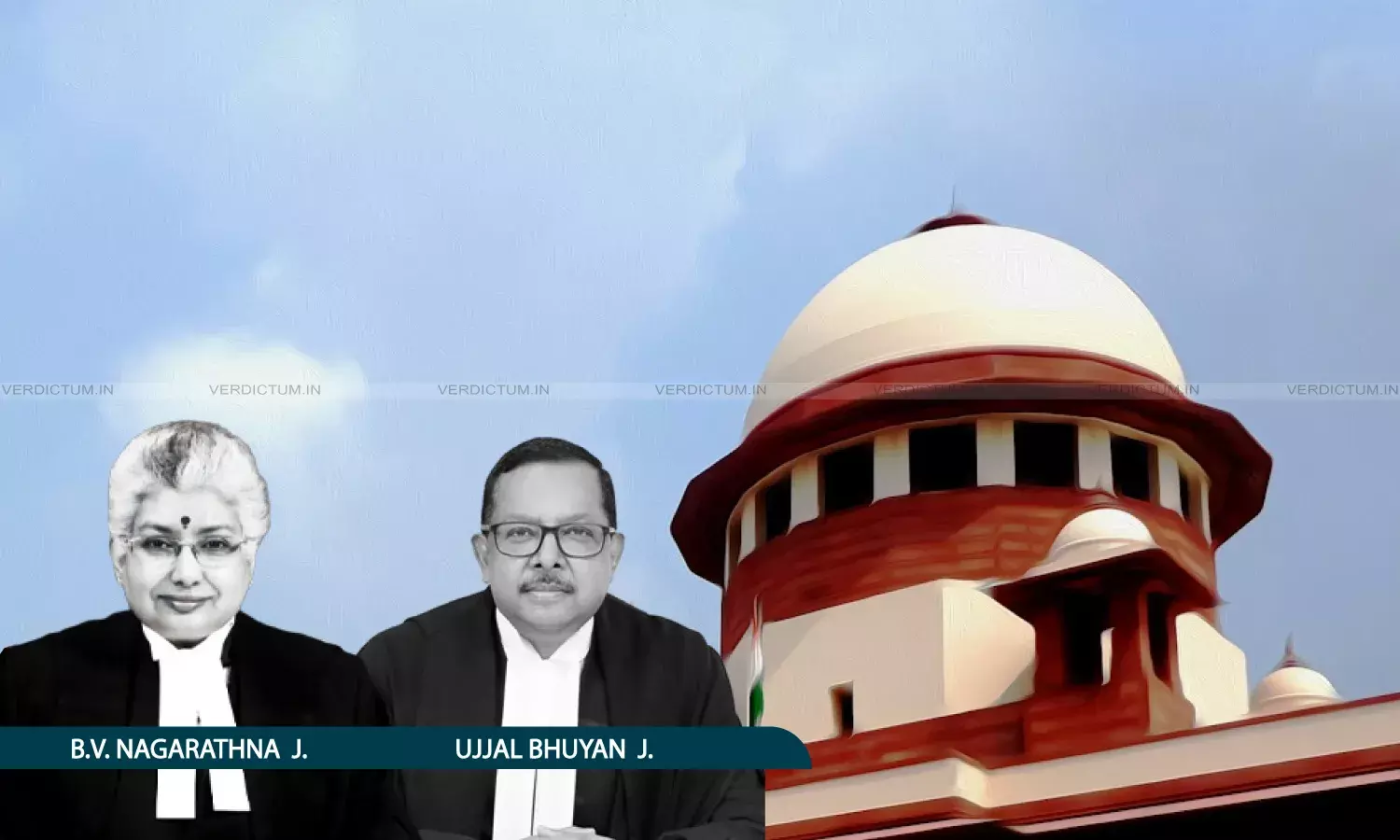
Justice B.V. Nagarathna, Justice Ujjal Bhuyan, Supreme Court
The Supreme Court has held that a bank, acting as an agent for its customer, is under a strict obligation to exercise due diligence in presenting negotiable instruments within their prescribed validity period.
In the present case involving the failure to re-present cheques after a bank strike, the Court held that such negligence constitutes a "deficiency in service" under consumer protection laws, as it deprives the customer of legal remedies like those under Section 138 of the Negotiable Instruments Act, 1881. However, the Court modified the quantum of compensation, emphasising that token awards must reflect the indeterminate nature of the actual loss when the final outcome of potential legal proceedings remains speculative.
Justice B.V. Nagarathna and Justice Ujjal Bhuyan while scrutinising whether external factors like bank strikes could perpetually excuse delays in presentment under Section 75A NI Act, observed,“A bank receiving cheques for collection acts as an agent of the customer and is under an obligation to exercise due diligence in presenting the instruments within the prescribed validity period. Failure to do so resulting in the instrument becoming stale, in the absence of any reasonable explanation, would result in negligence in the discharge of banking duties which would constitute deficiency in rendering service within the meaning of the consumer protection law”.
Advocate Brijesh Kumar Tamber appeared for the appellant and Ashish Pandey, AOR appeared for the respondent.
The respondent, Kavita Chowdhary, deposited two cheques totaling Rs. 1,06,10,768.00 into her Canara Bank account on May 29, 2018. The cheques, issued by Assotech Limited, were near their expiration date of June 2, 2018.
Due to a bank strike on May 30 and 31, the cheques were not cleared, and despite the bank reopening on June 1, Canara Bank failed to re-present the cheques on that day or the following working day (June 2), leading to the instruments becoming "stale".
Consequently, the respondent was unable to recover the funds or initiate criminal proceedings under Section 138 NI Act against the drawer, which was undergoing insolvency.
The respondent filed a complaint before the National Consumer Disputes Redressal Commission (NCDRC) alleging deficiency in service. The NCDRC allowed the complaint on September 24, 2024, finding the bank negligent.
It directed Canara Bank to pay 10 percent of the total cheque amount as compensation, along with 8 percent interest and litigation costs. Canara Bank appealed this decision to the Supreme Court, arguing that the delay was excused by the strike and that the compensation was excessive.
Now, the Supreme Court held that while the strike justified the initial delay, the bank failed to provide a reasonable explanation for not re-presenting the cheques on June 1 or June 2. The Court noted that in the digital age, re-presentation requires minimal effort once data is captured. By allowing the cheques to lapse, the bank caused a "deficiency in service". Regarding compensation, the Court observed that the loss was "indeterminate" because a successful Section 138 prosecution depends on multiple factors beyond mere dishonor.
“While the approach adopted by the Commission cannot be said to be wholly erroneous, in our considered opinion, the compensation fixed by the Commission appears to be on the higher side by applying the standard of reasonable compensation having regard to the peculiar facts of the present case. 10 percent of the face value of the cheque amount as a token compensation would not accurately reflect the nature of the loss suffered by the complainant because the loss itself is indeterminate despite the finding of deficiency in service”, the Bench noted.
Accordingly, the Court modified the NCDRC's order by reducing the compensation from 10 percent to 6 percent of the total cheque amount (Rs. 1,06,10,768.00) for each complainant. The bank was directed to pay this amount with interest at the rate of 6 percent per annum from the date of filing the complaints. The rest of the NCDRC's judgment, including litigation costs, remained undisturbed.
Cause Title: Canara Bank v. Kavita Chowdhary (Neutral Citation: 2026 INSC 363)
Appearances:
Appellant: Brijesh Kumar Tamber, AOR, Vinay Singh Bist, Prateek Kushwaha, Arani Mukherjee, Sahas Bhasin, Yashu Rustagi, Advocates.
Respondent: Ashish Pandey, AOR, Vinod Agarwal, Swantra Rai, Shubham Saxena, Ashutosh Bhardwaj, Prateek Rai, Anmol Goyal, Aishwarya Sharma, Advocates.