

In Criminal Appeals, High Courts Must Issue Notice To Convict With Intimation Of Contacting Amicus If His Counsel Is Absent: Supreme Court
The Supreme Court was considering an appeal challenging the judgment and order of the Jharkhand High Court altering the appellant's conviction to one under Section 304 - Part II of the IPC.

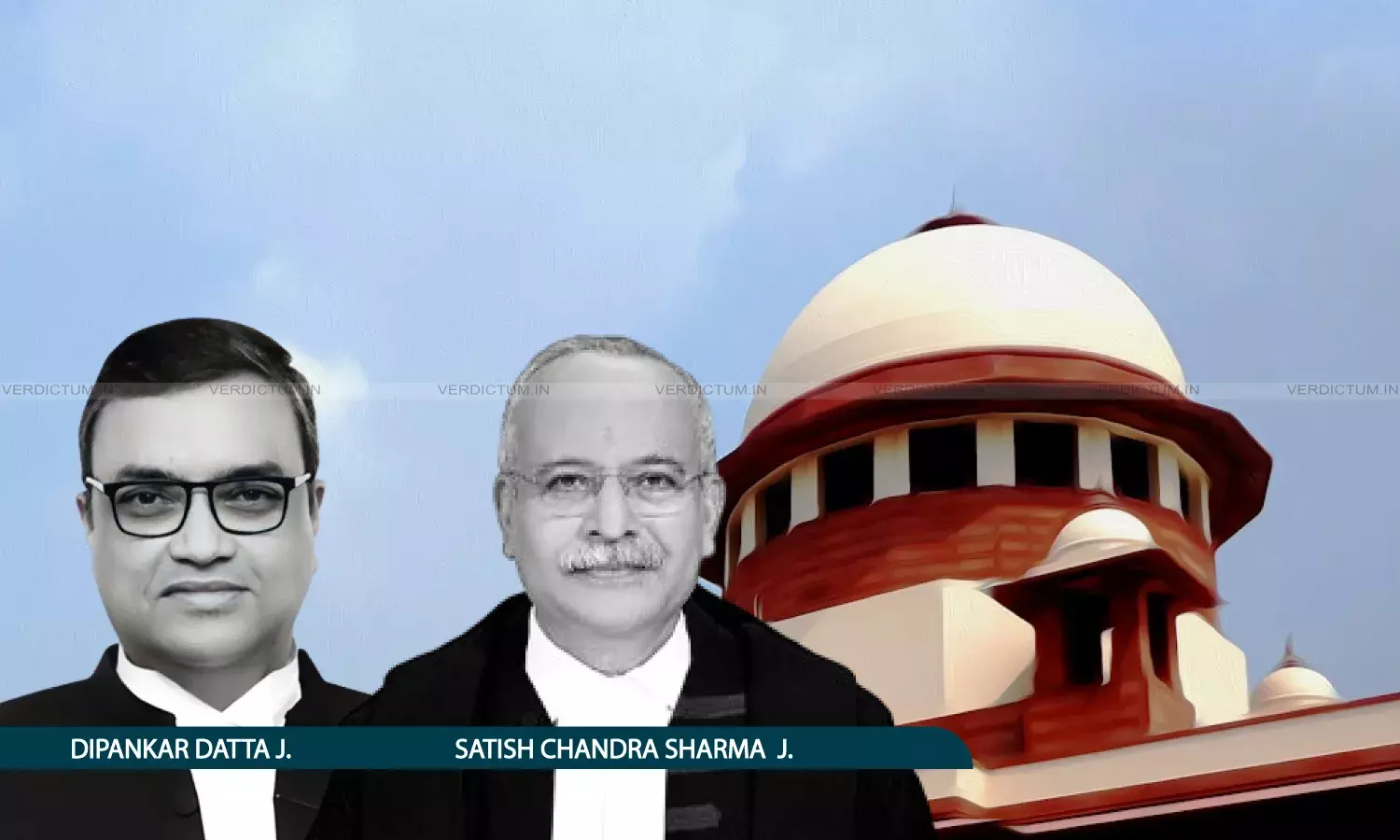
Justice Dipankar Datta, Justice Satish Chandra Sharma, Supreme Court
The Supreme Court has held that whenever an appellate court considers it desirable to appoint an amicus to represent a convict whose counsel is absent, such court may also consider the desirability of issuing a notice from the registry to the address of the convict with an intimation that the convict may contact the amicus and provide him necessary instructions so that his case is argued before the court effectively and meaningfully.
The Apex Court was considering an appeal challenging the judgment and order of the Jharkhand High Court setting aside the conviction against the appellant under Section 302 of the Indian Penal Code, altering the conviction to one under Section 304 - Part II and sentencing the appellant to 5 years rigorous imprisonment.
Referring to the judgment in Anokhi Lal vs. State of Madhya Pradesh (2019), the Division Bench of Justice Dipankar Datta and Justice Satish Chandra Sharma held, “These convicts, enjoying the concession of bail and misusing it, need to be dealt with firm and strong hands by the courts. Having regard to the dictum of the three-Judge Bench in Anokhi Lal (supra) and in order to curb the tendency of convicts to raise technical pleas of the nature which were advanced before us, we observe that, henceforth, whenever an appellate court considers it desirable to appoint an amicus to represent a convict whose counsel is absent, such court may also consider the desirability of issuing a notice from the registry to the address of the convict mentioned in the memorandum of appeal, for such notice to be served on him through the jurisdictional police station, with an intimation that the convict may contact the learned amicus and provide him necessary instructions so that his case is argued before the court effectively and meaningfully. In the event the convict contacts the amicus and provides instructions, there would ordinarily be no impediment in proceeding with hearing of the appeal. If, indeed, the convict desires to have his own counsel argue the appeal on his behalf and not the amicus, the court may hear such counsel in addition to the amicus.”
“However, if the service report indicates that the convict was not found at the address or that he refused to accept notice despite being present, it would amount to sufficient compliance if the notice is pasted on the outer wall of the premises, address whereof is mentioned in the cause title of the memorandum of appeal. Should the convict still remain dormant, and it is so reported, the High Court may proceed to decide the appeal without waiting for the convict to turn up either in person or through the counsel of his choice engaged by him. This process, in our view, would substantially serve the purpose of eliminating any plea of unfairness being raised before this Court if an appeal is disposed of upon hearing the amicus appointed by the court”, it added.
AOR Harsh Kaushik represented the Appellant, while AOR Pallavi Langar represented the Respondent.
Factual Background
The appellant was convicted by the relevant Sessions Court in respect of the crime of murder committed by him in 2000, whereafter he carried such conviction before the High Court in appeal in the early part of 2003 itself. October 29, 2000, onwards, the appellant was in pre-trial custody. The custody certificate revealed that he was released from custody on March 10, 2003. The appellant obtained an order for suspension of sentence and was consequently released on bail. For 20 years, the appeal was not listed for a hearing. Ultimately, the appeal came to be listed before a Division Bench of the High Court on November 14, 2024. The order passed on that day recorded that none had appeared on behalf of the appellant despite repeated calls.
The appeal having been filed in 2003, the Division Bench appointed an advocate of more than 15 years’ standing as amicus curiae to assist the Court. As per the custody certificate, the appellant had served a little less than three years and seven months out of the prison term of five years. When the special leave petition, out of which the appeal arises, was taken up for consideration, the counsel for the appellant had informed a coordinate bench of the Apex Court that the appellant had not been made aware of absence of the counsel engaged by him to prosecute the appeal before the Division Bench and such bench had proceeded to appoint the amicus without the appellant’s knowledge.
Arguments
It was the appellant’s case that he may be allowed to raise all such grounds he had raised in the memorandum of appeal that was filed in the High Court before the Apex Court to secure an order of setting aside the conviction under Section 304 Part – II.
Reasoning
The Bench rejected the argument made and noted that the blame cannot be placed on the amicus if the grounds the appellant did raise in the memorandum of appeal were not urged before the High Court by the amicus. “The learned amicus came to be appointed by the High Court when it was noticed that the appeal remained pending for more than two decades and there was no representation from the side of the appellant despite repeated calls. In his wisdom, the learned amicus urged only one ground and succeeded. We see nothing wrong in the approach of the learned amicus”, it stated.
The Bench also did not find the approach of the High Court to be unjustified in endeavouring to expedite a decision on the appeal. “Appellant was enjoying the concession of bail for two decades without being in any manner concerned about the fate of his appeal”, it added. The Bench was of the view that, whatever be the worth of the grounds so raised, the appellant cannot appeal to consider the same for the first time once it is found that such grounds were not pressed for consideration by the High Court.
The Bench further found that the High Court in its anxiety to deliver justice without further delay and to decide the appeal expeditiously upon hearing the amicus, had not made an attempt to inform the appellant that his appeal having been listed for final hearing after two decades and there being absence of representation from his side, on the first day an amicus had been appointed to represent him. On this aspect, the Bench mentioned, “The High Court was under no obligation to inform the appellant of his counsel’s absence; however, it would have been a desirable precaution if the appellant were so informed. This is more so, because, this Court has taken the view that assistance in the form of legal aid should be real and meaningful and not by way of a token gesture or to complete an idle formality.”
The Bench thus ordered a remand for a hearing of the appeal de novo. The impugned order was set aside, and the appellant’s appeal stood revived on the file of the High Court. “Since the appellant wishes to be represented by his own counsel before the Division Bench, there shall be no need to appoint an amicus if such counsel does not turn up to press the appeal on the date to be notified a week in advance by the Registry”, it ordered while partly allowing the appeal and directing the release of the appellant on bail.
The Bench concluded the matter by further observing, “Additionally, in a case of like nature where the appeal is listed two decades after grant of bail, this process would ensure obtaining of information as to whether the appeal survives for decision or stands abated. In case of the latter, the courts could avoid spending precious judicial time deciding an appeal which, by operation of law, may not require a decision on merits. Of course, for a convict in custody who has committed an offence punishable with death or life imprisonment, the directions in Anokhi Lal (supra) have to be scrupulously followed apart from the relevant rules regulating the business of the courts concerned.”
Cause Title: Bhola Mahto v. The State of Jharkhand (Neutral Citation: 2026 INSC 257)
Appearance
Appellant: AOR Harsh Kaushik, Advocate Arpit Srivastava
Respondent: AOR Pallavi Langar, Advocates Kumar Anurag Singh, Sujeet Kumar Chaubey, Zain A Khan, Dev Aaryan, Mohd. Abran Khan