

Confession Can Sustain Conviction Only If Voluntary And Corroborated: Supreme Court Acquits Man Accused Of Murdering Friend
A confession can form the basis of a conviction only if the Court is satisfied that it is true and voluntarily made, and a conviction cannot be founded on such a confession in the absence of corroboration, the Supreme Court held while restoring the acquittal.
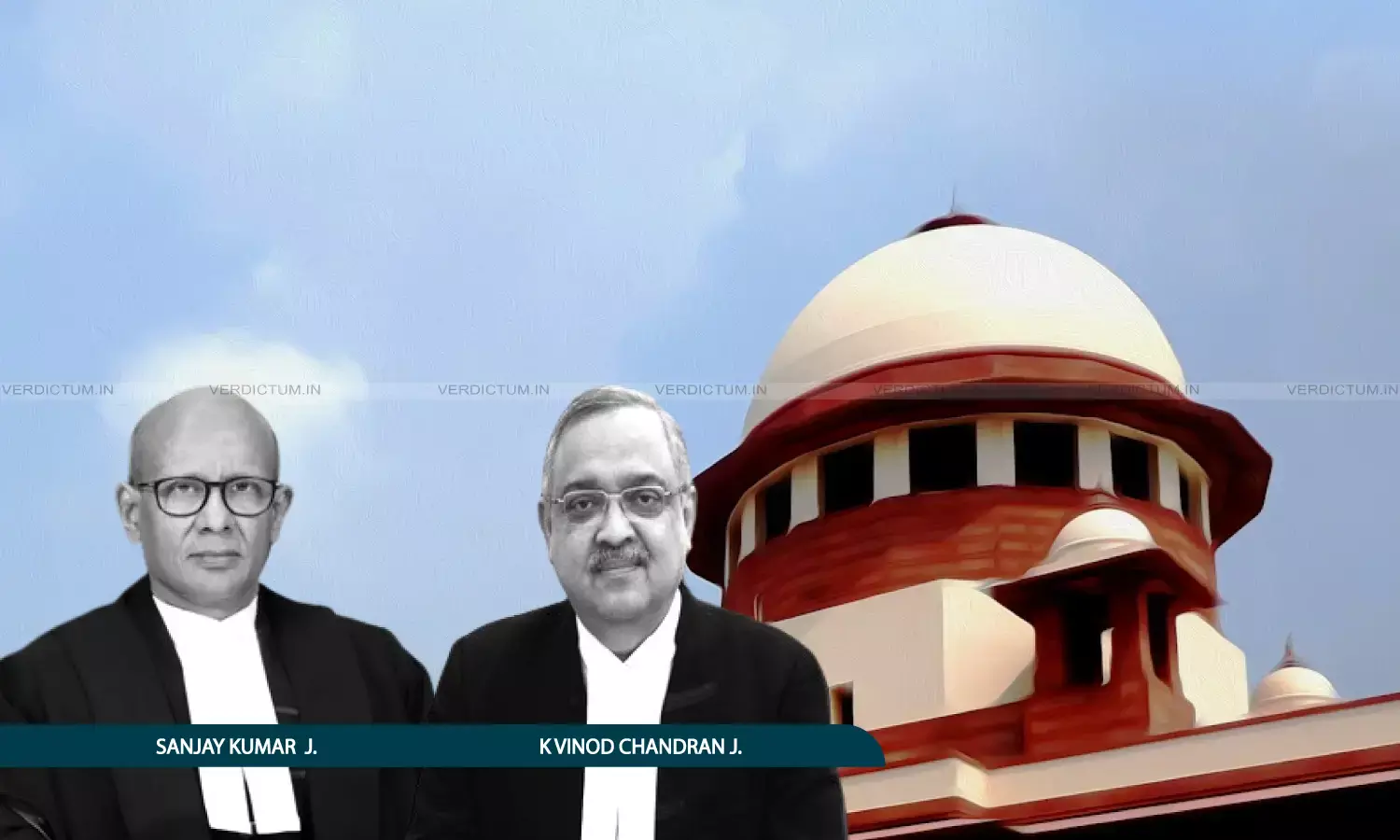
The Supreme Court, while setting aside an order of the Meghalaya High Court convicting a man of murder, has held that while a voluntary and truthful confession can constitute legal evidence, a court cannot base a conviction solely on a confession without independent corroboration.
The Court was hearing criminal appeals challenging the High Court judgment, which had reversed an order of acquittal and convicted the accused based on circumstantial evidence and confessional statements.
A Division Bench of Justice Sanjay Kumar and Justice K. Vinod Chandran, while relying on the Apex Court’s ruling in Manoharan v. State by Inspector of Police (2019), reiterated that “confession can form a legal basis of a conviction if the Court is satisfied that it was true and was voluntarily made, …however, it was also held that a Court shall not base a conviction on such a confession without corroboration”.
Background
The trial court had acquitted the accused after holding that the chain of circumstantial evidence was incomplete and that the prosecution had failed to establish guilt beyond a reasonable doubt.
The Meghalaya High Court, in an appeal by the State, reversed the acquittal and recorded a conviction, holding that the principles governing circumstantial evidence stood satisfied.
The High Court relied, inter alia, on confessional statements recorded under Section 164 of the Code of Criminal Procedure, along with other circumstantial material, to reverse the acquittal.
Aggrieved by the reversal of the acquittal, the accused approached the Supreme Court, challenging the High Court’s findings on the appreciation of evidence and the reliance placed on the confessional statements.
Court’s Observation
The Supreme Court undertook a comprehensive reappraisal of the circumstantial evidence relied upon by the High Court and held that the foundational requirement of a complete and unbroken chain of circumstances was not satisfied. The Court emphasised that each incriminating circumstance must be firmly established and must collectively point only to the guilt of the accused, excluding every other reasonable hypothesis.
On the issue of confessional statements, the Court analysed the governing principles relating to admissibility and evidentiary value. It reiterated that a confession can be acted upon only if the Court is satisfied that it was made voluntarily, truthfully, and without any inducement, threat, or coercion. The Court further held that procedural safeguards surrounding the recording of confessions are integral to ensuring voluntariness and reliability.
The Supreme Court examined the manner in which the confessional statements were recorded and found that the circumstances surrounding their recording raised serious doubts as to their reliability. The Court noted deficiencies in the process and held that such infirmities undermined confidence in the voluntariness and authenticity of the statements.
The Bench further held that even where a confession is assumed to be voluntary, settled law requires that it be corroborated by independent evidence. The Court reaffirmed that a conviction cannot be founded solely on a confession and that corroboration must connect the accused to the offence in material particulars.
The Supreme Court then evaluated the remaining circumstantial evidence on record and held that such evidence did not independently establish the guilt of the accused. The Court found that the circumstances relied upon were either not conclusively proved or were incapable of forming a complete chain leading only to the inference of guilt.
The Bench also examined the approach adopted by the High Court in reversing the acquittal and held that the High Court had substituted its own view for a plausible view taken by the trial court. The Court held that the trial court’s appreciation of evidence was neither perverse nor unreasonable and that the High Court had erred in discarding that view without recording legally sustainable reasons.
On a cumulative assessment of the evidentiary record, the Supreme Court concluded that the prosecution had failed to establish guilt beyond a reasonable doubt. Accordingly, the Court held that the High Court’s judgment reversing the acquittal was unsustainable in law and that the trial court’s order of acquittal was required to be restored.
"The confession allegedly made by the appellants is of no use in bringing home a conviction, especially when there was no corroboration available, of the statements made, from other valid evidence", the Apex Court concluded.
Conclusion
The Supreme Court allowed the criminal appeals and set aside the judgment of conviction passed by the High Court. The order of acquittal passed by the trial court was restored.
Cause Title: Bernard Lyngdoh Phawa v. The State of Meghalaya (Neutral Citation: 2026 INSC 85)
Appearances
Appellant: Advocates Subhro Sanyal, AOR, Deepmala, Anki Kashyap, Ajay Sabharwal, Prabhas Bajaj, AOR Harsh Chauhan
Respondents: Advocates Avijit Mani Tripathi, AOR, T.K. Nayak
