

Permission From High Court To Withdraw Prosecution Missing: Supreme Court Dismisses Ex-MP’s Appeal Against Rejection Of Quashing Plea
The appeal before the Supreme Court was filed by a former MP Bal Kumar Patel challenging the judgment of the Allahabad High Court.

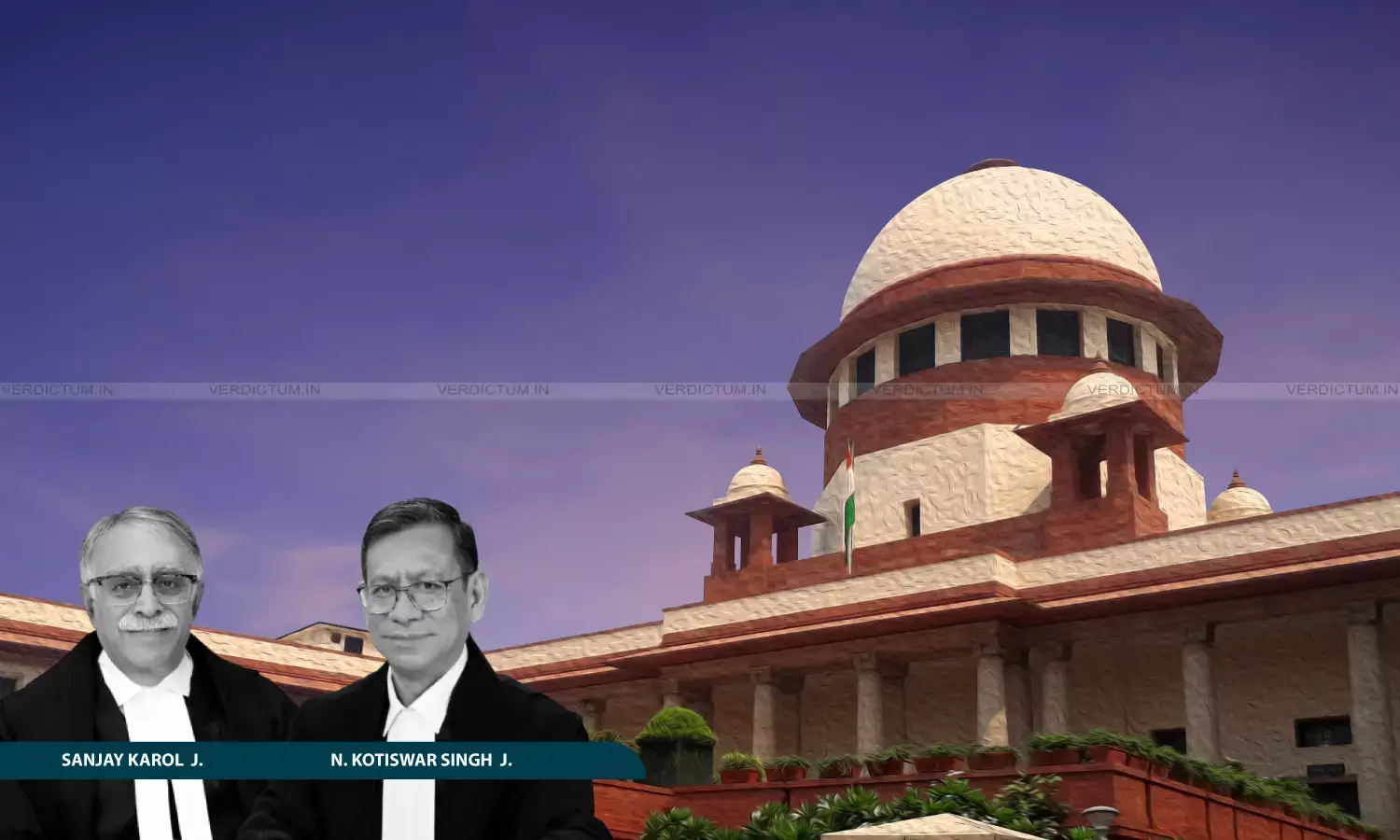
Justice Sanjay Karol, Justice Nongmeikapam Kotiswar Singh, Supreme Court
The Supreme Court has dismissed an appeal filed by the former MP Bal Kumar Patel challenging the decision refusing to quash a criminal proceeding against him on the ground that the permission as required under law, to withdraw prosecution against sitting/former Members of Parliament or Members of Legislative Assembly, was not sought by the State from the High Court.
The appellant approached the Apex Court seeking leave to appeal under Article 136 of the Constitution to challenge the judgment of the Allahabad High Court declining to exercise its jurisdiction under Section 482 Code of Criminal Procedure, 1973 and quash the criminal proceeding against him.
The Division Bench of Justice Sanjay Karol and Justice Nongmeikapam Kotiswar Singh held, “The Public Prosecutor who has a duty to assist the Court ‘with a fairly considered view’ on the case, in his application and in the interest of justice should disclose all reasons that weighed with them to put forward this application to the Court. This is in furtherance of the well recognised principle that reasons are the soul of a judicial as well as administrative function. In view of Ashwini Kumar Upadhyay (supra) this application disclosing the reasons for withdrawal of prosecution given by the Public Prosecutor as also the records of the case should be before the High Court, which would exercise its judicial mind and give a reasoned order, granting or denying such permission.”
“As is obvious, this permission is missing in the present case. The impugned judgment therefore cannot be faulted with”, it added.
AOR Rohit Amit Sthalekar represented the Appellant, while AOR Shaurya Sahay represented the Respondent.
Factual Background
The appellant was a holder of an arms license issued by the competent authority of the State, but the common FIR from which all these proceedings arose came to be filed against him in 2007, with the allegation that, in holding the arms license, he had acted against the provisions of the Arms Act 1959. The District Magistrate, Raebareli, had restored the Arms license which originally stood cancelled by an order passed in a Case registered under Section 17(3)(b) of the Arms Act. The FIR was processed, and the Chief Judicial Magistrate took cognisance of the chargesheet. By a Government Order, the Special Secretary, Government of Uttar Pradesh, wrote to the District Magistrate Raebareli stating that the Government had decided to withdraw the Case against the Appellant, in the public interest and also in the interest of justice.
Pursuant to the said G.O., the Public Prosecutor filed an application under Section 321 CrPC before the Trial Court for withdrawal of the cases. The Trial Court observed that the State had not sought permission of the High Court in accordance with Ashwini Kumar Upadhyay (supra), and as such, permission to withdraw could not be granted. In order to grant the State ample opportunity to do so, a thirty-day time period was given, but the State did not seek permission. The appellant, however, filed an application seeking quashing. Such an application was rejected, and thus the matter reached the Apex Court.
Reasoning
The Bench referred to the judgment in State of Bihar v. Ram Naresh Pandey (1957), which spoke in the context of a Trial Court and the duty that is cast upon it when an application for withdrawal is made by the Public Prosecutor, after the latter has made an independent assessment of the justifiability of such an application.
“Undoubtedly this is the duty of the Trial Court when applications for withdrawal from prosecution is made in regular course before the Court, however, we are of the considered view that the duty described above, of the applications of judicial mind, applies in letter and spirit to the High Court as well, when considering applications for permission in cases concerning MPs or MLAs, which can only be filed before it in terms of the law referred to supra”, it added.
Considering the fact that the permission was missing in the present case, the Bench held that the High Court had rightly dismissed the petition for quashing. The Bench thus dismissed the appeal.
Cause Title: Bal Kumar Patel @ Raj Kumar v. State of U.P. (Neutral Citation: 2025 INSC 1378)
Appearance
Appellant: AOR Rohit Amit Sthalekar, Advocates Sankalp Narain, B.P. Tiwari
Respondent: AOR Shaurya Sahay, Advocates Palak Mathur, Aman Jaiswal, Kameshwar Nath Mishra, Jitendra Kumar Tripathi