

Courts Must Not Be Seen To Stifle Free Speech: Justice Ujjal Bhuyan Notes In His Separate Opinion After Supreme Court Records Withdrawal Of ‘Ghooskhor Pandat’ Movie Title
While disposing of plea after filmmaker’s undertaking, Justice Ujjal Bhuyan reiterates S. Rangarajan v. P. Jagjivan Ram to note that freedom of speech cannot surrender to blackmail, intimidation

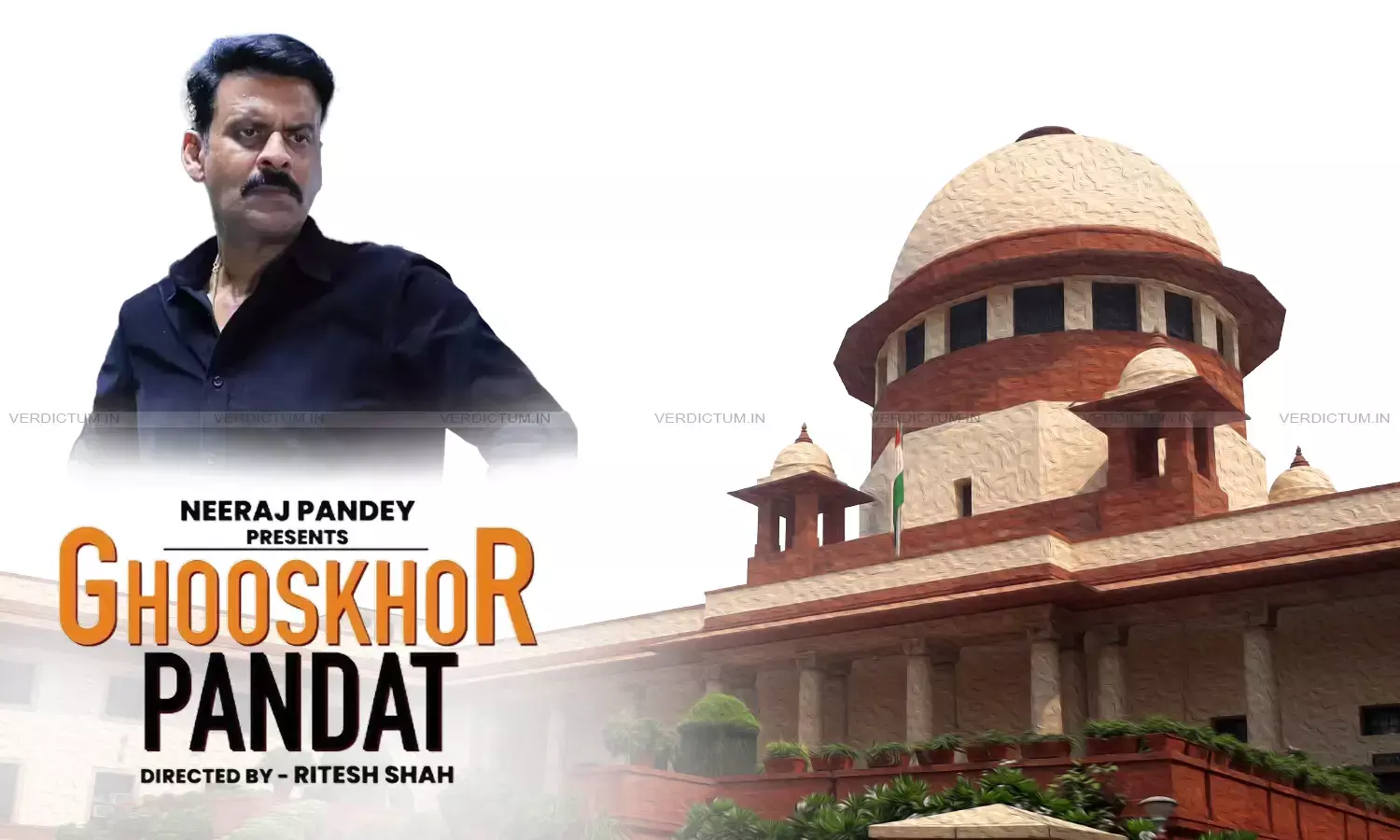
The Supreme Court disposed of a writ petition challenging the film “Ghooskhor Pandat” after recording an unequivocal undertaking by the filmmaker to withdraw the existing title and adopt a new one not evocative of the earlier name.
While the disposal order was brief, Justice Ujjal Bhuyan authored a separate but concurring opinion delivering a pointed reaffirmation of the centrality of free speech in a constitutional democracy, cautioning that courts must not regulate or stifle expression.
While referring to S. Rangarajan v. P. Jagjivan Ram 2 SCC 574, Justice Bhuyan noted, “…a three-Judge Bench of this Court declared in no uncertain terms that freedom of expression which is legitimate and constitutionally protected cannot be held to ransom by an intolerant group of people. The fundamental freedom under Article 19(1)(a) can be reasonably restricted only for the purposes mentioned in Article 19(2) and the restriction must be justified on the anvil of necessity and not the quicksand of convenience or expediency. Sounding a note of caution, the Bench observed that freedom of expression cannot be suppressed on account of threats of demonstration and processions or violence. That would amount to negation of the rule of law and a surrender to blackmail and intimidation”.
“In a democracy, it is not necessary that everyone should sing the same song; freedom of expression is the rule. Everyone has the fundamental right to form his own opinion on any issue of general concern. Freedom of expression cannot be suppressed on account of threats of demonstration and violence. That would tantamount to negation of the rule of law and a surrender to blackmail and intimidation”, Justice Bhuyan further noted.
The Bench also comprised Justice B.V. Nagarathna.
Advocate Pawan Kumar Shukla appeared for the petitioner, Tushar Mehta, SG, Senior Advocate Neeraj Kishan Kaul appeared for the respondent, and Advocate Shivam Singh appeared for impleader.
Earlier the Court in the writ petition filed by Atul Mishra (Brahman Samaj of India) challenging the proposed release of the film had said that it would not allow Manoj Bajpayee starrer film's release on Netflix unless the title is changed, noting that such names can cause social unrest and violate the constitutional principle of fraternity.
In his separate opinion, Justice Bhuyan emphasised that liberty of thought and expression is one of the foundational ideals of the Constitution of India and that the freedom guaranteed under Article 19(1)(a) remains one of the most cherished rights in a liberal constitutional democracy.
“Article 19(2) cannot be allowed to overshadow the substantive rights under Article 19(1) including the right to freedom of speech and expression”, the order read, adding that restrictions must remain reasonable and cannot be fanciful or oppressive.
While quoting Imran Pratapgarhi v. State of Gujarat (2026) 1 SCC 721, Justice Bhuyan noted “75 years into our republic, we cannot be seen to be so shaky on our fundamentals that mere recital of a poem or for that matter, any form of art or entertainment… can be alleged to lead to animosity or hatred amongst different communities…”.
"Constitutional courts must be at the forefront to zealously protect the fundamental rights of the citizens, including the freedom of speech and expression which is one of the most cherished rights a citizen can have in a liberal constitutional democracy", it further read.
The opinion also revisited the statutory framework under the Cinematograph Act, 1952, observing that once a film is certified by the Central Board of Film Certification, courts should ordinarily exercise restraint unless statutory grounds for interference are clearly made out. Law and order concerns, it reiterated, cannot be used as a pretext to curb expression once an expert body has cleared the film.
While strongly defending free speech, the Court also noted that fraternity remains a constitutional objective and that no individual, State or non-State actor, can vilify or denigrate any community.
However, since the producer had voluntarily withdrawn the contentious title and undertaken to adopt a non-evocative alternative, no further adjudication was required.
Disposing of the matter, the Bench expressed hope that in light of the conciliatory stand taken by the filmmaker, the controversy would be given a complete quietus “whether in the form of civil or criminal proceedings or in any other form.”
Referring to the Court's judgment in Indibily Creative Private Limited v. Government of West Bengal 12 SCC 436, the order read, “The views of the writer of a play, the metre of a poet or the sketches of a cartoonist may not be palatable to those who are criticized. Those who disagree have a simple expedient; of not watching a film, not turning the pages of the book or not hearing what is not music to their ears. The ability to communicate ‘ideas’ is a legitimate area of human endeavour and is not controlled by the acceptability of the views to those to whom they are addressed".
Cause Title: Atul Mishra v. Union Of India & Others WRIT PETITION (C) NO.181 OF 2026
Appearances:
Petitioner: Dr. Vinod Kumar Tewari, AOR, Pawan Kumar Shukla, Pramod Tiwari, Vivek Tiwari, Bhoopesh Pandey, Vishwa Pati Trivedi, Priyanka Dubey, Sk Warish Ali, Manindra Dubey, Ravi Ketan, Jitesh Sharma, Advocates.
Respondent: Tushar Mehta, SG, Prerna Dhall, Madhav Goel, Bhavan Kapoor, Amrish Kumar, AOR, Neeraj Kishan Kaul, Sr. Adv., Sachin Gupta, AOR, Rohit Pradhan, Surekha Srinivasan, Advocates.
Impleaders: Shivam Singh, J. S. Marahatta, Mukesh Kumar Singh, Narendra Kumar Goyal, Kadam Hans, Advocates.