Corporation Cannot Reject Gratuity Claim On Ground Of Resignation If Not Exempted From Payment Of Gratuity Act: Supreme Court
The Court held that in the absence of a notification under Section 5 of the Payment of Gratuity Act, 1972, exempting the employer, an employee’s resignation does not disentitle them from receiving statutory gratuity, provided the qualifying service condition is satisfied.
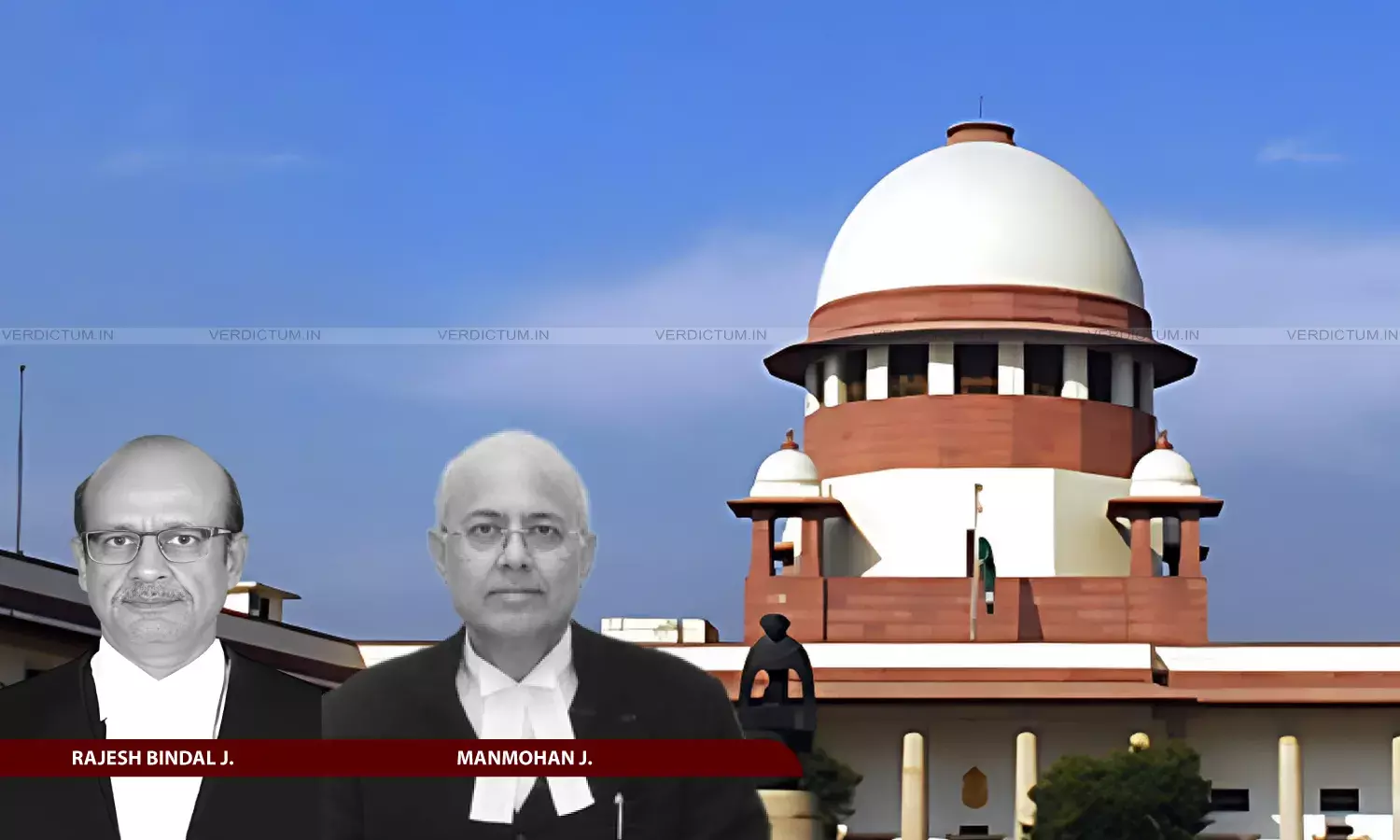
Justice Rajesh Bindal, Justice Manmohan, Supreme Court
The Supreme Court has held that gratuity cannot be denied to an employee merely because they resigned from service when the employer continues to be governed by the Payment of Gratuity Act, 1972 and has not obtained a statutory exemption from its applicability.
The Court clarified that the right to gratuity is a statutory entitlement, independent of pension rules, and resignation does not operate as a bar to such entitlement where the establishment remains subject to the Act.
The Apex Court was hearing an appeal against the dismissal of claims for pension, gratuity, and leave encashment made by a former conductor of Delhi Transport Corporation (DTC), whose resignation was accepted by the Corporation.
A Bench of Justice Rajesh Bindal and Justice Manmohan observed: “There is no dispute on the fact that in terms of Section 5 of the 1972 Act there is no notification issued by the appropriate government exempting the Corporation from the application of the 1972 Act. Once it could not be established by the respondent that the 1972 Act is not applicable to the Corporation, the claim of the appellant for release of gratuity cannot be denied even if he had resigned from service. Hence, they are held entitled to receive gratuity in terms of the provisions of the 1972 Act for the service rendered by him”.
Advocate Narender Kumar Verma, AOR, represented the appellant, while Advocate Aviral Saxena represented the respondents.
Background
The deceased employee had joined DTC in 1985 as a conductor. A new pension scheme was later introduced, which he had opted into. In 2014, he resigned, citing family circumstances, and his resignation was accepted. When his request to withdraw his resignation was denied, he sought payment of his retirement dues, including pension, gratuity, provident fund, and leave encashment.
DTC denied all retirement benefits except the provident fund, citing forfeiture of service under Rule 26 of the Central Civil Services (Pension) Rules, 1972. The Tribunal and the High Court upheld DTC’s stand. His legal heirs continued the claim before the Supreme Court after his death.
Court’s Observation
The Supreme Court held that a pension is not payable upon resignation because Rule 26 of the CCS Pension Rules explicitly mandates forfeiture of past service unless resignation is permitted to be withdrawn in the public interest. The Bench relied on BSES Yamuna Power Ltd. v. Ghanshyam Chand Sharma, where the distinction between resignation and voluntary retirement was reaffirmed.
However, turning to gratuity, the Court examined Section 4 of the Payment of Gratuity Act, 1972, which expressly entitles an employee to gratuity upon superannuation, retirement or resignation, provided at least five years of continuous service is completed. It noted that this right arises by statute.
The Bench emphasised that Section 5 of the Act permits the Government to exempt an establishment from its application only by notification, subject to conditions. In the matter at hand, the Court noted that “…there is no dispute on the fact that in terms of Section 5 of the 1972 Act there is no notification… exempting the Corporation from the application of the 1972 Act.”
Accordingly, the Apex Court held that DTC could not avoid statutory liability merely by referring to pension rules that operate independently of gratuity rights. The Court also noted that the employee had over five years of continuous service, satisfying eligibility under the Act.
With respect to leave encashment, the respondent fairly conceded liability, and the Court ordered its release.
Conclusion
The Supreme Court partly allowed the appeal. While affirming the denial of pension due to resignation and operation of Rule 26 of CCS Rules, it directed DTC to release Gratuity under the Payment of Gratuity Act, 1972, and leave encashment pay to the legal heirs of the deceased employee within six weeks, together with 6% interest per annum from the date of resignation until the date of payment.
All pending applications were disposed of.
Cause Title: Ashok Kumar Dabas (Dead Through Legal Heirs) v. Delhi Transport Corporation (Neutral Citation: 2025 INSC 1404)
Appearances
Appellant: Advocate Narender Kumar Verma, AOR
Respondent: Advocates Aviral Saxena, Abhinav Sharma, Paritosh Goyal, Vedant Varshney