

Supreme Court Appoints Justice Sanjay Kishan Kaul As Mediator To Resolve Vadakalai-Thenkalai Sect Dispute At Sri Devarajaswamy Temple Kanchipuram
The Petitioner challenges the judgment passed by the Madras High Court, which restricted the Vadakalai sect of Sri Vaishnavas from reciting two prayers.

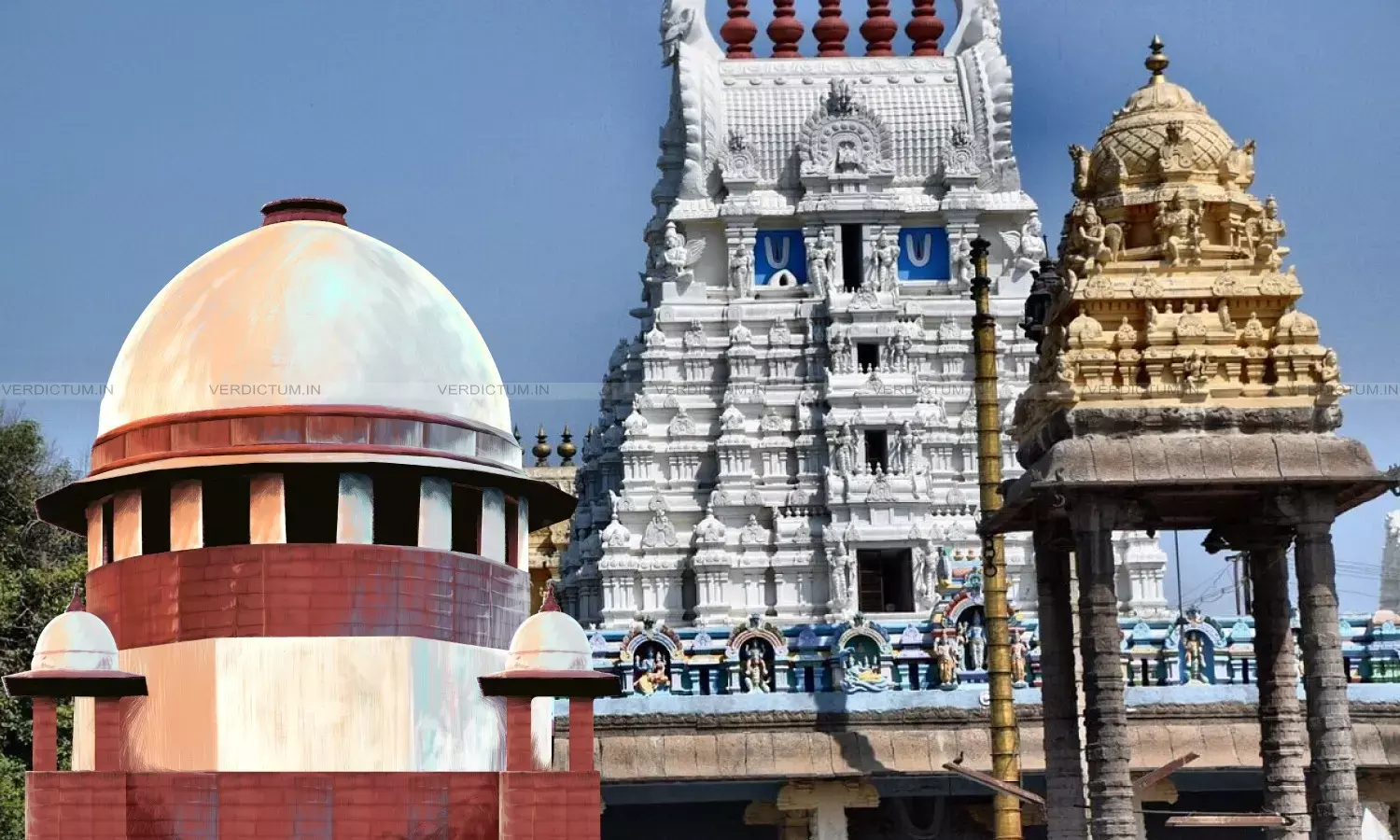
The Supreme Court, today, appointed Former Justice Sanjay Kishan Kaul to act as a mediator in the dispute pertaining between the sects of Shri Ramanujacharya with respect to the method and prayer at the Vaishnav Temples in Tamil Nadu, including Sri Devarajaswamy Temple, Kanchipuram.
The bench of Chief Justice Surya Kant and Justice Joymalya Bagchi ordered, “Two sects, i)Thengalai sect and ii) Vadakalai Sect of Shri Ramanuja Acharya, are parties to this dispute with respect to the method and prayer at the Vaishnav Temples in Tamil Nadu, including Sri Devarajaswamy Temple at Kanchipuram. During the course fo preliminary hearing, we have impressed upon and Learned Senior Counsels have gracefully agreed to explore mediation so that day-to-day rituals can be performed in an amicable manner. In this regard, we request Hon’ble Mr Justice Sanjay Kishan Kaul, former Judge of the Supreme Court and Chief Justice of Madras High Court, to act as the principal mediator. Justice Kaul may associate two persons of his choice who are well conversant with Tamil and Sanskrit languages and the rituals and history of Tamil Nadu...Both sides have agreed to approach Justice Kaul by tomorrow. We request Justice Kaul to accept this responsibility of a delicate nature. We also request Justice Kaul to fix his own two associates, in addition to the secretarial assistance that may be required by him. Post the matter on 13.03.2026.”
Senior Advocates Arvind Datar and C.S. Vaidyanathan appeared for the Petitioner, while Senior Advocates Dama Seshadri Naidu and CA Sundram appeared for the Respondents.
The Petitioner challenges the Judgment and Final Order passed by the Madras High Court, whereby the High Court had dismissed the Writ petition filed by the Petitioner and restricted the Vadakalai sect of Sri Vaishnavas from reciting two prayers: (i) Ramanuja Dayapatram, verses in praise of their Spiritual Guru Sri Vedanta Desika, before the 4000 Divya Prabandhams; and (ii) Vaazhi Thirunaamam at the end of the 4000 Divya Prabandhams.
A plea, filed by AOR G Balaji, also challenges an order passed by the Executive Trustee restricting Vadakalais from reciting their Thaniyan, Prabandham, and Vazhi Thirunamam. The order also barred them from reciting the Tamil Prabandham composed by their Acharya, Sri Vedanta Desikan.
Senior Advocate Arvind Datar submitted, “We are not saying that we want priority…How can people coexist together? It is not antithetical to them, we are not defining the garbhgharha at all.”
Justice Kant said, “All these apprehensions, whatever the past unfortunate incidents have happened, those can be taken care of. We are requesting both sides, please go for some kind of mediation…both are such beautiful languages of this country. Such a wonderful heritage, this Country feels proud of it and you are one of the States where this entire heritage is so well maintained. Everybody feels so happy that you showcase the Indian culture…”
“Agar aap in devta ki ek baar nhi do baar puja krenge toh devta khush honge ya naraz honge?”, Justice Kant remarked.
The Court further remarked, “Right now we want a workable solution. We don’t want both the sects of the same great Ramanuja Followers to fight in course…”
The Petitioner says in its plea that the followers of Ramanuja, known as Srivaishnavas, are a recognised religious denomination under Article 26 of the Constitution. The Supreme Court confirmed this in the Shirur Mutt case. The Petitioner said that he is an ardent devotee and regular worshipper at Sri Devarajaswamy Temple, Kanchipuram. He belongs to the Vadakalai sub-sect of the Sri Vaishnava community.
He says that Sri Devarajaswamy Temple is one of the 108 holy abodes of Lord Vishnu in Tamil Nadu. It is one of the four most celebrated temples. The Temple has a shrine for Sri Vedanta Desikan (13th Century), the forerunner of the Vadakalai sub-sect and a principal devotee of Sri Ramanuja. Devotees worship Sri Vedanta Desika by reciting the Ramanuja Dayapatram and hymns praising him with reverence. The Thatacharya family, belonging to the Vadakalai sub-sect, has administered the Temple since the Vijayanagara period. The Thathacharyas perform various services, including Veda Parayanam (Vedic recital), Stotrapadam (recital of Stotrams), Mantrapushpam (recital with flower offerings), Purana Patanam (reading Puranas), bringing holy water, Thirumanjana Kattiyan (reciting glory during the Lord's bath), and Thirumeni Kaaval (securing idols during processions). Another service is the recitation of the 4000 Divya Prabandham (songs in praise of Lord Vishnu).
He further says that the other sub-sect of the Sri Vaishnava community is the Thenkalai sect. Thenkalais revere Sri Manavala Mamunigal, a 14th-15th century saint, as their forerunner, just as Vadakalais revere Sri Vedanta Desikan. In 1711, Thenkalais obtained the right to recite the Thaniyan (verse in praise of a guru) of Sri Manavala Mamunigal. The Thathacharya office-holders conceded this right under the Attan Jeeyar Agreement, which permitted the recitation of 'Sri Sailesa Dayapatram' before the 4000 Divya Prabandham.
It is the case of the Petitioenr, that using this Agreement, Thenkalais restricted Vadakalais from reciting their Thaniyan- 'Ramanuja Dayapatram'-in praise of Sri Vedanta Desikan before the 4000 Divya Prabandham. This led to numerous civil litigations between the sub-sects before independence.
The Petition says, "Article 26 protects ceremonial law pertaining to temples: who may enter for worship, where they may stand and worship, and how worship should be conducted. It also protects religious rituals and ceremonies. All pre-Constitution judgments against the Vadakalai sect clearly conflict with Article 26 of the Constitution under Article 13. In 2018, Vadakalai Sri Vaishnavas approached the Madras High Court in W.P. No. 24729 of 2018, seeking permission to recite verses in praise of Sri Vedanta Desikan. The Court permitted Vadakalais to recite Sri Ramanuja Dayapatram before the 4000 Divya Prabandham. Meanwhile, Mr. T.A. Ranganathan of the Thenkalai sub-sect filed Cont.P. No. 367 of 2020 in A.S. No. 175 of 1910, seeking action against the Executive Trustee for allowing Vadakalais to recite their Thaniyan and Vazhi Thirunamam."
The High Court had passed an order recognising Vadakalai rights. Then, Thengalais challenged this, and the Division Bench remanded the issue for fresh consideration. A Thengalai devotee filed a writ petition, seeking police protection to restrain Vadakalais from reciting Ramanuja Dayapatram.
The Petition inter alia raises the following grounds, "Whether the Vadakalais, a minority section even among the Vaishnavaite denomination, can be prohibited and/or criminally prosecuted for reciting mantras in praise of their Acharya Vedanta Desikan, who is present as one of the deities in the Vadakalai temple at Kanchipuram?..Whether settlement or agreement granting the Thengalai sect rights to recite mantras in praise of their Acharya Manavala Mahamuni can prohibit the Vadakalai from reciting mantras in praise of Vadakalai deities, including Acharya Vedanta Desikan, in the temple?"
It is submitted, "The High Court failed to appreciate that the hereditary Mirasi right claimed by the Thengalai sect for exclusive recitation of Prabandham was abolished by the Tamil Nadu Hindu Religious and Charitable Endowments (Amendment) Act, 1970 (Tamil Nadu Act 2 of 1971). This Hon'ble Court upheld the abolition in Seshammal v. State of Tamil Nadu (1972). The High Court erred in holding that Seshammal does not apply merely because the right was purportedly bestowed upon a community of residents. Once the concept of hereditary entitlement to office is abolished by statute, no group can claim perpetual, exclusive rights to office or service by succession or locality. The finding that the abolition right survives statutory is legally unsustainable."
The Petitioner also says that the High Court failed to note the significance of a decision that may be rendered in this lis. The stark injustice that would result from upholding the Thengalai sect's assertion is that the Vadakalai Sect will be prohibited from reciting Sri Ramanuja Dayapatram, in honour of Sri Vedanta Desikan, a Vadakalai saint, in a Vadakala Temple, where the deity of the saint holds a place of extreme importance. The Vadakalais' part to prevent the Thengalai sect from reciting Sri Sailesa Dayapatram. In fact, the right asserted by the Vadakalais is not of simultaneous recitation or a right to commence the recitation. The Vadakalais merely seek to honour the saint whose scholarship and piety are recognised by the establishment of a shrine in his name, the plea says.
Accordingly, the matter is now listed in March 2026.
Cause Title: S. Narayanan v. The State of Tamil Nadu & Ors. [SLP (C) 2855 OF 2026]