

Whether A Member Of Consortium Itself Can Invoke Section 11 A&C Act?: Supreme Court Answers
The Supreme Court dismissed Civil Appeals arising from an Order of the Telangana High Court, constituting an Arbitral Tribunal.
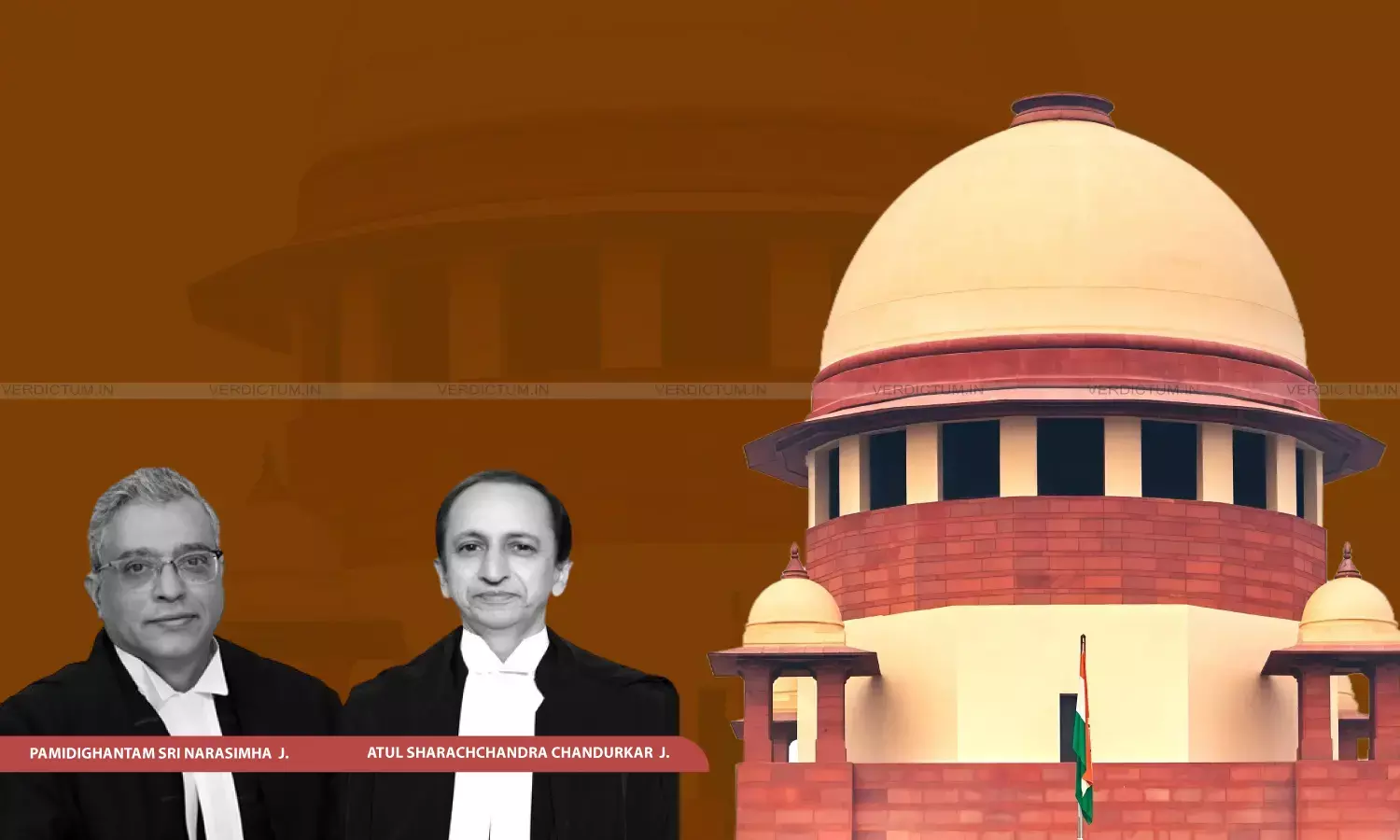
Justice Pamidighantam Sri Narasimha, Justice Atul S. Chandurkar, Supreme Court
The Supreme Court has answered whether a member of a consortium can itself invoke Section 11 of the Arbitration and Conciliation Act, 1996 (A&C Act).
The Court was deciding two Civil Appeals arising from an Order of the Telangana High Court passed under Section 11(6) of A&C Act, constituting an Arbitral Tribunal (AT) for resolution of dispute as per the arbitration clause in General Conditions of Contract (GCC).
The two-Judge Bench comprising Justice P.S. Narasimha and Justice Atul S. Chandurkar explained, “It is certainly a matter of institutional discipline for the referral courts to enable “parties” to identify and exercise alternative remedies, particularly that of arbitration, with clarity and consistency. The question whether a member of a consortium can itself invoke Section 11 of the Act, 1996 is not one that admits of a monolithic or a uniform answer. Answer to that question will necessarily depend on enquiry into the terms of the principal contract, as well as the Consortium Agreement. The specific terms of the Consortium Agreement, parties to that agreement, and the nature of the rights and mutual obligations that the agreement creates will have to be examined in detail.”
The Bench added that the Reference Court will, however, confine its enquiry only to a prima facie satisfaction as to whether a member of a consortium qualifies as a ‘party’ to the arbitration agreement and this prima facie satisfaction is sufficient for the Referral Court to constitute and refer the dispute to the Arbitral Tribunal and thereafter, it is for the AT to undertake the detailed enquiry as to whether a member of the consortium is in fact a veritable party to the arbitration agreement or not.
ASG N. Venkataraman and Senior Advocate Guru Krishnakumar appeared for the Appellant, while AOR Balaji Srinivasan and Advocate Anirudh Krishnan appeared for the Respondents.
Brief Facts
The Appellant-Andhra Pradesh Power Generation Corporation Limited (APGENCO) floated a tender inviting bids from a Consortium of companies for an EPC contract pertaining to works for their Rayalseema Thermal Power Plant. The tender specifications incorporated the Instructions to Bidders (IB) and the General Conditions of Contract (GCC), comprising of dispute resolution through arbitration under Clause 22.2. A Consortium comprising Respondents was constituted for exclusively participating in the tender process. The Consortium emerged successful, and a Letter of Intent (LOI) was issued to the Consortium through the first Respondent, being the lead member. Thereafter, three Purchase Orders were issued in favour of the Consortium and execution commenced, each member undertaking its respective scope of work. During execution, the first Respondent encountered severe financial distress, resulting in project delays.
Consequently, VA Tech, being jointly and severally liable as a consortium member, undertook first Respondent’s scope of work and was subsequently recognised as the lead member. Later, the first Respondent was admitted into Corporate Insolvency Resolution Process (CIRP), followed thereafter by an order initiating liquidation. The Appellant issued a letter to the first Respondent that it was responsible for substantial delays in execution of the project. As the Appellant did not release the claimed amount, arbitration clause was invoked by the first Respondent. As the Appellant did not take any steps to constitute the Arbitral Tribunal, proceedings were instituted before the High Court. The Appellant objected to maintainability on the ground that the first Respondent as an individual member, cannot unilaterally invoke arbitration. However, the application was allowed and the disputes were referred to arbitration. Being aggrieved, the Appellant was before the Apex Court.
Court’s Observations
The Supreme Court in the above regard, observed, “Beyond the prima facie enquiry, it should be the discipline of the referral court to refrain from undertaking a detailed enquiry on basis of evidence to arrive at a finding of fact in the nature of a ‘proof’.”
The Court was of the view that once the High Court was satisfied that an arbitration agreement prima facie existed, an aspect neither seriously disputed nor refutable at this stage, its decision to constitute the Arbitral Tribunal cannot be faulted.
“While we hold that there is certainly a prima facie case for referring the dispute to arbitration under Section 11, a detailed scrutiny on the basis of evidence must be left to AT. Whether first respondent has validly invoked arbitration individually, whether the Consortium continues to exist, whether consent of other Consortium partners was necessary, and whether claims are maintainable after commencement of liquidation, are all matters which may legitimately be raised, contested and determined before the AT under Section 16. Entertaining these questions here would amount to conducting a mini trial at the Section 11 stage, contrary to the settled principles of minimal judicial intervention and kompetenz-kompetenz”, it said.
The Court, therefore, concluded that the High Court has not committed any error in constituting the Arbitral Tribunal in exercise of its powers under Sections 11(6) and 11(6-A) of the A&C Act and the AT will consider all questions including preliminary objections relating to maintainability of the arbitration on their own merit.
Accordingly, the Apex Court dismissed the Appeals.
Cause Title- M/s Andhra Pradesh Power Generation Corporation Limited (APGENCO) v. M/s Tecpro Systems Limited & Ors. (Neutral Citation: 2025 INSC 1447)
Appearance:
Appellant: ASG N. Venkataraman, Senior Advocate Guru Krishnakumar, AORs Venkita Subramoniam T.R, Guntur Pramod Kumar, Advocates Neeraj Kumar, Meenakshi Jha, and Prerna Singh.
Respondents: AORs Balaji Srinivasan, Guntur Pramod Kumar, Advocates Anirudh Krishnan, K. Shiva, Anuraag Rajagopalan, Pranay Prakash, Varun Venkatesan, and Sasank Iyer.
