

Voluntary Statements Recorded U/S.108 Of Customs Act Admissible in Evidence: Supreme Court Upholds 1985 Smuggling Conviction
The Supreme Court was considering two appeals arising from a common judgment of the Gujarat High Court whereby the revisions preferred by the original accused 1, 2, 3, 5, 6, 7 and 11 were dismissed, and their conviction for the offence punishable under section 135(1)(b)(i) of the Customs Act, 1962 was affirmed.

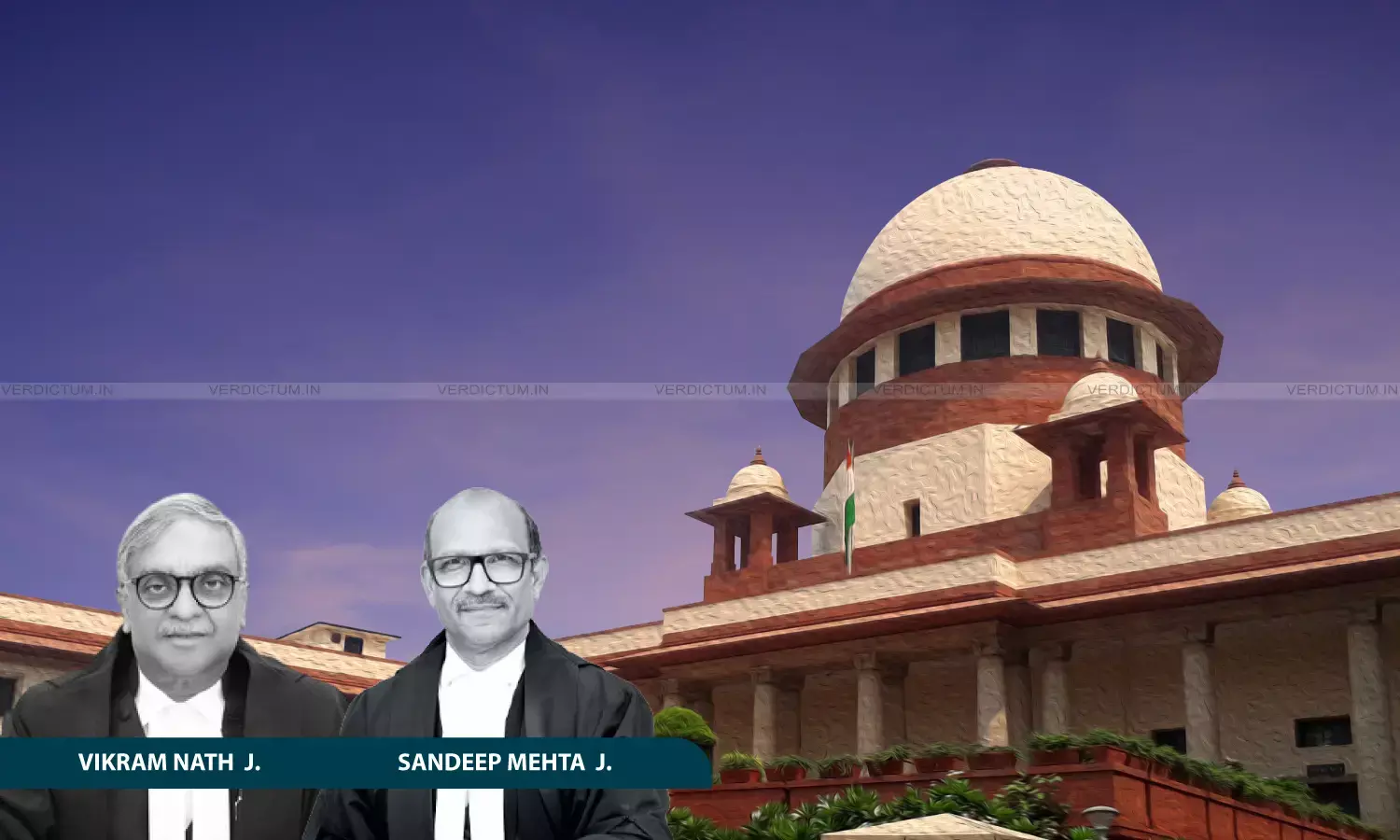
Justice Vikram Nath, Justice Sandeep Mehta, Supreme Court
While concurring with the view that the voluntary statements recorded under Section 108 of the Customs Act, 1962, by duly authorised Customs Officers are admissible in evidence, the Supreme Court upheld the conviction in a 1985 smuggling case. However, considering the age of the accused and other attending circumstances, the Bench reduced their sentence to the period already undergone.
The Apex Court was considering two appeals arising from a common judgment of the Gujarat High Court whereby the revisions preferred by the original accused 1, 2, 3, 5, 6, 7 and 11 were dismissed, and their conviction for the offence punishable under section 135(1)(b)(i) of the Customs Act, 1962 was affirmed.
The Division Bench of Justice Vikram Nath and Justice Sandeep Mehta held, “At the outset, it would be apposite to note that the contention that the conviction of the appellants could not be founded solely upon the statements recorded under Section 108 of the Customs Act, 1962, was also urged before the High Court in revision. The High Court, upon a detailed examination of the statutory framework and the judicial precedents governing the admissibility and evidentiary value of such statements, rejected the said contention. It was observed that statements recorded under Section 108 of the Customs Act, 1962 by duly authorized Customs Officers are admissible in evidence and do not attract the bar contained in Sections 24, 30, or 34 of the Indian Evidence Act, 1872, provided they are made voluntarily.”
Senior Advocate Amar Dave represented the Appellant while AOR Swati Ghildiyal represented the Respondent.
Factual Background
The Customs officers at Mandvi received a secret intelligence indicating that prohibited, smuggled foreign wristwatches had been concealed near a fisherman’s jetty. It was reported that two jute sacks containing smuggled wrist watches of foreign brands such as Seiko, Citizen, and Ricoh were concealed in two pits. Acting on this intelligence report, the Customs officers from Mandvi, accompanied by two independent panch witnesses, conducted a search. During the excavation of the pits, two jute sacks were recovered. Based on their packaging, quantity, and nature, the Customs officers formed a reasonable belief that the contents were smuggled foreign wrist watches. Upon close inspection, a total of 777 foreign-made wrist watches and 879 wrist watch straps were found, with an estimated value of Rs 2,22,190.
The goods were confiscated under the provisions of the Customs Act on the reasonable belief that they had been illegally imported into India. Further investigation revealed that the seized goods had been smuggled into India during the first week of February 1985. The first and second Accused were identified as the owners of the ship, while the third Accused was its captain. Other accused persons were alleged to have actively participated in concealing, storing, transporting, selling, or facilitating the disposal of the smuggled goods. Some of the accused were found to have kept the smuggled watches in their custody, while others sold portions of the goods or retained sale proceeds. Cash amounts derived from such illegal sales were also seized from some of the accused persons.
After obtaining sanction from the Collector of Customs, Ahmedabad, a criminal complaint was filed against 21 accused persons for the above offence. The trial Court took cognisance and framed charges against the accused persons under Section 135 (1)(b)(i) of the Customs Act. Accused 9, 12, 13, 15, 16, 17, 19 and 21 were acquitted, whereas accused 1, 2, 3, 5, 6, 7 and 11 were convicted and held guilty. Each convicted accused was sentenced to three years' rigorous imprisonment. The convicted accused preferred separate appeals, but the same were dismissed. The appellants preferred separate revisions against the dismissal of their criminal appeals, which were rejected by the High Court. This became a subject matter of challenge in the appeals by special leave.
Reasoning
The Bench noted that the High Court observed that statements recorded under Section 108 of the Customs Act, 1962, by duly authorised Customs Officers are admissible in evidence and do not attract the bar contained in Sections 24, 30, or 34 of the Indian Evidence Act, 1872, provided they are made voluntarily. It was also held by the High Court that the conviction of the appellants was not based merely on confessional statements, but in addition thereto, the prosecution provided tangible corroborative evidence. The Bench thus stated, “The findings of guilt recorded by the trial Court, which stand concurrently affirmed by the appellate Court as well as the High Court do not suffer from any perversity, illegality, or manifest error warranting interference by this Court in exercise of its jurisdiction under Article 136 of the Constitution of India.”
The Bench took note of the fact that the recovery related to the year 1985, and the offending consignment of watches was recovered lying in an abandoned condition. The conviction of the appellants was primarily based on confessional statements recorded under Section 108 of the Customs Act, 1962; however, conscious possession of the smuggled goods was not attributed to the appellants.
The Bench also noticed that some of the appellants had passed away during the pendency of the appeals. The surviving appellants were now of advanced age and had undergone a substantial period of incarceration, reportedly around one year, which was more than the statutory minimum sentence of six months contemplated under the proviso to Section 135 (1)(b)(i) of the Customs Act, 1962, as it then existed.
“In this backdrop, considering the totality of circumstances, including the fact that the incident is nearly four decades old, the period of incarceration already undergone by the appellants, the prolonged pendency of proceedings, and the advanced age of the surviving appellants, we are of the considered view that directing the appellants to undergo any further incarceration at this point of time would be unduly harsh and would not subserve the ends of justice. In the peculiar facts and circumstances of the present case, ends of justice would be served by reducing the sentence to the term already undergone by the appellants”, it added.
Thus, partly allowing the appeals, the Bench affirmed the judgment of conviction passed by the trial Court but reduced the sentence awarded to the appellants to the period already undergone by them.
Cause Title: Amad Noormamad Bakali v. The State of Gujarat (Neutral Citation: 2026 INSC 180)
Appearance
Appellant: Senior Advocate Amar Dave, AOR S. Sudheer, Advocates Rishi Maheshwari, Anne Mathew, Bharat Sood, Jai Govind M J, Jashan Vir Singh, Yadunandan Bansal, AOR Ravi Panwar
Respondent: AOR Swati Ghildiyal, AOR Deepanwita Priyanka, AOR Arvind Kumar Sharma