

Supreme Court: Section 19(b) Specific Relief Act Have To Give Way To Doctrine Of Lis Pendens U/S 52 Transfer Of Property Act
The Supreme Court said that the Executing Court can decide whether the resister or obstructor is a person bound by the decree and whether he refuses to vacate the property.
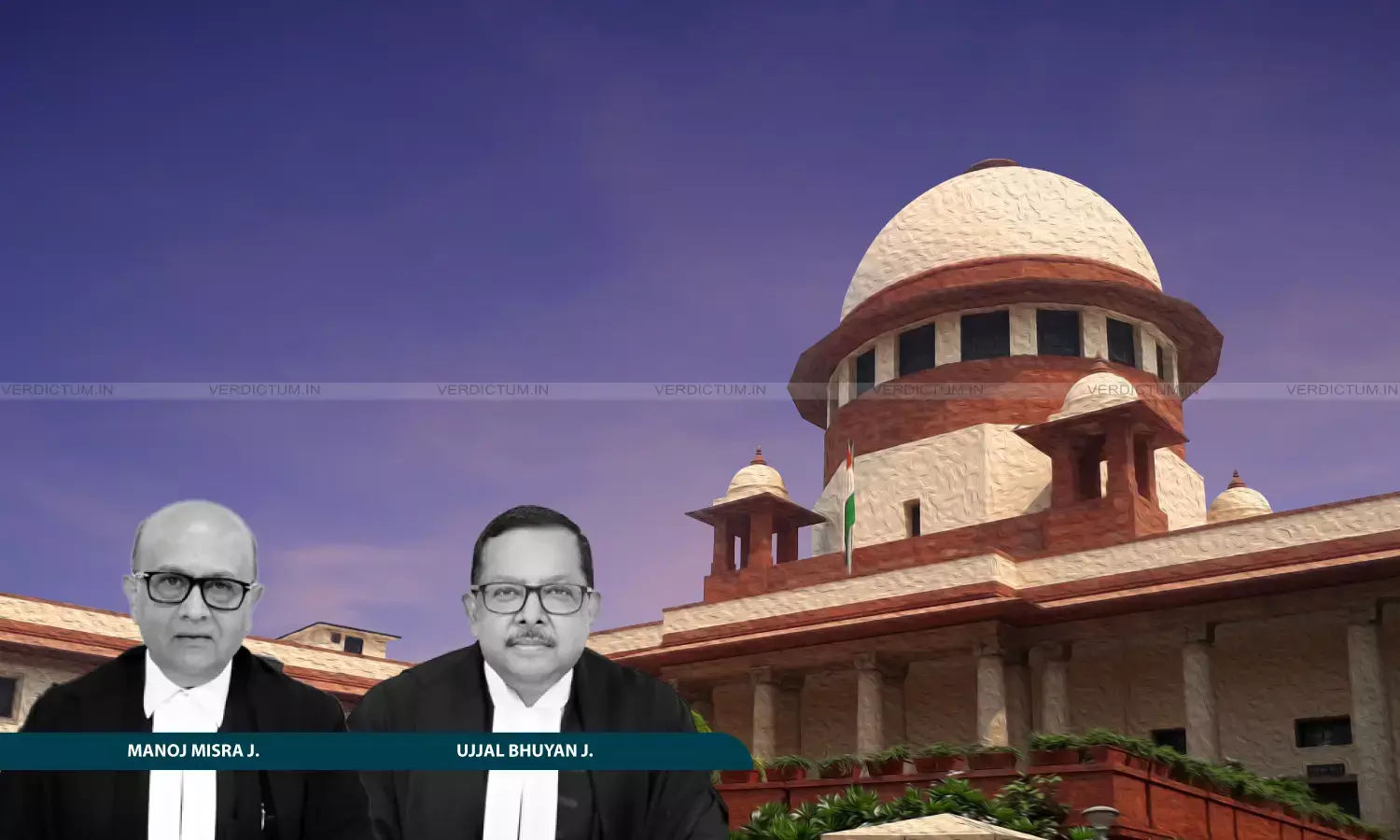
Justice Manoj Misra, Justice Ujjal Bhuyan, Supreme Court
The Supreme Court held that Section 19(b) of the Specific Relief Act, 1963 (SRA) would have to give way to Section 52 of the Transfer of Property Act, 1882 (TPA) the moment a suit or proceeding is instituted by a party.
The Court held thus in Civil Appeals preferred against the Judgment of the Bombay High Court, which dismissed Second Appeals holding that there is no merit in any of the substantial questions of law raised by the Appellants.
The two-Judge Bench comprising Justice Manoj Misra and Justice Ujjal Bhuyan observed, “As pointed out above, Section 19(b) of the Specific Relief Act would be available to a party to a contract who suffers a subsequent transfer of property. However, the moment a suit or proceeding is instituted by a party to the contract whereafter there is transfer of the suit property, Section 19(b) of the Specific Relief Act would have to give way to Section 52 of the Transfer of Property Act in which event the doctrine of lis pendens would come into force."
The Bench said that the Executing Court can decide whether the resister or obstructor is a person bound by the decree and whether he refuses to vacate the property.
Senior Advocate Vinay Navare appeared on behalf of the Appellants, while the Respondent appeared in person.
Facts of the Case
The Respondent-Plaintiff entered into an agreement for sale of the subject property with the Defendant (Judgment Debtor) in the year 1973. Since the Defendant failed to perform his part of the contract, the Respondent as the Plaintiff instituted Regular Civil Suit in 1986. The Respondent-Plaintiff registered lis pendens. During the pendency of the suit, the Judgment Debtor by eight sale deeds transferred the right, title, and interest of various parcels of the suit property to different persons from whom the Appellants further purchased portions of the suit property. In 1989, one of the transferees pendente lite constructed a bungalow over a part of the suit property. The Trial Court decreed the suit in favour of the Plaintiff.
Within a period of one year from the date of decree, the Plaintiff filed an Execution Petition against the Judgment Debtor. In 1993, on Orders of the Executing Court, the Court Commissioner executed the sale deed in favour of the Plaintiff, thus transferring title over the property to decree holder. Though the Judgment Debtor attempted to belatedly challenge the Judgment and Decree, the same was unsuccessful. Further, his challenge to execution of sale deed by the Court Commissioner was also rejected by all the Courts. Resultantly, the Judgment and Decree attained finality. Again, the Judgment Debtor resisted the Execution Petition and the same was dismissed by the Executing Court. In the execution proceedings, on completion of various procedural steps, the Executing Court passed an Order issuing possession warrant.
Appellants as obstructionists resisted execution and raised objections before the Executing Court and the decree holder filed applications for removal of obstruction. The Executing Court allowed the decree holder’s application and directed the obstructionists i.e. the Appellants to vacate the premises within one month. This Order was challenged by the Appellants, however, the Appellate Court dismissed their Appeals. Meanwhile, the judgment debtor filed an application for dismissal of Regular Darkhast, which was however dismissed. Though there was a further challenge before the High Court via Revision Application, the same was also dismissed. The related Second Appeals were filed by the Appellants, which were dismissed by the High Court. Being aggrieved, the Appellants approached the Apex Court.
Reasoning
The Supreme Court in view of the above facts, noted, “Merely because appellants are lis pendens purchasers, their objection to the execution could not have been rejected as has been done in the instant case.”
The Court reiterated that the scope of adjudication is limited to the only question as to whether the objector who has resisted execution is a transferee pendente lite or not and if the finding is in the affirmative, then such a transferee has no right to resist.
“… it is clear as day light that the rights of the appellants who are subsequent purchasers are subservient to the rights of the decree holder. After the judgment and decree of the trial court and following execution of the sale deed by the Court Commissioner, a valid title qua the suit property passed on to respondent No. 1 (decree holder). Admittedly in the present case, the transfer of the suit property is pendente lite”, it remarked.
The Court was of the view that the doctrine of lis pendens as encapsulated in Section 52 of TPA is squarely applicable and all the Courts have recorded a clear finding of fact that the Appellants were fully aware of the pendency of the suit, however, even that is not necessary.
“Reliance placed by Mr. Navare on Thomson Press is totally misplaced. There is no dispute to the proposition that transfer pendente lite is neither illegal nor void ab initio. But it remains subservient to the decree that may be passed by the court. Now that the decree and conveyance in favour of respondent No. 1 have attained finality, the transferee pendente lite i.e. the appellants have to give way and hand over actual physical possession of the suit property to respondent No. 1”, it added.
The Court further said that the Appellants being transferee pendente lite, the doctrine of lis pendens applies with full force to them and that apart, Respondent (decree holder) had sought for execution within a period of one year from the date of the Judgment and Decree of the Trial Court.
“Article 129 of the Limitation Act prescribes a period of limitation of 30 days for filing an application for possession after removing resistance or obstruction to delivery of possession of immovable property decreed or sold in execution of a decree. This period of 30 days is to be counted from the date of resistance or obstruction. Likewise, under Article 134, the period of limitation for delivery of possession by a purchaser of immovable property at a sale in execution of a decree is one year which limitation period would begin to run from the date when the sale becomes absolute. Obviously, Article 134 is not attracted in the present case. Respondent No. 1 got the title over the suit land transferred to him by way of a sale deed executed by the Court Commissioner since respondent No. 2 failed to comply with the judgment and decree of the trial court. In so far Article 129 is concerned, the present appellants raised objections to the execution of the decree concerning handing over of possession on 18.01.2019. Respondent No. 1 filed the application for removal of obstruction on 11.02.2019, which is well within the period of 30 days”, it also observed.
Conclusion
The Court held that there is no error or infirmity in the view taken by the High Court and there is no merit in the two Appeals which are liable to be dismissed. It, therefore, directed the Appellants to hand over actual physical possession of the suit property to the Respondent (Decree Holder) on or before February 15, 2026.
“… it has been more than 3 decades but respondent No. 1 is yet to enjoy the fruits of his litigation success as actual physical possession of the suit property has still not been handed over to him, despite adjudication of the objection of the appellants as obstructionists to the complete satisfaction of the Executing Court. In the process, he has suffered multiple rounds of litigation either at the hands of the judgment debtor or at the instance of the appellants. In order to ensure that respondent No. 1 (decree holder) does not have to undergo the ordeal of further frivolous litigation thus prolonging his hardship, we deem it appropriate to issue certain direction(s)”, it noted.
Hence, the Court directed that no further Application(s) or Petition(s) either by the Appellants or by the Judgment Debtor i.e. Respondent No. 2 or by any other person claiming right qua the suit property through them shall be entertained by any Court.
“We consider such a direction to be necessary to ensure that respondent No. 1 is not subjected to any further harassment which will meet the ends of justice”, it concluded.
Accordingly, the Apex Court dismissed the Appeals, upheld the impugned Judgment, and issued necessary directions.
Cause Title- Alka Shrirang Chavan & Anr. v. Hemchandra Rajaram Bhonsale & Ors. (Neutral Citation: 2026 INSC 52)
Appearance:
Appellants: Senior Advocate Vinay Navare and AOR Shivaji M. Jadhav.
Respondents: Caveator-in-person
