

Judicial Pronouncements Are Binding Commands Of Law; State Must Exemplify Obedience To Them: Supreme Court
The Apex Court underscored that judicial decisions, once they attain finality, are not advisory opinions but binding commands of law, and that the executive is constitutionally obligated to faithfully implement them rather than reasserting invalidated positions through altered instruments.
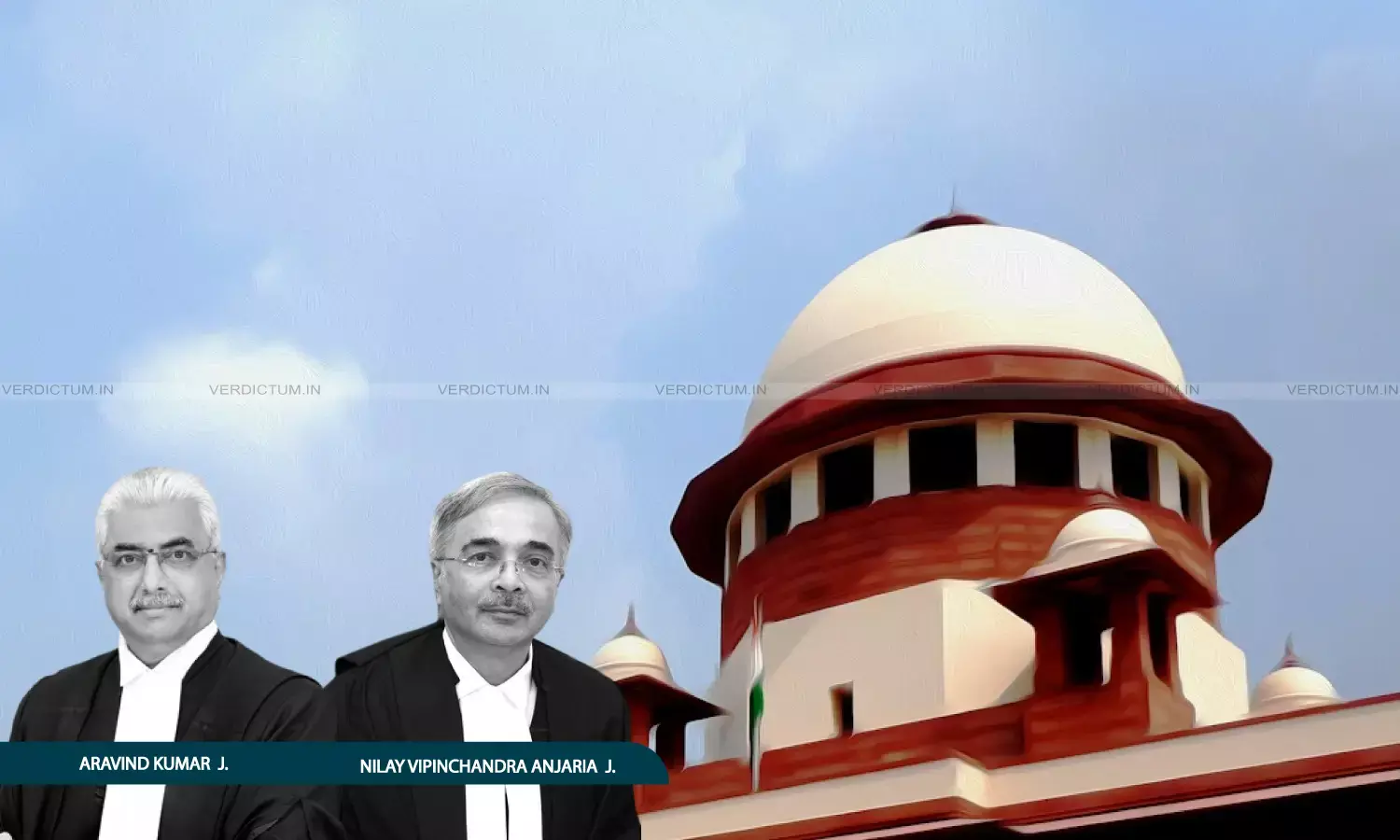
Justice Aravind Kumar, Justice N.V. Anjaria, Supreme Court
The Supreme Court has observed that judicial decisions, once they attain finality, are binding commands of law and not advisory opinions, and that the executive is constitutionally obligated to faithfully implement such decisions rather than resisting them through altered subordinate instruments.
The Court was hearing an appeal arising from a prolonged dispute concerning the enforcement of a levy that had earlier been declared ultra vires by a High Court, a declaration which had attained finality after the Supreme Court declined to interfere.
A Bench comprising Justice Aravind Kumar and Justice N.V. Anjaria, while examining the conduct of the authorities following the earlier judicial determination, observed that “judicial pronouncements are not advisory opinions; they are binding commands of law,” and stressed that “the State must exemplify obedience to judgments, not resistance to them.”
Senior Advocate P. Chidambaram represented the appellant, while Raghvendra P. Shankar, A.S.G., represented the respondents.
Background
The matter before the Court had its origins in a levy which was declared ultra vires by a High Court, a declaration that subsequently attained finality after the Supreme Court declined to interfere. Despite this authoritative determination, the levy continued to be enforced by the authorities for later periods through modified subordinate instruments.
As a result, the affected party was compelled to approach the High Court again, not to seek a fresh adjudication on the legality of the levy, but to seek implementation of the earlier judicial declaration and consequential relief. The denial of such relief by a coordinate Bench of the High Court eventually led the matter back to the Supreme Court.
Court’s Observation
The Supreme Court observed that the case raised concerns extending beyond the immediate dispute between the parties and directly implicated the conduct expected of the executive after courts had finally settled a legal position. The Court emphasised that “the authority of the rule of law rests not only in the pronouncement of judgments but equally in their proper implementation.”
Addressing the conduct of the authorities, the Court held that when a High Court of competent jurisdiction declares a levy to be ultra vires and unconstitutional, and such a declaration is allowed to attain finality, “it is incumbent upon the authorities thereafter to conform their conduct to the law so declared.” The Court underscored that the State cannot, “consistent with constitutional discipline, continue to enforce the same levy for a later period on the strength of slightly altered subordinate instruments and then resist restitution on grounds of technical pleading.”
Reiterating the principle that there must be an end to litigation in public interest, the Court noted that the appellant had succeeded in the earlier round, the State had failed in its challenge before the Supreme Court, and the subsequent proceedings were essentially an effort to secure implementation of what had already been recognised in principle. The Bench emphasised that “to deny relief on the footing that it is a new notification or that period was not expressly mentioned is to frustrate finality and to compel the citizen to engage in repetitive litigation to secure, in practice, what has already been recognised in principle.”
The Court further reaffirmed that “judicial pronouncements are not advisory opinions; they are binding commands of law,” observing that “when the executive continues to enforce, under new guise, a levy that has been judicially struck down, it acts in defiance of constitutional discipline and erodes public confidence in the rule of law.”
Emphasising that finality of adjudication is an essential component of good governance, the Court cautioned that “the repetition of an invalidated levy through successive notifications compels needless litigation, burdens the courts, and subjects citizens to prolonged uncertainty.” The authorities, it held, were obliged to treat the matter as concluded and extend the benefit of the earlier decision uniformly to subsequent periods until the law was altered by legislative action.
Invoking the doctrine “interest reipublicae ut sit finis litium”, the Court concluded that it is in the public interest that there be an end to litigation and that the State must “exemplify obedience to judicial decisions, not resistance to them.”
Conclusion
The Supreme Court concluded that the litigation, which had spanned more than a decade, revolved around a substantive question that had already been conclusively answered years earlier and had withstood scrutiny before the apex court itself. What ought to have followed, the Court held, was faithful implementation of that decision, not renewed resistance through altered executive instruments.
Holding that the failure of the authorities to conform their conduct to a binding judicial declaration justified judicial intervention, the Supreme Court allowed the appeal. The Court further directed that the authorities shall not raise any hyper-technical objections to defeat the substance of the relief granted.
It was ordered that no further demand shall be enforced against the appellant in respect of the levy having been held unsustainable. In view of the directions issued, the Court made no order as to costs and disposed of all pending applications.
Cause Title: Adani Power Limited & Anr. v. Union of India & Ors. (Neutral Citation: 2026 INSC 1)
Appearances
Appellant: Senior Advocate P. Chidambaram, with Advocates Mahesh Agarwal, Anshuman Srivastava, Rohan Talwar, Naman Agarwal, E. C. Agrawala, AOR
Respondents: Raghvendra P. Shankar, A.S.G., with Gurmeet Singh Makker, AOR and Advocates Sharath Nambaiar, Diwakar Sharma, Satvika Thakur, B. Sunita Rao, Ishaan Sharma
