

High Court Cannot Stifle Investigation Ordered U/S 156(3) CrPC Stage If Prima Facie Cognizable Offence Disclosed: Supreme Court
The Court noted that such an exercise would amount to conducting a mini-trial, defeating the very purpose of directing an investigation by the Police.

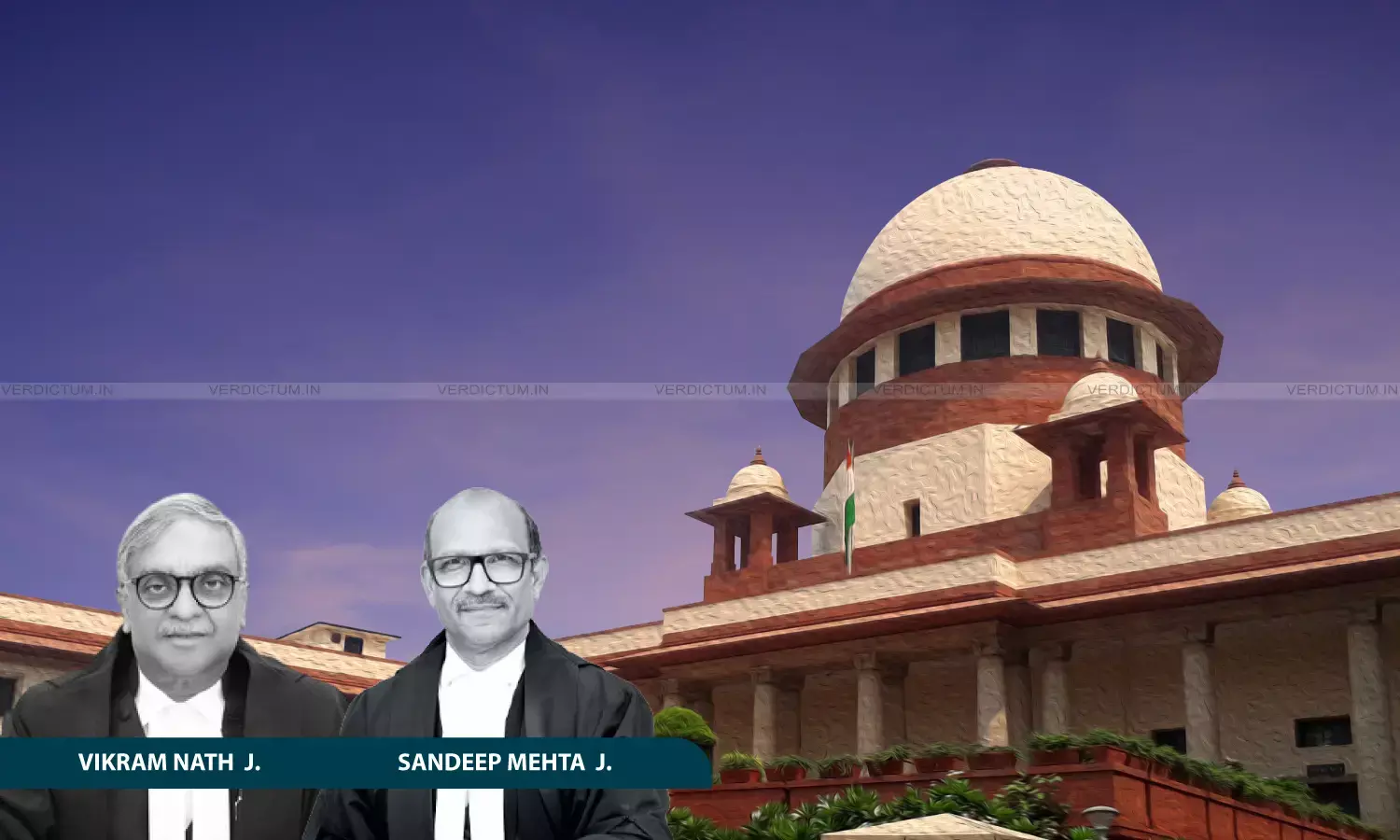
Justice Vikram Nath, Justice Sandeep Mehta, Supreme Court
The Supreme Court has held that a High Court transgresses its jurisdiction under Section 482 CrPC, if it quashes a criminal investigation at the threshold stage of a Section 156(3) CrPdirection, provided the complaint discloses a cognizable offence.
The Court said that at the stage where a Magistrate merely directs the police to register an FIR and undertake an investigation, the judicial scrutiny is limited to ascertaining whether the allegations warrant an inquiry. By stifling the process at its inception, the High Court effectively prevents the investigating agency from performing its statutory duty to probe serious allegations of fraud and forgery.
Justice Vikram Nath and Justice Sandeep Mehta while setting aside the common judgment of the Karnataka High Court, observed, “…it was not at all justified for the High Court to have quashed proceedings merely on the ground that the dispute appeared to be civil in nature…By entering into an evaluation of the dispute on merits and proceeding to quash the order directing investigation, the High Court effectively stifled the investigative process at its inception. Such an approach runs contrary to the principles consistently laid down by this Court”.
Senior Advocate Santosh Paul appeared for the appellant and Senior Advocate P Niroop appeared for the respondent.
In the matter, the dispute was regarding lands in Survey No. 12 of Doddagubbi Village, Bengaluru, originally owned by Bajjappa and others, who executed powers of attorney in favor of developer Joseph Chacko in 1994. The lead appellant, Accamma Sam Jacob, an NRI residing in Canada, purchased a residential plot in "Athina Township" that same year.
The complainants alleged that starting in 2006, a group of accused persons forcibly entered the layout, demolished structures, and used forged General Powers of Attorney and confirmation deeds to transfer the properties to third parties without consent or consideration. The appellants asserted that their signatures were obtained under false pretenses, purportedly for civil filings, but were instead used to execute deeds in favor of the accused.
Thereafter, the appellants filed private complaints after the local police declined to act, and on November 6, 2013, the Magistrate exercised powers under Section 156(3) CrPC, directing the registration of FIRs for offences including theft, cheating, and forgery.
The accused-respondents challenged these FIRs in the High Court, which quashed the proceedings on September 28, 2016. The High Court had noted that because the disputes involved overlapping claims and registered instruments, the matter was "purely civil" and required adjudication by a civil court before criminal liability could be entertained.
Now, the Bench noted that the High Court had adopted a nearly identical, flawed reasoning in a related matter involving the developer, which the Supreme Court had already set aside. The Bench held that if facts are "hazy" and an investigation has just begun, the courts must permit the investigating agency to proceed with its statutory duty.
“…Any such exercise at the stage of Section 156(3) of CrPC would amount to conducting a mini-trial and would be wholly impermissible. Permitting such defence material to be weighed at the threshold would frustrate and defeat the very purpose of directing an investigation by the police”, the Bench said.
The Court noted that the High Court erred by treating the existence of registered sale deeds as a "civil" shield, holding that requiring the prior cancellation of such deeds under Section 31 of the Specific Relief Act before criminal law can be set in motion is an impermissible hurdle.
“…we find that the reasoning adopted by the High Court in both cases proceeds on substantially identical lines and rests on the same foundational premise, namely, that the dispute between the parties is predominantly civil in nature and that criminal proceedings could not be sustained unless the registered sale deeds were first cancelled by resorting to proceedings under Section 31 of SRA. In such circumstances, the divergence in attribution cannot be a ground to discard the present complaints at the threshold. On the contrary, the existence of rival narratives in respect of the similar allegations underscores the necessity of a proper investigation to ascertain the identity and role of the persons involved”, the Bench noted.
Accordingly, the Court set aside the High Court’s judgment and restored the FIRs and arising proceedings to the file of the concerned Police Station and Magistrate.
Cause Title: Accamma Sam Jacob v. The State of Karnataka & Anr. Etc. (Neutral Citation: 2026 INSC 362)
Appearances:
Appellant: Santosh Paul, Sr. Adv., Sriharsh Nahush Bundela, AOR, Raghav Dixit, Aditi Rai, Naveen Kumar Yadav, Aditya Sonawane, Rakshha, Ranji Thomas, Sr. Adv., Varinder Kumar Sharma, AOR M/S. Hooda & Co., AOR, Advocates.
Respondent: P Niroop, Sr. Adv., Chandan Kumar, B Veera Swamy Raju, Venkat Ramana Reddy, Manoj C. Mishra, Sanchit Garga, AOR, Sanjay Kumar Visen, AOR, Gyanendra Vikram Singh, Soumya Gulati, Advocates.