

State Must Act As Model Employer, Not Hard-Bargaining Negotiator: Supreme Court On Denial Of Regularisation To ‘Academic Arrangement’ Paramedical Staff
Appeals were filed by paramedical staff including staff nurses and female multipurpose health workers who had been appointed in government medical institutions under the Jammu and Kashmir Medical and Dental Education (Appointment on Academic Arrangement Basis) Rules, 2009

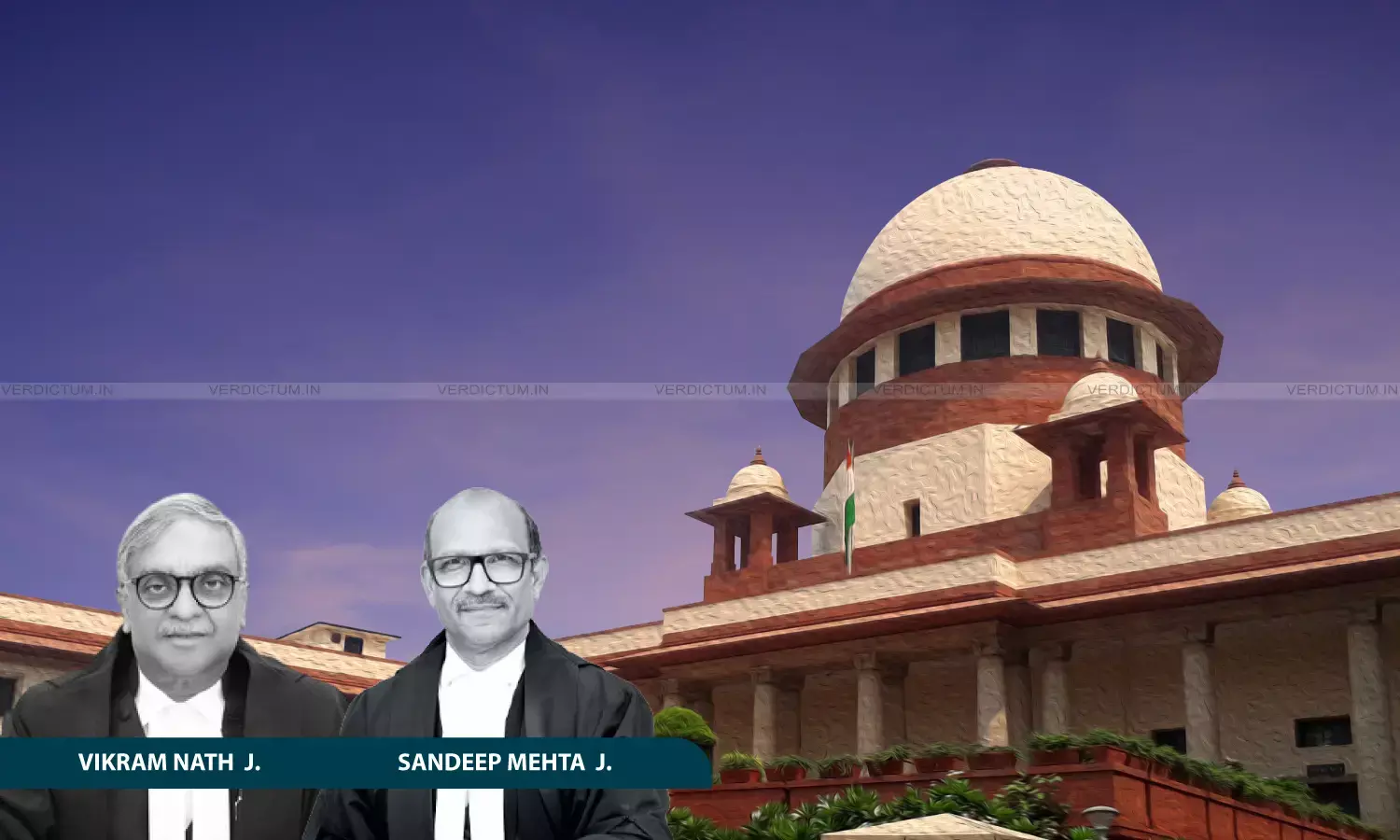
Justice Vikram Nath, Justice Sandeep Mehta, Supreme Court
The Supreme Court has held that excluding employees appointed on an “academic arrangement” basis from consideration for regularisation under Section 3(b) Jammu and Kashmir Civil Services (Special Provisions) Act, 2010 is unconstitutional and violative of Articles 14 and 16 of the Constitution of India. In the judgment the Bench criticising the manner in which the State proceeded, remarked that a ‘State is expected to act as a model employer and not as a hard-bargaining or avaricious negotiator’.
The Division Bench allowed a batch of appeals filed by paramedical staff including staff nurses and female multipurpose health workers who had been appointed in government medical institutions under the Jammu and Kashmir Medical and Dental Education (Appointment on Academic Arrangement Basis) Rules, 2009 (SRO 384). Their claim for regularisation had earlier been rejected by the Jammu & Kashmir and Ladakh High Court.
Justice Vikram Nath and Justice Sandeep Mehta observed, “The State is expected to act as a model employer and not as a hard-bargaining or avaricious negotiator. We deem it appropriate to record our serious disapproval of the manner in which the respondent-State proceeded to issue the impugned SRO of 2009…To compound the matter, when the respondent-State did eventually act in the manner expected of a responsible employer by enacting the 2010 Act providing for regularisation of services, it once again carved out an exclusion by wholly denying appointees engaged on an academic arrangement basis the benefit of regularisation. Such a classification rests on considerations alien to settled constitutional jurisprudence and the equality mandate. By creating two categories, one comprising appointees on an academic arrangement basis and the other consisting of those engaged on a contractual, ad hoc or consolidated basis, the respondent-State has failed to establish any reasonable nexus between the classification and the object sought to be achieved by extending the benefit of regularisation to the latter category alone”.
“Accordingly, we have no hesitation in holding that the respondent-State has not only failed to demonstrate any distinction in the nature of duties discharged by the appellants, but has, by engrafting the impugned exception in the 2010 Act, subjected the present appellants to invidious discrimination, thereby infringing their fundamental right to equality”, it noted further.
Advocate Brajesh Pandey appeared for the appellant Advocate G.M. Kawoosa appeared for the respondent.
The Court noted that the 2010 Act was enacted to regularise long-standing irregular appointments and provide protection to employees who had been working for extended periods against substantive posts. However, the Act expressly excluded employees appointed on an academic arrangement basis from its ambit.
The Court emphasised that once the statutory conditions for regularisation under Section 5 of the 2010 Act, including completion of the requisite period of service, are satisfied, the nature or nomenclature of the initial appointment becomes irrelevant.
The Court held that mere nomenclature of appointment cannot determine constitutional rights. It noted that Employees engaged on an “academic arrangement” basis, when performing duties and working under conditions similar to those appointed on ad hoc, contractual, or consolidated terms, cannot be denied equal treatment solely because of the label attached to their engagement, as such classification would violate Article 14 of the Constitution of India.
The Court further ruled that the exclusion of such employees under the Act was arbitrary and failed the test of reasonable classification, as it lacked an intelligible differentia and had no rational nexus with the Act’s objective of regularising long-standing irregular appointments. It clarified that once employees satisfy the statutory conditions for regularisation under Section 5, the nature of their initial engagement becomes irrelevant, and the State, as a model employer, cannot create artificial classifications to deny them the benefit of regularisation under Articles 14 and 16 of the Constitution of India.
The Bench, thus, holding the exclusion unconstitutional, directed the State of Jammu and Kashmir to consider the appellants’ cases for regularisation within four weeks in accordance with the Act, without relying on the label of “academic arrangement” in their appointments.
Cause Title: Abhishek Sharma & Ors. v. The State Of Jammu And Kashmir & Ors. [Neutral Citation: 2026 INSC 220]
Appearances:
Appellant: Brajesh Pandey, Kanchan Kumar Jha, Paramhans Sahani, M/S. Brajesh Pandey & Associates, AOR. Anilendra Pandey, AOR, Advocates.
Respondent: G.M. Kawoosa, Pashupathi Nath Razdan, AOR, Advocate.