

Order Passed In Writ Jurisdiction Without Impleading Affected Or Necessary Party Is Liable To Be Invalidated On That Ground Alone: Supreme Court
The appellant had approached the Supreme Court challenging the judgment of the Allahabad High Court.

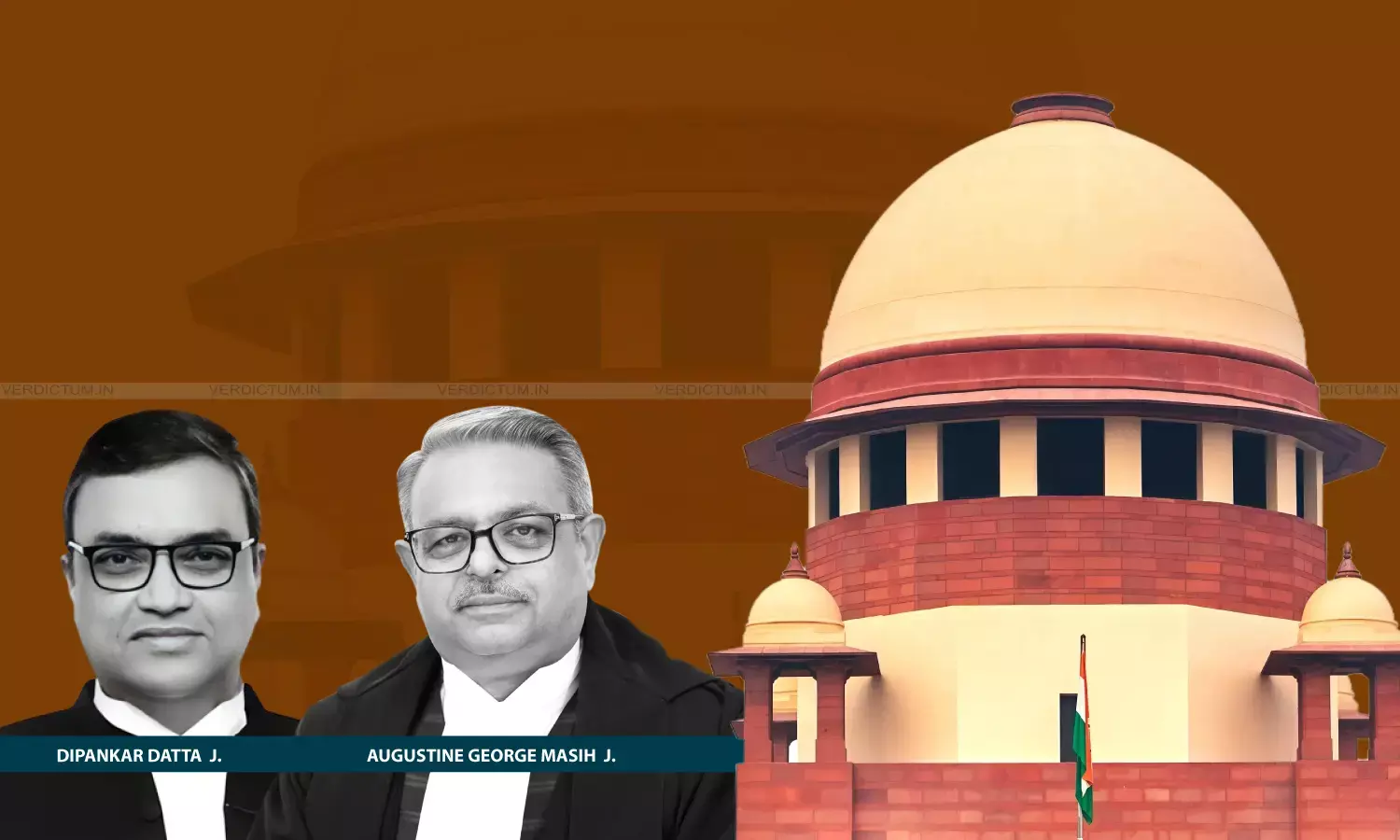
Justice Dipankar Datta, Justice Augustine George Masih, Supreme Court
In a civil case where a litigant raised the contention that he was not given an opportunity of hearing, the Supreme Court has held that an order passed in writ jurisdiction without impleading an affected or necessary party is liable to be invalidated on that ground alone. The Apex Court also held that where an allegation of nonjoinder of a necessary party is raised in an intra-court appeal, the High Court, if satisfied that such an allegation has merit, should either remand the matter to the Single Judge or decide it on the merits.
The appellant had approached the Apex Court challenging the judgment of the Allahabad High Court.
The Division Bench of Justice Dipankar Datta and Justice Augustine George Masih held, “In the circumstances before us, the bar created by Rule 5 must yield to the foundational principles of natural justice, namely, the right to be heard and the right to a fair hearing. It is trite law that the principle of non-joinder, though originating from the Code of Civil Procedure, 1908, applies with equal force to writ proceedings. An order passed in writ jurisdiction without impleading an affected or necessary party is liable to be invalidated on that ground alone. Since the courts exist to administer justice, the rigours of Rule 5 would not apply and stand relaxed in a case of the present nature where the order under challenge is one, passed by a Single Judge on a petition under Article 226 of the Constitution, adversely affecting the rights of a party who was not a party-respondent before the Single Judge.”
“For the foregoing reasons, we hold that where an allegation of nonjoinder of a necessary party is raised in an intra-court appeal, the High Court, if satisfied that such allegation has merit, should either remand the matter to the Single Judge or decide it on the merits. Such an approach while not militating against the object and purpose of Rule 5 would, at the same time, accord with the maxim ubi jus, ibi remedium”,it added.
AOR Pranav Krishna represented the Appellant, while AOR Sanjeev Malhotra represented the Respondent.
Factual Background
The Appellant was allotted, by grant of a license, a fair price shop in place of the first respondent, upon revocation of the license of such respondent on the ground of breach of lawful terms and conditions. The license was revoked and the appellate order reaffirming such revocation were the subject matter of challenge in a writ petition presented by the first respondent before the Allahabad High Court. In such writ petition, the appellant was not impleaded as a party. The writ petition of the first respondent came to be allowed by a Single Judge. The order revoking the license of the respondent stood set aside. In pursuance of such order, the respondent was required to be reinstated as a fair price shop licensee by the official respondents.
The appellant approached a Division Bench of the High Court with an intra-court appeal. His complaint was that the order passed by the Single Judge prejudicially affected his interest, without him being given an opportunity of hearing. Such appeal was dismissed by the Division Bench as not maintainable, placing reliance on Chapter VIII Rule 5 of the Allahabad High Court Rules, 1952 and a Full Bench Judgment in Sheet Gupta v. State of U.P. (2010). The appellant was granted liberty to apply for a review of the judgment before the Single Judge. In the appeals, before the Apex Court, the appellant had questioned the judgment of the Division Bench as well as the order of the Single Judge.
Reasoning
On a perusal of the impugned judgment of the Division Bench, the Bench found that it neither reproduced Rule 5 of Chapter VIII of the 1952 Rules nor adverted to the specific answer given by the Full Bench in Sheet Gupta (supra) to the question which was referred. “On a plain reading of Rule 5, the Special Appeal of the appellant would appear to be barred. However, there is much more than what is plainly visible. In our considered opinion, the Special Appeal ought not to have been held not maintainable for the reasons we propose to assign”, it added.
The Bench noted that in Sheet Gupta (supra), the Full Bench in course of answering the reference had not been called upon to examine whether an appeal with an application seeking leave to appeal, by a nonparty to a writ petition under Article 226, would or would not be maintainable if the order - appellate or revisional - under challenge in such petition is passed by the Government or officer or authority under a Central/State legislation. “Since this was not a question which the Full Bench was required to examine, whatever has been laid down in Sheet 5 Gupta (supra) on interpretation of Rule 5 may not be decisive in a situation under consideration. This aspect of the matter escaped the attention of the Division Bench which, erroneously, dismissed the appeal as not maintainable”, it stated.
The Bench noted although Rule 5 ordains that no Special Appeal shall lie from an order passed by a Single Judge of the High Court in writ proceedings under Article 226 of the Constitution where an appellate/revisional order of the Government or any officer or authority under any of the specified enactments is under challenge, Rule 5 has to be read and understood in a manner that advances the cause of “access to justice” and not thwart it. The Bench held, “In our further considered opinion, the law laid down by this Court in Smt. Jatan Kanwar Golcha v. Golcha Properties (P) Ltd. and State of Punjab v. Amar Singh that an appeal could be preferred with an application for leave to appeal, provided the non-party appellant demonstrates that either the order under challenge is prejudicial to his interest or adversely affects him or is binding on him, would be applicable.”
“Also, the maxim ubi jus, ibi remedium cannot be ignored. A party suffering an adverse order in judicial proceedings where he is not noticed, because he was not a party, cannot be left without a remedy. Although he can apply for a review, the scope of a review is much narrow than an appeal and would not provide a remedy as effective as an appeal”, the order read.
The Bench also noticed that the appellant, by way of abundant caution, had appealed against the judgment of the Single Judge. Thus, setting aside the impugned judgment and order of the Division Bench and restoring the Special Appeal of the appellant to its original file and number, the Bench ordered, “The same may now be heard by the Division Bench and disposed of expeditiously, since we are not inclined to allow the appellant to run the fair price shop for the present.”
Cause Title: Abhishek Gupta v. Dinesh Kumar (Neutral Citation: 2025 INSC 1406)
Appearance
Appellant: AOR Pranav Krishna, Advocates Lavam Tyagi, Srishti Mayank
Respondent: AOR Sanjeev Malhotra, Advocates Ashwin Vaish, Vinod Pandey, AOR Ashutosh Thakur, Himanshu Pandey, Sandeep Yadav, Ritu Pandey, Uttam Panwar
HC can decide on allegation of nonjoinder of necessary party: SC
In a civil case where a litigant raised the contention that he was not given an opportunity of hearing, the Supreme Court has held that where an allegation of nonjoinder of a necessary party is raised in an intra-court appeal, the High Court, if satisfied that such an allegation has merit, should either remand the matter to the Single Judge or decide it on the merits.