

Object Of Muslim Women (Protection Of Rights On Divorce) Act Aligns With Article 21: Supreme Court Allows Wife's Appeal Seeking Return Of Gold & Cash Given To Husband
The appeals before the Supreme Court were filed against the judgment passed in an application for modification by the Calcutta High Court at the instance of a divorced muslim woman.

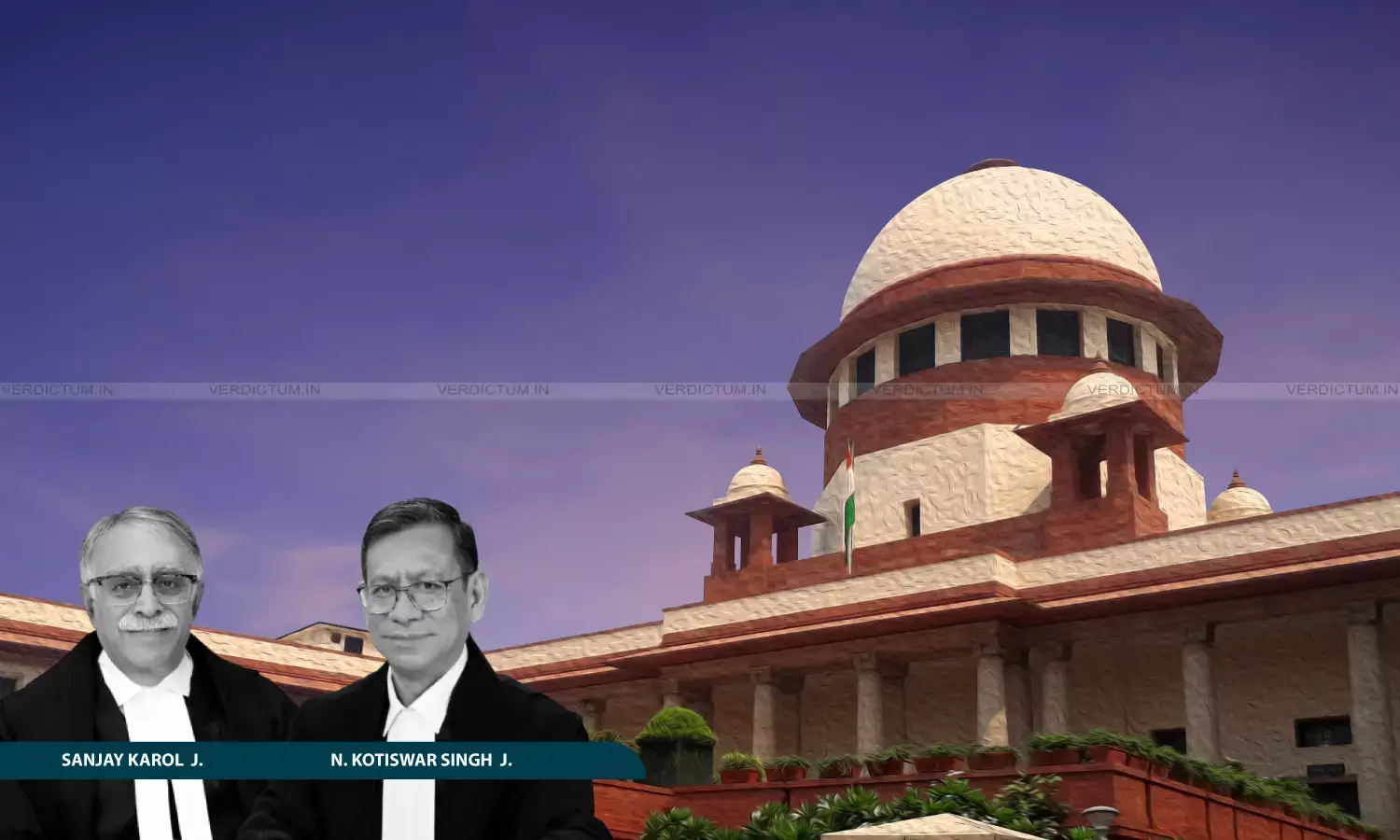
Justice Sanjay Karol, Justice Nongmeikapam Kotiswar Singh, Supreme Court
While allowing an appeal filed by a divorced muslim woman seeking the return of gold and cash given by her father to her husband at the time of marriage, the Supreme Court has held that the object of Muslim Women (Protection of Rights on Divorce) Act, 1986 is concerned with securing the financial protection of a Muslim women post her divorce which aligns with the rights of a women under Article 21 of the Constitution.
The appeals before the Apex Court were filed directed against the judgment passed in an application for modification by the Calcutta High Court at the instance of the Appellant, who is the former wife of the first Respondent.
The Division Bench of Justice Sanjay Karol and Justice Nongmeikapam Kotiswar Singh held, “To put it in context, the scope and object of 1986 Act is concerned with securing the dignity and financial protection of a Muslim women post her divorce which aligns with the rights of a women under Article 21 of the Constitution of India. The construction of this Act, therefore, must keep at the forefront equality, dignity and autonomy and must be done in the light of lived experiences of women where particularly in smaller towns and rural areas, inherent patriarchal discrimination is still the order of the day.”
AOR Syed Mehdi Imam represented the Appellant, while Advocate Kumud Lata Das represented the Respondent.
Factual Background
The parties got married on August 28, 2005. Differences arose shortly thereafter, and the Appellant departed from her matrimonial home in 2009. She filed an application under Section 125 of the Code of Criminal Procedure, 1973 and initiated proceedings under Section 498-A of the Indian Penal Code, 1860. The marriage eventually ended in divorce, after which she approached the Court under Section 3 of The Muslim Women (Protection of Rights on Divorce) Act, 19865, seeking the return of a total of Rs 17,67,980.
The appellant claimed that she was entitled to receive the amount from the opposite party, which included the dower amount, dowry, gold ornaments, the value of the fridge and stabiliser, TV and other items. The CJM allowed the application and granted a total of Rs 8.3 lakh. Both parties preferred revision petitions before the Session Judge, who remanded the matter for a fresh consideration. The Additional Chief Judicial Magistrate held that the proof of marriage, the original qabilnama and the inability of the opposite party to disprove the entry in question made the opposite party liable to return the 7 lakh and 30 bhories gold to the appellants. Aggrieved thereby, the respondent preferred a Criminal Revision, which was dismissed. The Respondent went before the High Court under Article 227 of the Constitution, and his petition was allowed. Aggrieved thereby, the appellant approached the Apex Court.
Reasoning
Referring to Section 3(1) of the 1986 Act, the Bench explained that the Section deals with mehr/dower and/or other properties given to a woman at the time of her marriage clearing the way for the woman to set up a claim against her husband in the above situations, or claim back from her husband properties given, as the case may be.
The Bench noted that the High Court’s primary basis for not giving the amount and gold in question to the appellant was the apparent contradiction between the statement of the Kazi, i.e. marriage Registrar and the father of the appellant. The former stated in evidence that the entry recording the amount and gold being given to the husband was erroneously done so and it should have been that the said amounts were only given without specifying to whom. The father of the appellant stated that he had given the amounts in question to the respondent. The High Court observed that since the father was directly responsible for giving the said amounts, it would be prudent to accept his version of events. “What, apparently, the High Court lost sight of is the end result of the proceedings in which the said statement of the father was given”, it added.
The Bench noticed that the High Court recorded that the latter statement regarding writing and overwriting in the entry in the marriage register was proved by him having produced the same before the Court. “Mere allegation as to his conduct being suspicious on account of overwriting in the marriage register is not sufficient to discard his testimony”, it added.
The Bench observed, “This case presents the possibility of two interpretations and whereas it is a settled rule that this Court under its plenary, Article 136 jurisdiction does not interfere with the findings of the High Court simply because there are two views possible, this case, in our considered view, does not fall under this exception for the High Court missed the purposive construction goalpost and instead proceeded to adjudicate the matter purely as a civil dispute. The Constitution of India prescribes an aspiration for all, i.e. equality which is, obviously, yet to be achieved. Courts, in doing their bit to this end must ground their reasoning in social justice adjudication.”
Thus, allowing the appeal and setting aside the order of the High Court, the Bench ordered, “Learned Counsel for the Appellant would supply the bank and other relevant details to the learned counsel for the respondent within three working days from the date of this judgment. The amount be directly remitted into the bank account of the Appellant.”
Cause Title: AB v. XY (Neutral Citation: 2025 INSC 1375)
Appearance
Appellant: AOR Syed Mehdi Imam, Advocates Mohd Parvez Dabas, Uzmi Jamil Husain, Tabrez Ahmad, Pooja Kumari, S Prasada Rao
Respondent: Advocates Kumud Lata Das, Sukesh Ghosh, AOR Sadhana Sandhu, Advocates Pooja Rathore, Siddhant N. Das, AOR Kunal Mimani, Advocate Shraddha Chirania