

Lone Allegation Of Quarrel Can’t By Itself Attract Offence U/S.498A IPC & Dowry Act: Supreme Court Grants Relief To Parents-In-Law
The Supreme Court was considering an appeal filed against the judgment of the Patna High Court refusing to quash criminal proceedings against the father-in-law and mother-in-law of a woman in a dowry harassment case.

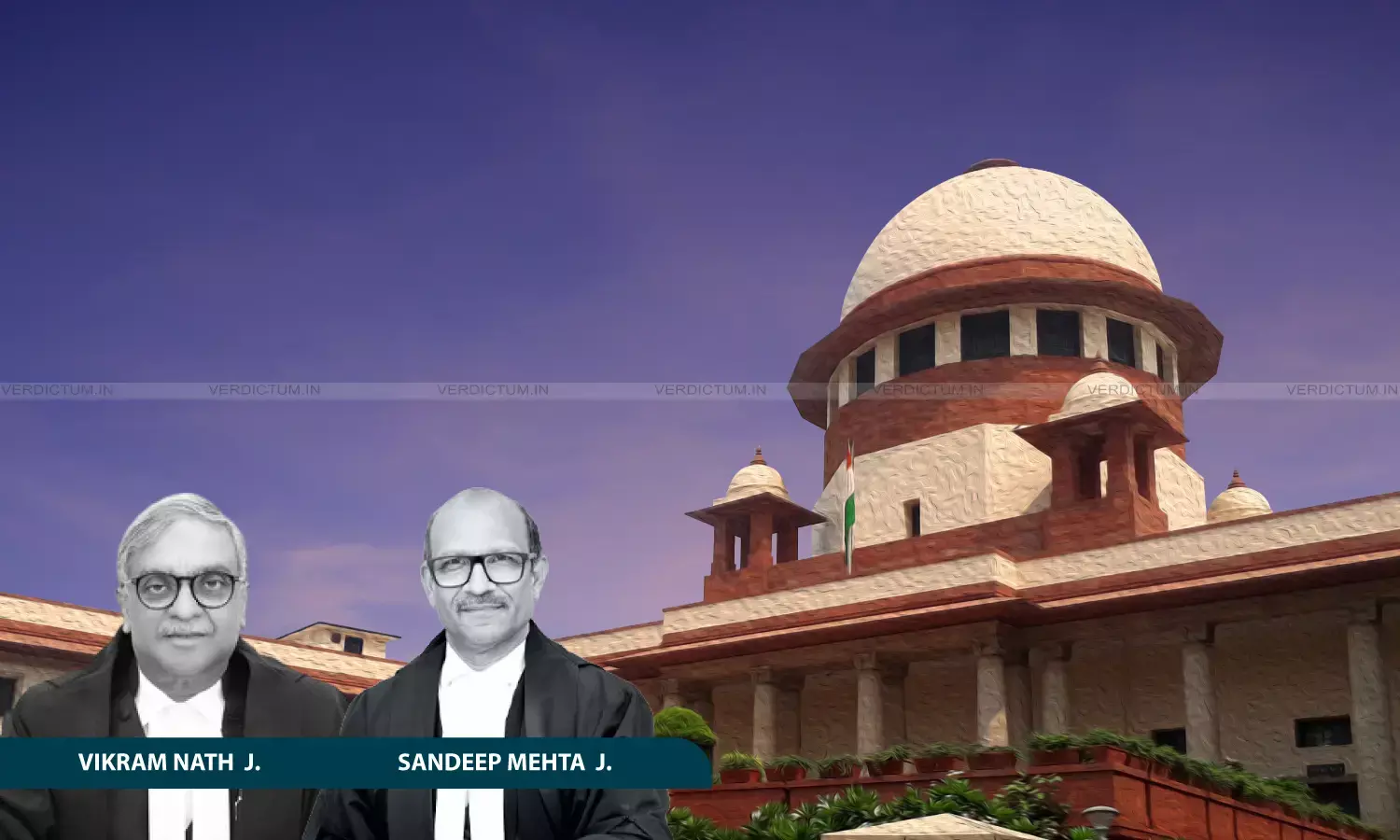
Justice Vikram Nath, Justice Sandeep Mehta, Supreme Court
The Supreme Court has quashed cruelty and dowry harassment proceedings against the parents-in-law of a woman after noting the absence of any specific or overt act attributed to them. The Apex Court held that the lone allegation of quarrel would not by itself, sustain cognizance of the offences under Section 341, 323, 498A & 34 of the IPC and Sections 3 & 4 of the Dowry Act.
The Apex Court was considering an appeal filed against the judgment of the Patna High Court quashing the criminal proceedings against the sister-in-law of the complainant (one of the accused persons), while declining to extend the same relief to the other accused-appellants, who are the father-in-law and mother-in-law of the complainant.
The Division Bench of Justice Vikram Nath and Justice Sandeep Mehta held, “A comparative reading of the FIR reveals that the allegations levelled against the sister-in-law and those against the present appellants are, in all material particulars, identical. The FIR does not assign any specific or overt act to either appellant; there are no particular dates, places, or individual acts attributed to them. The lone allegation that stands separately against the present appellants is that they would quarrel. This, however, does not constitute a criminal offence and cannot, by itself, sustain cognizance of the offences under Section 341, 323, 498A & 34 of the IPC and Sections 3 & 4 of the Dowry Act for which the appellants have been summoned.”
AOR Rohit Kumar Singh represented the Appellant while Senior Advocate Bharat Sangal represented the Respondent.
Factual Background
The complainant married the son of the appellants in 2019. On March 31, 2021, the husband instituted a divorce petition against the complainant under Section 13 of the Hindu Marriage Act, 1955. On March 18, 2022, the complainant submitted a written report, on the basis of which First Information Report was registered under Sections 341, 323, 498A and 34 of the Indian Penal Code, 18603, and Sections 3 and 4 of the Dowry Prohibition Act, 1961, against the husband, the two appellants, and the sister-in-law. The complainant alleged that, soon after the marriage, she was subjected to persistent torture and cruelty, particularly on account of demands for a luxury car and other valuable articles, which she was unable to fulfil.
It was further alleged that the husband physically assaulted her, and the accused persons, acting in concert, tied a sheet around her neck and strangulated her one day with the intent to cause her death. The Judicial Magistrate took cognizance of offences under Sections 341, 323, 498A and 34 of the IPC and Sections 3 and 4 of the Dowry Act against the husband, the appellants herein, and the sister-in-law. The appellants, along with the sister-in-law , filed a petition under Section 482 of the Code of Criminal Procedure, 1973 seeking quashing of the cognizance order. The High Court, by the impugned order, partly allowed the petition for quashing, but only insofar as the sister-in-law of the complainant was concerned. Aggrieved thereby, the complainant’s parents-in-law approached the Apex Court.
Reasoning
On a perusal of the facts of the case, the Bench noted that the FIR did not assign any specific or overt act to either appellant and the sole allegation of quarrel alone did not constitute a criminal offence. “The standard applied by the High Court in quashing proceedings against the sister-in-law, on the ground that the allegations against her were general and omnibus, applies with equal force to the present appellants, and there is no principled basis for distinguishing between them”, it added.
The Bench also noticed that the marriage was solemnised in July 2019, and the husband filed the divorce petition as early as March 2021. The criminal complaint against the appellants was, however, lodged only in March 2022, nearly a year after the filing of the divorce petition.
The Bench thus stated, “Though this delay, standing alone, would not constitute a sufficient ground for quashing the criminal proceedings against the appellants. However, viewed in conjunction with the absence of any specific allegations attributable to them, the delay lends credence to the submission that the criminal complaint against the in-laws may have been instituted by way of a counter-blast to the divorce proceedings initiated by the husband.”
Considering that the allegations against the appellants and the sister-in-law were, in substance, the same, the Bench held that the reasoning that led the High Court to quash the proceedings against the sister-in-law ought equally to have led to the quashing of proceedings against the appellants.
Thus, allowing the appeal and setting aside the impugned order, the Bench quashed all proceedings insofar as the appellants were concerned. “The criminal proceedings against the husband shall continue in accordance with law”, it ordered.
Cause Title: A v. State Of Bihar (Neutral Citation: 2026 INSC 212)
Appearance
Appellant: AOR Rohit Kumar Singh, Advocates Lal Babu Singh, Rana Prashant, Akash Kumar, Mahender Rathour
Respondent: Senior Advocate Bharat Sangal, Advocate Hemant Kumar Tripathi, AOR Nagarkatti Kartik Uday, Addl. Standing Counsel Anshul Narayan, Advocates Vineeta Singh, Anshuman Harsh, AOR Prem Prakash