

Report Of ICC Constituted Under POSH Act Can Be Challenged Before Armed Forces Tribunal: Supreme Court Restores Application
The Supreme Court was of the view that the Armed Forces Tribunal ought to have considered the correctness of the report in accordance with law.

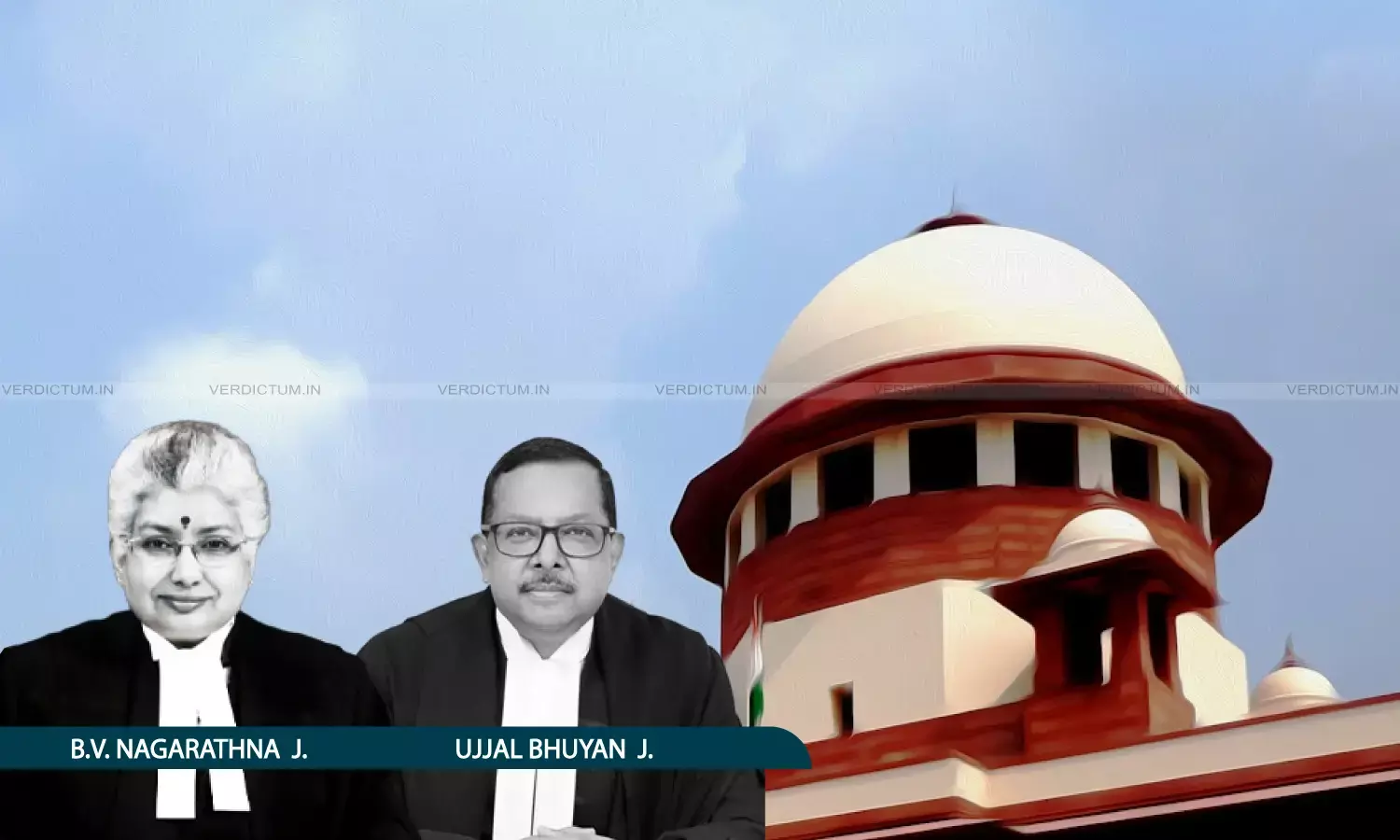
While restoring an original application filed by a Naval Officer, the Supreme Court has held that the Officer had rightly approached the Armed Forces Tribunal to assail the report as well as the recommendations of the Internal Complaints Committee (ICC) constituted under the POSH Act.
The Apex Court was of the view that the Armed Forces Tribunal ought to have considered the correctness of the report in accordance with law.
The Appeal before the Apex Court was filed against the judgment of the Delhi High Court.
The Division Bench of Justice B.V. Nagarathna and Justice Ujjal Bhuyan held, “Section 14 of the AFT Act, 2007 when read in juxtaposition with Section 18 of the POSH Act, we find that the appellant herein had rightly approached the Tribunal so as to assail the report as well as the recommendations of the ICC. The Tribunal ought to have considered the correctness of the said report in accordance with law. The Show Cause Notice dated 05.03.2025 was premised on the basis of the recommendations of the ICC.”
Senior Advocate Sanjiv Sen represented the Appellant, while ASG Vikramjeet Banerjee represented the Respondent.
Factual Background
The appellant was commissioned in the Indian Navy on January 1, 2006 and subsequently promoted to the rank of Commander. He later joined INS Shakti as Commander (Engineering) in April 2022. The Complainant who was working as a Principal Medical Officer wrote a letter to the Commanding Officer, INS Shakti alleging that the appellant, during the course of his deployment, committed acts of sexual harassment against her on different occasions and in pursuance to the said complaint, the Internal Complaints Committee (ICC) was constituted under the Sexual Harassment of Women at Workplace (Prevention, Prohibition and Redressal) Act, 2013 (POSH Act). A report was submitted recommending that appropriate action be initiated against the appellant. Based on the findings and recommendations of the ICC report, a show-cause notice was issued to the appellant.
Being aggrieved by the report, the recommendations made by the ICC constituted by the respondents and the Show Cause Notice, the appellant filed an Original Application before the Armed Forces Tribunal, Principal Bench, New Delhi, but the same was dismissed. Being aggrieved by the said order, the appellant preferred a writ petition. The Division Bench of the Delhi High Court, while dismissing the Writ Petition, held that the appeal against the recommendations of the ICC, as envisaged in Section 18 (1) of the POSH Act, was not available to the petitioner.
Reasoning
The Bench took note of the fact that the Show Cause Notice was premised on the ICC’s report and on certain incidental findings of the ICC. The Bench explained that the power under Section 15 of the Navy Act, read with Regulation 216 of the Regulations for the Navy Part-II (Statutory), could be exercised, on foundational facts which include meaningful consideration of the report of the officer’s misconduct. Secondly, the Government or the Chief of Naval Staff is satisfied that the trial of the officer by a court-martial is inexpedient or impracticable; and thirdly, there must be an opinion formed that further retention of the said officer in the service is undesirable.
The Bench further explained that the Government after considering the report and the officer’s defence and the recommendation of the Chief of the Naval Staff, may dismiss or discharge the officer with or without pension or call upon him to retire or resign and on his refusing to do so, the officer may be compulsorily retired or discharged from the service on pension or gratuity, if any, admissible to him.
Section 18 of the POSH Act provides that if there is an adverse recommendation made by the ICC under Section 13(3)(i), an appeal could be made to the Court or the Tribunal in terms of the service rules. The Bench made it clear that Regulation 216 is general in nature vis-à-vis any complaint that could be made against a naval officer or other persons serving the Navy. However, Section 18 is specific since it is under a special enactment which enables a person who intends to assail the report and recommendations of the ICC to proceed under that provision to the Tribunal by filing an appeal under Section 18 of the POSH Act. The appellant had done so in the instant case.
As per the Bench, the High Court was not right in holding that the appellant had no right under Section 18 of the POSH Act. “We find that the Tribunal has not adjudicated the appeal filed by the Tribunal in terms of the Section 18 of the POSH Act read with Section 14 of the AFT Act, 2007 but has primarily proceeded on the basis that what was in issue was essentially the Show Cause Notice dated 05.03.2025 and this was at a preliminary stage of the proceedings, whereas the appeal under Section 18 of POSH Act was the subject matter of OA No.1024 of 2025”, it added.
Cause Title: 42605-B CDR Yogesh Mahla v. Union of India (Neutral Citation: 2026 INSC 107)
Appearance
Appellant: Senior Advocates Sanjiv Sen, Rajshekhar Rao, AOR Akshay Bhandari, Advocates Col Mukul Dev, Shriya Gilhotra, Prahalad Balaji, Parimal Rai, Radha Gupta, Jharna Singh, Simran Gupta, Advocates Gauri Puri, Harshil Wason, Kashish Bhardwaj, AOR Yadav Narender Singh
Respondent: ASG Vikramjeet Banerjee, Senior Advocate Nachiketa Joshi, AOR Mukesh Kumar Maroria, Advocates Aditya Kashyap, Santosh Kumar, P.V. Yogeswaran, ASG Archana Pathak Dave, Advocates Shubhendu Anand, Rajan Kumar Chourasia, Vatsal Joshi, Ishaan Sharma, AOR Arvind Kumar Sharma, AOR Hrishikesh Baruah, Advocates Yashaswy Ghosh, Kshitij Singh, Pragya Agarwal, Nistha Sachan