

Supreme Court: Generation-Based Incentives Must Be Paid To Wind Power Producers Over And Above Fixed Tariffs
The Court held that while Regulatory Commissions have plenary power over tariff determination, they cannot exercise authority in a manner that nullifies the policy intent of Union Government grants.

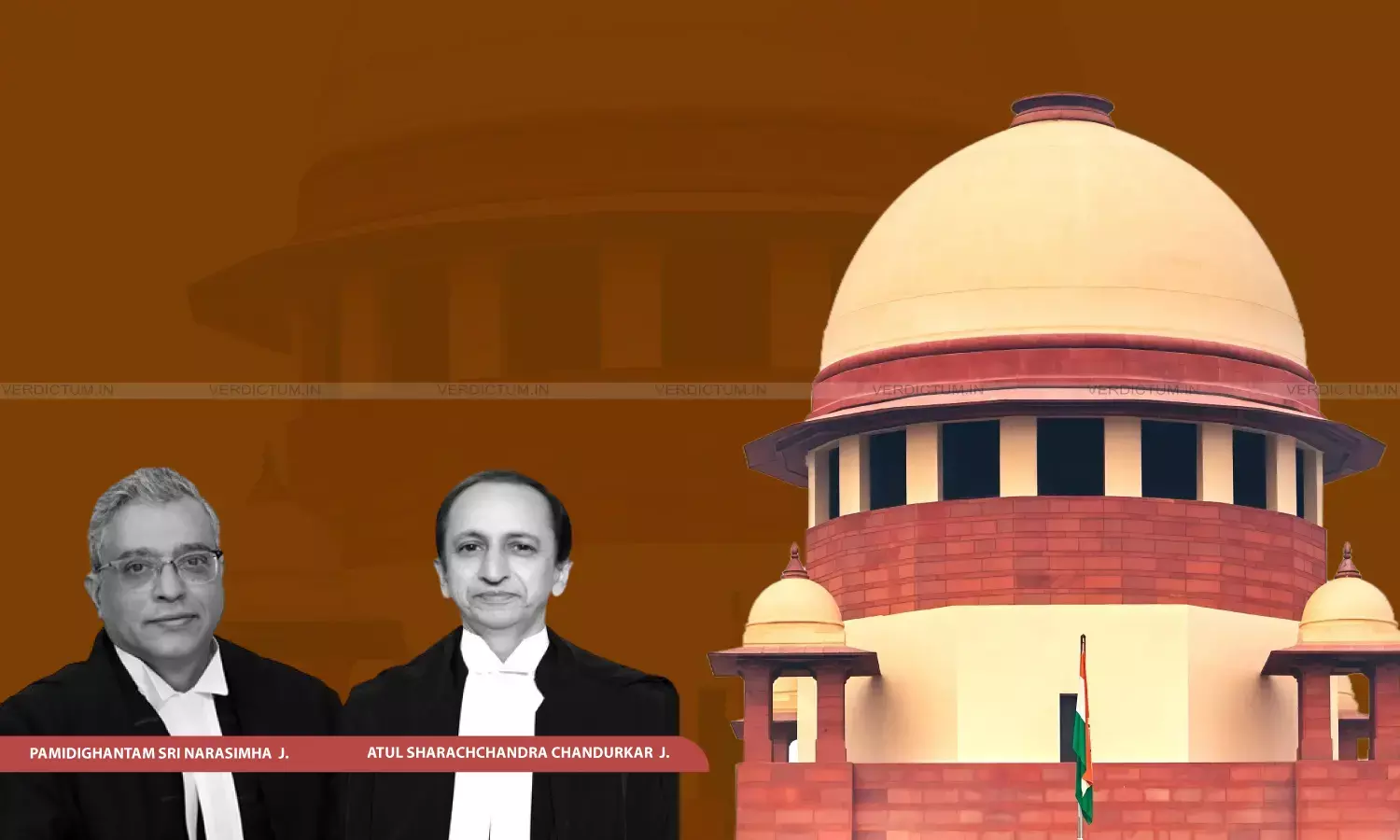
Justice Pamidighantam Sri Narasimha, Justice Atul S. Chandurkar, Supreme Court
The Supreme Court has dismissed an appeal by Andhra Pradesh DISCOMs, affirming that the Generation-Based Incentive (GBI) is intended to be a performance-linked benefit disbursed to generating companies (GENCOs) over and above the determined tariff.
Formulating the doctrine of "Regulation as a Collaborative Enterprise," the Bench observed that while State Electricity Regulatory Commissions (SERCs) possess exclusive and plenary jurisdiction over tariff determination—leaving no "unallocated regulatory residue"—this power must be exercised in cohesion with other stakeholders, including the Ministry of New and Renewable Energy (MNRE).
The Bench of Justice Pamidighantam Sri Narasimha and Justice Atul S Chandurkar observed two principles, “i) Regulatory Commissions have plenary power over tariff determination and there is no unallocated regulatory residue remaining outside its power to determine tariff. The argument that Regulatory Commissions do not have the power to take into account a Grant made by the Central Government under Article 282 is rejected. Tariff determination is the exclusive province of the Regulatory Commissions. ii) However, this regulatory power must be exercised as a collaborative enterprise. It must not be exercised in a manner that ignores the purpose and object of a policy or grant by other stakeholders.”
Senior Advocate Nidhesh Gupta appeared for the Appellants, while Senior Advocate Basava Prabhu S Patil, Senior Advocate Shyam Divan, and Senior Advocate Aditya Sondhi appeared for the Respondents.
The Court held that the APERC erred in treating the GBI as a factor for tariff deduction, ruling instead that such incentives are vital instruments for meeting India’s international climate commitments under the Paris Agreement. By protecting the GBI from being converted into a consumer subsidy, the Court ensured that the legislative and policy intent to attract investment in the renewable energy sector remains subserved.
Facts of the Case and the Impugned Judgment
The Ministry of New and Renewable Energy (MNRE) originated from the 1970s energy crisis, evolving from the Commission for Additional Sources of Energy (CASE) in 1981 to a full-fledged Ministry in 1992. Tasked with transitioning India toward sustainable power, the MNRE introduced the Generation Based Incentive (GBI) scheme via Notification dated 17.12.2009. The GBI was designed as a promotional incentive of ₹0.50 per unit (capped at ₹62 lakhs per MW) to attract independent power producers. Crucially, the scheme stipulated that this incentive was "over and above" the tariff fixed by State Regulatory Commissions and was mutually exclusive to the benefit of Accelerated Depreciation (AD).
In exercise of powers under Sections 61, 86, and 181 of the Electricity Act, 2003, the Andhra Pradesh Electricity Regulatory Commission (APERC) notified the 2015 Tariff Regulations. These regulations provided a comprehensive framework for "levelized generic preferential tariff" determination. Regulation 20 of the said notification mandated that the Commission "shall take into consideration" any subsidy or incentive offered by the Central or State Government (including AD benefits) while determining the tariff for wind power projects.
Initially, APERC issued Tariff Orders in 2015 and 2016 without factoring in the GBI benefits availed by Power Generating Companies (GENCOs). Upon a petition filed by Distribution Companies (DISCOMs), the APERC, vide Order dated 28.07.2018, permitted the deduction of GBI amounts from the monthly bills. The Commission held that: 1. Regulation 20 is mandatory, and the word "shall" necessitates the factoring of all incentives to protect consumer interest. 2. The Commission possesses the inherent power to amend, modify, or mold tariff orders under Section 64(6) of the Electricity Act to rectify an omission. 3. The GBI and AD benefits are functionally similar; since AD was deducted, failing to deduct GBI resulted in an unintended windfall for GENCOs.
On appeal by the GENCOs, the Appellate Tribunal for Electricity (APTEL) set aside the APERC’s order, directing a refund of the deducted amounts with 12% interest. The APTEL’s reasoning was anchored on the following legal principles: 1. A levelized tariff determined for the 25-year life of a project, followed by the execution of a Power Purchase Agreement (PPA), cannot be altered at the "mere asking" of DISCOMs absent exceptional statutory infringement. 2. The phrase "shall take into consideration" in Regulation 20 implies an exercise of discretion and "attentive thought," rather than a mandatory obligation to deduct the incentive from the tariff. 3. While Section 64(6) of the Electricity Act read with Section 21 of the General Clauses Act grants the power to amend, such power must be exercised within the four corners of the Regulations. Since the 2015 and 2016 Tariff Orders were passed with conscious knowledge of the GBI scheme, there was no "infringement" justifying a retrospective revision of the tariff.
Issues for Consideration
i) Scope and ambit of the SERC’s power and jurisdiction to determine tariff.
ii) Given the power and exclusive jurisdiction to determine tariff, what are the duties and obligations of the SERCs while determining tariff.
Observations of the Court
Regarding the First Issue, the Court held, “We are, therefore, of the considered view that the SERC does possess the power to take into consideration the benefit offered under GBI while determining tariff, provided, such exercise is within the statutory framework of the Electricity Act and the Regulations framed thereunder. The contrary proposition urged by the respondents would curtail the statutory power of the Commission. The issue no. 1 is accordingly answered by holding that the regulatory power of the SERC extends to considering and, where warranted, factoring into the tariff any incentive or subsidy availed by the GENCO, including those granted by the Union Government. The Commission’s authority in this regard flows directly from the Electricity Act and the Regulations framed thereunder and is not excluded by the mere existence of a Union grant.”
The Respondents argued that since the GBI is a grant from the Consolidated Fund of India under Article 282 (assented to by Parliament), its destination as a "generator incentive" cannot be altered by the SERC into a "consumer incentive." However, the Court found such a contention to be a "misconception." The prohibition under Article 114(2) relates to the appropriation process within Parliament. Once the grant is released and reaches the GENCO, it has achieved its intended destination. The grant does not enjoy "perpetual immunity" from the operation of other laws or regulatory oversight.
As regards the Second Issue, the Court held that the Electricity Act, 2003, contemplates a plurality of duty bearers (Union Government, State Governments, MNRE, and Regulators) who must work in "cohesion." While the Regulatory Commission is an independent and autonomous body, it is not expected to act in a "silo." Instead, it must adopt a collaborative approach to ensure that electricity—as a "public good"—remains affordable and accessible while fulfilling the social justice obligations of the State.
Under Section 61(h) of the Act, the Commission is legally obligated to promote renewable energy. The Court held that this statutory duty must be interpreted in light of India’s international commitments under the Paris Agreement and its Nationally Determined Contributions (NDCs). The transition from fossil fuels to green energy is not just a strategic goal but a "fundamental necessity" for environmental preservation. Therefore, regulators must ensure that their tariff decisions consistently promote investment in renewable sectors.
“Where environmental protection is weighed in to make electricity policy, it is necessary for regulators to take a holistic approach which balances competing interests without any sacrifices. Further, policy decisions taken on the basis of the national and international goals must be incorporated at various stages to ensure that investment in renewable energy is continually promoted”, it said.
The Court introduced a vital jurisprudential distinction between two models of regulation:
Regulation as Control: A traditional model where the regulator merely intervenes to correct market failures or prevent abuse, leaving social or distributive concerns entirely to the Government.
Regulation as Enterprise: A modern, proactive model where the regulator acts as a "Government in Miniature." In this view, economic efficiency and social distributive goals are inseparable. The Commission acts as a delegate of the Government’s inherent power to act in the "public interest," working as a collaborative partner with other state organs.
It was observed, “When the domain regulator acts in the larger interest and in coordination with other duty bearers under the Act and those responsible for development of the concerned sector, they coordinate with different stakeholders and work towards a common enterprise and for larger public purpose; this approach has the virtue of integrating and effectuating regulatory power in areas having social justice and/or environmental considerations.”
The Court emphasized that Regulators must maintain a "delicate balance" between competing values—such as the financial viability of utilities and the protection of consumer interests—without sacrificing the development of the renewable sector. Policy decisions made at national or international levels (like the GBI Scheme) must be integrated into the regulatory process. The Court held that it is the duty of the regulator to supplement and complement other stakeholders rather than contesting their initiatives from a solitary perspective.
The Court reaffirmed that since tariff determination is a highly specialized and technical task, Constitutional Courts must exercise restraint. Courts should not "fragment" regulation by taking certain aspects out of the regulator's scope. Instead, the legal system must enable the regulator to exercise "comprehensive and comprehensive jurisdiction" to ensure that sectoral laws are developed in a coordinated and systematic fashion.
Conclusion
The Court said that it restated that the Parliamentary allocation and grant of generator incentive does not ipso facto exclude the regulatory mechanism, nor does it denude the Regulatory Commission of its tariff determination power. However, while it was held that the Commission has the last word in the determination of tariff, we are in disagreement with its treatment of the GBI while determining the tariff in the present case. Regulatory authority cannot be exercised in a manner that nullifies the legislative or policy intent or the intent of the grant, just because the power and jurisdiction to determine tariff is exclusively vested in the Regulatory Commission.
“The electricity sector functions through the coordinated action of the Union Government, State Governments and independent Regulatory Commissions. The powers of these duty bearers must be read harmoniously so that each operates within their sphere without rendering the other irrelevant…For the reasons stated above, we are of the opinion that the APERC was obligated to apply GBI in furtherance of the purpose for which it was designed, that is, to incentivise renewable power generators and give the benefit as intended in the scheme”, it was observed.
With the declaration of the powers and jurisdiction of the Electricity Regulatory Commission in determination of tariff as indicated in the judgment, the Court dismissed the Civil Appeal filed against the judgment and order passed by the APTEL by holding that the GBI is intended to be disbursed to the GENCOs over and above the tariff.
Cause Title: Southern Power Distribution Company of Andhra Pradesh Limited & Anr. v. Green Infra Wind Solutions Limited and Ors. [Neutral Citation: 2026 INSC 294]
Appearances:
Appellant: Senior Advocate Nidhesh Gupta, Advocate on Record Tarun Gupta, Advocate Yelamanchili Shiva Santosh Kumar, Advocate Rudrajit Ghosh.
Respondents: Senior Advocate Basava Prabhu S Patil, Senior Advocate Shyam Divan, Senior Advocate Aditya Sondhi, Advocate on Record Alok Tripathi, Advocate on Record Nishtha Kumar, Advocate on Record Pukhrambam Ramesh Kumar, Advocate on Record Ag Veritas Law, Advocate on Record Dua Associates, Advocate on Record Sakya Singha Chaudhuri, Advocate on Record Geet Ahuja, Advocate on Record Krishna Dev Jagarlamudi, Advocate on Record Faisal Sherwani, Advocate on Record Gyan Prakash Srivastava, Advocate Aditya K Singh, Advocate Mridul Gupta, Advocate Vineet Gupta, Advocate Divyansh Singh, Advocate Dalima Gupta, Advocate Vishrov Mukerjee, Advocate Pratyush Singh, Advocate Damodar Solanki, Advocate Deepak Thakur, Advocate Hemant Sahai, Advocate Molshree Bhatnagar, Advocate Nipun Sharma, Advocate Rishabh Sehgal, Advocate Karun Shamra, Advocate Anupama Ngangom, Advocate Rajkumari Divyasana, Advocate Gaichangpou Gangmei, Advocate Arjun D. Singh, Advocate Maitreya Mahaley, Advocate Yimyanger Longkumer, Advocate Kamei Bestman Kabui, Advocate Chipika Zhimo, Advocate Avijeet Lala, Advocate Shreya Dubey, Advocate Astha Sharma, Advocate Astha Sehgal, Advocate Akshaya Babu, Advocate Chaitanya Ahuja, Advocate Purnima Chanana, Advocate Arpit Kumar Mishra, Advocate Vishnu Kanth Munda, Advocate Shadab Azhar, Advocate Shivam Rajpal, Advocate Ayush Chatterjee.