

Where Both Enactments Have Non-Obstante Clause, Then One Has To See Dominant Purpose For Which Special Act Was Made: Supreme Court
The Court held that the IBC and the Telegraph Act operated in distinct "legal provinces."

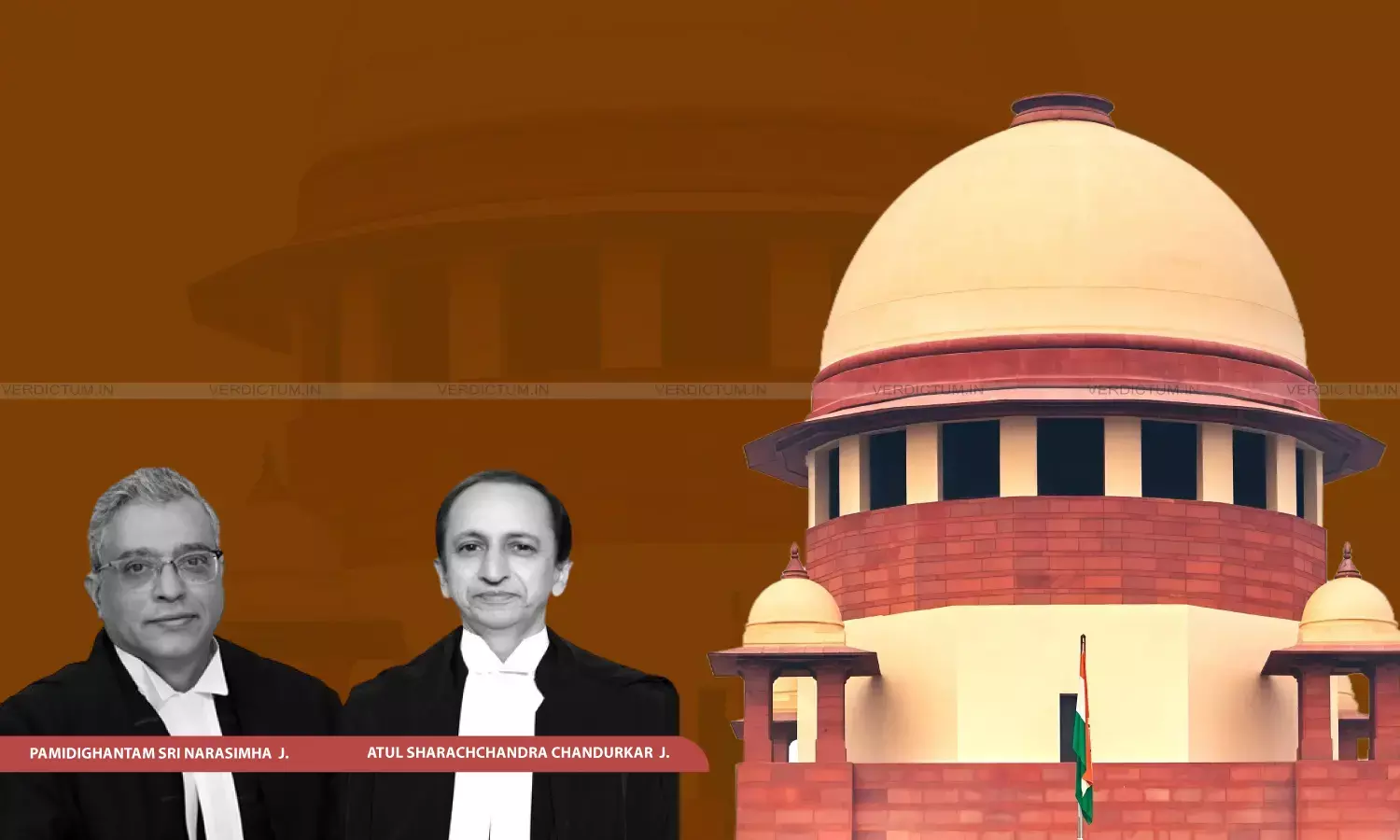
Justice Pamidighantam Sri Narasimha, Justice Atul S. Chandurkar, Supreme Court
The Supreme Court, while observing that IBC cannot be the guiding principle for restructuring the ownership and control of telecom spectrum, has also clarified that in a conflict between two statutes containing non obstante clauses, the Court must look to the "dominant purpose" and the specific subject matter of each enactment to determine legislative intent.
The Court also addressed the apparent conflict between the Insolvency and Bankruptcy Code (IBC), 2016, and the Indian Telegraph Act, 1885. The Court sought a "reconciliatory interpretation" to determine which law governed the right to use spectrum when a telecom company entered insolvency.
The Bench of Justice Pamidighantam Sri Narasimha and Justice Atul S. Chandurkar observed, “Where both the enactments have the non obstante clause then in that case, the proper perspective would be that one has to see the subject and the dominant purpose for which the special enactment was made and in case the dominant purpose is covered by that contingencies, then notwithstanding that the Act might have come at a later point of time still the intention can be ascertained by looking to the objects and reasons.”
Senior Advocate Gopal Jain, Senior Advocate Shyam Divan, and Senior Advocate Rakesh Dwivedi appeared for the Appellant, while Attorney General for India R. Venkataramani, Additional Solicitor General K.M Nataraj, and Senior Advocate Rakesh Dwivedi appeared for the Respondents.
Factual Background
The Aircel Group entities (the corporate debtors) were granted telecom licences by the Department of Telecommunications (DoT) in 2006. To fund their operations and acquire spectrum rights in various bands (900 MHz, 1800 MHz, and 2100 MHz), they secured massive loans from domestic lenders, led by the State Bank of India, totalling over ₹13,729 crores. However, the companies eventually failed to pay their requisite licence fees.
When the DoT attempted to recover the unpaid dues, the corporate debtors filed for voluntary insolvency under Section 10 of the Insolvency and Bankruptcy Code (IBC). The National Company Law Tribunal (NCLT) admitted these applications in March 2018, appointing a Resolution Professional. The DoT participated in the proceedings as a creditor, asserting claims of approximately ₹9,894 crores for unpaid licence fees and spectrum usage charges.
A resolution plan was eventually approved by the Committee of Creditors and sanctioned by the NCLT in June 2020. This prompted the DoT to appeal the approval before the NCLAT. During this period, a landmark Supreme Court judgment (the AGR case) clarified the definition of "Adjusted Gross Revenue," significantly increasing the liabilities of telecom companies. The Supreme Court expressed concern that companies were using the IBC to "wriggle out" of paying massive government dues by seeking a moratorium, which effectively wiped out those debts while paying only a fraction to the government as an "operational creditor."
The NCLAT eventually concluded that while spectrum was an intangible asset subject to insolvency, it was a natural resource held by the government in trust. Crucially, it ruled that the right to use spectrum could not be transferred without clearing past dues and that triggering insolvency with the "malicious intent" of avoiding government payments was impermissible. This led to a wave of appeals and cross-appeals by the State Bank of India, the Resolution Professionals, and the Union of India, all challenging different facets of the NCLAT's findings.
Contention of the Parties
Arguments of the Lenders and TSPs
The counsels for the banks and Resolution Professionals argued that the NCLAT reached contradictory conclusions. They contended that if spectrum usage rights were "assets" and DoT dues were "operational debt," then the government could not demand full payment of past dues to allow a transfer. They asserted that Section 238 of the IBC overrides all other laws and contracts, meaning the approved resolution plan should have wiped out old debts. They maintained that spectrum—while owned by the State—is a commercially exploitable asset that must be used to maximize value for all creditors, not just the DoT.
Arguments of the Union of India (DoT)
The Attorney General argued that spectrum is a sovereign natural resource held in public trust, not a private property. He maintained that a licence is merely a "revocable privilege" and cannot be treated as an asset of the company under the IBC. He challenged the classification of DoT dues as "operational debt," arguing they are actually regulatory fees for a sovereign grant. Alternatively, he suggested the DoT should be a "financial creditor" due to the deferred payment structure. Ultimately, the Union claimed that companies cannot use insolvency to "wipe off" thousands of crores in public money while keeping control of a national resource.
Observations of the Court
The question for consideration was whether telecom service providers (TSPs), called upon to pay the license dues by the Department of Telecommunication (DoT) can invoke a moratorium on the basis of a voluntary corporate insolvency resolution process under the Insolvency and Bankruptcy Code, 2016 (IBC), for restructuring of their assets. The asset in question was the Spectrum allocated to the TSPs through auction. The endeavour to treat spectrum as an asset in the hands of TSPs gave rise to a fundamental question as to its ownership, possession, use, transfer, or assignment.
The Court noted that the legal foundation for spectrum management was rooted in Section 4 of the Indian Telegraph Act, 1885. This statute vested the "exclusive privilege" of establishing, maintaining, and operating telecommunication systems in the Central Government. The Court clarified that this privilege was not a private property right but a sovereign power exercised by the State as a trustee for the people. Consequently, the State had the absolute authority to grant licenses and prescribe the terms, conditions, and fees for the use of radio waves.
While discussing the principles of IBC, the Court said, “Hence, IBC includes only those tangible or intangible assets within the insolvency framework over which the Corporate Debtor has ownership rights, including all rights and interests therein as recorded in the Balance Sheet…In conclusion, the framework of IBC is clear in excluding assets over which the corporate debtor has no ownership rights. Mere recognition of spectrum licensing rights as an intangible asset by TSPs in the Financial Statements is not conclusive of their ownership, as it only represents control over future economic benefits.”
The Court noted that while a license was a contract between the licensor (Government) and licensee (TSP), it was not an ordinary commercial agreement because it emanated from a sovereign statutory grant.
While discussing the interpretation of two statutory regimes, the Court said, “When confronted with a situation where two statutory enactments appear to operate in conflict, this Court is enjoined to interpret the concerned legislations in a manner that gives effect to both, to the extent such reconciliation is reasonably possible. Only where such harmonious construction is not feasible does the Court proceed to determine which enactment must prevail. Conflicts of this nature may arise either between a general statute and a special statute, or between two statutes each possessing a special character.”
The Court held that the IBC and the Telegraph Act operated in distinct "legal provinces." While the IBC focused on the resolution of corporate insolvency and the maximization of asset value, the Telegraph Act governed the sovereign management of a scarce natural resource. The Court observed that because spectrum was held in public trust, it could not be treated as a typical commercial asset. Therefore, the "overriding effect" of Section 238 of the IBC did not automatically extinguish the statutory conditions attached to a spectrum license.
The Supreme Court outlined four settled principles to resolve inconsistencies between two statutes:
1. Courts must determine if a statute is "general" or "special" by examining its dominant subject matter and legislative intent. A law may be considered "special" in one context but "general" in another, and both should be allowed to function within their designated spheres whenever possible.
2. When a special law conflicts with a general law, the maxim generalia specialibus non derogant applies. In such cases, the general provision must give way to the special provision.
3. If two "special" enactments both contain non-obstante clauses and are in direct conflict, the general rule is that the later enactment prevails over the earlier one.
4. The "later enactment" rule is not absolute. If two special acts clash, the court must analyze the dominant purpose of both to decide which prevails, prioritizing "harmonious construction" over the total exclusion of either law.
The Court observed, “The scope and ambit of IBC is to speed up the process providing for insolvency, and achieving maximisation of value of the asset of the entity undergoing CIRP. The focus is on the company. On the other hand, Telegraph Act, Wireless Telegraphy Act and TRAI Act forms a complete and exhaustive code for all matters relating to telecom sector. This includes declaration of the nature of the rights and liabilities arising out of holding and using spectrum. Powers of the Union includes restructuring the telecom sector through policy decisions by introducing reforms, provisioning bailout packages for stabilizing the sector, prescribing conditions for grant of license, enabling treatment of spectrum as an asset in the books of account of TSP to raise loans, enable spectrum trading and power to prescribe consequence of failure to pay the dues and also the power to recover the dues.”
The Court concluded that the two statutes have different subjects to deal with, different purposes to subserve, different laws to abide by, protect different rights, and create different liabilities; therefore, it is necessary for the constitutional courts to recognise their respective provinces and to ensure that they operate with harmony and without conflict.
Accordingly, the Court dismissed the appeals.
Cause Title: State Bank of India v. Union of India & Ors. [Neutral Citation:2026 INSC 153]
Appearances:
Appellant: Senior Advocate Gopal Jain, Senior Advocate Shyam Divan, Senior Advocate Rakesh Dwivedi, Advocate on Record Gurmeet Singh Makker, Advocate on Record S. S. Shroff, Advocate on Record Rohan Batra, Advocate on Record Cyril Amarchand Mangaldas Aor, Advocate Anoop Rawat, Advocate Misha, Advocate Vaijayant Paliwal, Advocate Saurav Panda, Advocate Charu Bansal, Advocate Mohna Nijhwan, Advocate Shreyas Gupta, Advocate Mohana Nijhawan, Advocate Kirti Gupta, Advocate Dhruv Dewan, Advocate Rishabh Bhargava, Advocate Dhruv Sethi, Advocate Harsh Vardhan Arora, Advocate Sanjukta Roy, Advocate Shailza Agarwal, Advocate Raunak Dhillon, Advocate Madhav Kanoria, Advocate Aishwarya Gupta, Advocate Niharika Shukla, Advocate Anchit Jasuja, Advocate Eklavya Dwivedi, Advocate Yasir.
Respondents: Attorney General for India R. Venkataramani, Additional Solicitor General K.M Nataraj, Senior Advocate Rakesh Dwivedi, Advocate on Record Amrish Kumar, Advocate on Record Rohan Batra, Advocate on Record S. S. Shroff, Advocate on Record Cyril Amarchand Mangaldas Aor, Advocate Digvijay Dam, Advocate Balaji Srinivasan, Advocate Akshay Amritanshu, Advocate Kanu Agrawal, Advocate S.k Singhania, Advocate Sansriti Pathak, Advocate Shashank Shekhar, Advocate Kartikay Aggarwal, Advocate Ameyavikrama Thanvi, Advocate Raman Yadav, Advocate Dhruv Dewan, Advocate Rishabh Bhargava, Advocate Dhruv Sethi, Advocate Harsh Vardhan Arora, Advocate Sanjukta Roy, Advocate Shailza Agarwal, Advocate Raunak Dhillon, Advocate Madhav Kanoria, Advocate Aishwarya Gupta, Advocate Niharika Shukla, Advocate Anchit Jasuja, Advocate Eklavya Dwivedi, Advocate Yasir.