

Failure to Challenge Order Of Reference Under Article 226 Does Not Waive Employer's Right to Contest Delay Before Labour Court: Supreme Court
The Bench set aside the High Court and Labour Court orders regarding reinstatement and back wages due to the significant time lapse.

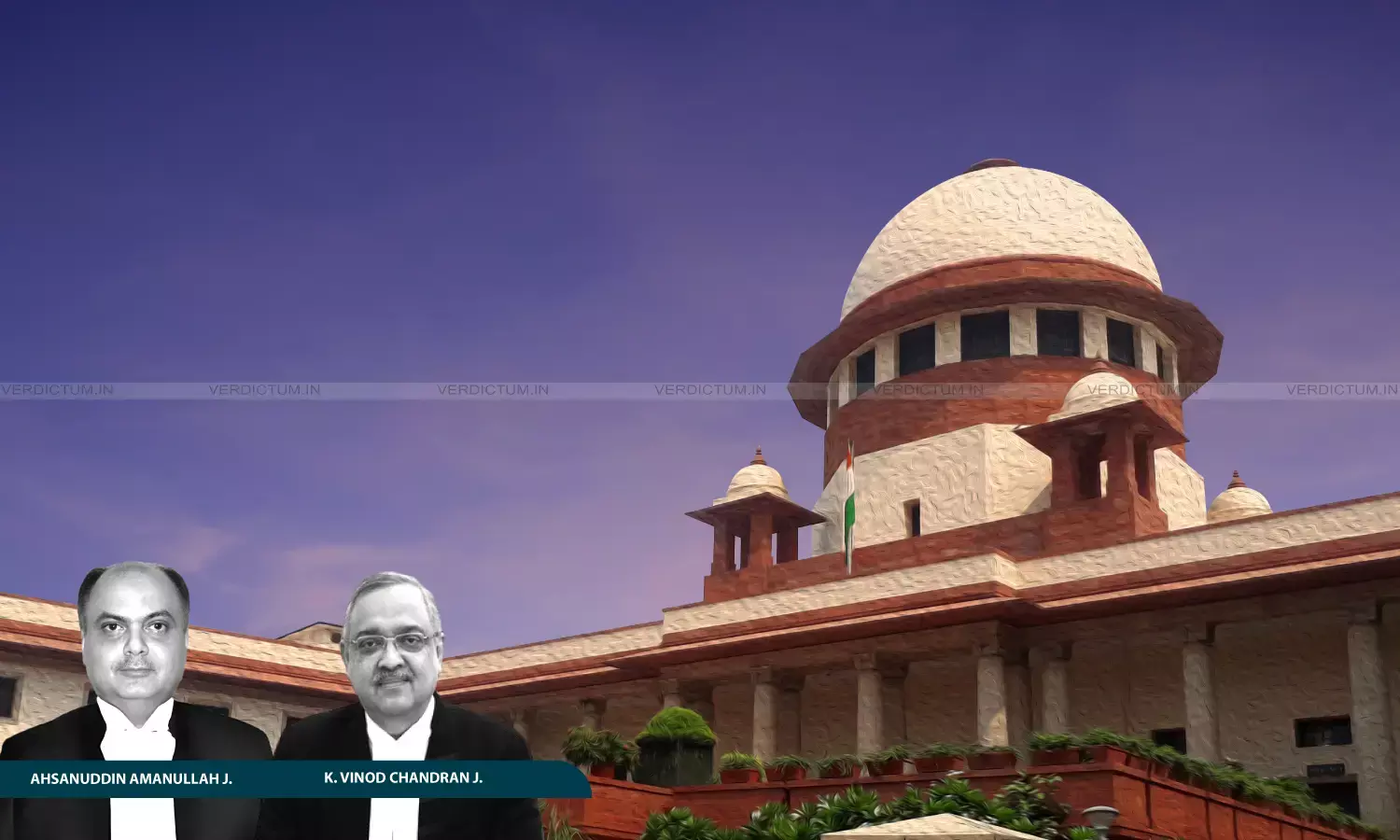
Justice Ahsanuddin Amanullah, Justice K. Vinod Chandran, Supreme Court
The Supreme Court observed that the employer’s failure to challenge a reference order via a writ petition under Article 226 does not preclude him from raising the issue of delay before the Labour Court.
The Court clarified that a conscious decision not to move the High Court against a reference on the ground of delay cannot be viewed as acquiescence, nor does it result in the "frustration" of that plea during the adjudication of the dispute.
The Bench of Justice Ahsanuddin Amanullah and Justice K Vinod Chandran observed, “In the instant case, admittedly no such challenge under Article 226 of the Constitution of India was made against the reference; which does not prevent or prohibit the employer from raising the question before the Labour Court itself. Before going to the series of decisions on the consequences of a delay in seeking reference, we cannot but observe that the mere failure, or a conscious decision not to challenge, the reference under Article 226 of the Constitution of India before the High Court, on the ground of delay, can neither result in the contention being frustrated in every manner nor can there be a ground of acquiescence taken against such plea. This is the purport of the decisions, which we will immediately refer to hereunder.”
Senior Advocate Rana Mukherjee appeared on behalf of the Petitioner, whereas Senior Advocate Sukumar Pattjoshi appeared for the Respondent.
Facts of the case
The State filed the present appeal assailing the judgment of the High Court which upheld the order of the Labour Court, in a reference regarding the validity of termination of the Respondent-workman affirming the award, which found the termination to be illegal and directed the State to pay back wages to the workman for the period from 2006 to 2015; the date of commencement being the date of reference, since there was a 15 years delay occasioned.
Contention of the Parties
It was submitted by the State that there is gross delay, which disentitles the order of back wages, but the State is not averse to compensation, as declared by the Supreme Court in a series of decisions.
Per Contra, the Respondent submitted that the back wages would come to at least Rs.15,00,000/- (Rupees Fifteen Lakhs) and there could be no interference caused to the award on the ground of delay.
Observations of the Court
The Court said, “As to the legal point, we notice that there are two distinct aspects on which there are two separate lines of decisions insofar as the issue of delay in seeking a reference. One of these is with respect to the challenge against a reference order itself, before the High Court under Article 226 of the Constitution of India and the other, the consequences of a delay while adjudicating a reference under the Industrial Disputes Act, 19473.”
The Court, while relying on a plethora of judgments, said, “As we noticed at the outset, in the present case, the failure of the State, or the conscious decision taken not to challenge the order of reference does not deny the employer-State the right to raise that contention before the Labour Court. Moreover, the same had been raised at the first instance before the Labour Court and this is not a case where for the first time the ground of delay was urged before the High Court or before this Court.”
Conclusion
The Court ordered that the considering the 16-year delay in seeking a reference, a lump sum compensation of Rs. 2,50,000/- would suffice. The order of the Labour Court, as affirmed by the High Court were both set aside to the extent of reinstatement and award of back wages.
Accordingly, the Court allowed the appeal.
Cause Title: State of Uttar Pradesh v. Krishna Murari Sharma [Neutral Citation:2025 INSC 1500]
Appearances:
Petitioner: Senior Advocate Rana Mukherjee, Advocates Rajeev Kumar Dubey, Ashiwan Mishra, Vinod Kumar, Krishna Pandey, Vaidruti Mishra, Aditi Mishra, Vidushi Pandey, Subham Bahuguna, Himanshu Kumar, and AOR Kamlendra Mishra.
Respondent: Senior Advocate Sukumar Pattjoshi, Advocates K.B. Upadhyay, S.N. Tripathi, Manoj Kumar Rai, Shailesh Tiwari, Raja Ram Tripathi, S. D. Mishra, Preeti Singh, Mariya, Maruti Nandan, Pushkar Anand, and AOR Raina Anand.