

Candidate Placed In Wait List Has No Vested Right To Invariably Claim Appointment Therefrom: Supreme Court
The Court clarified that a rank list is not an independent source of recruitment; its operation is governed by specific statutory mandates.

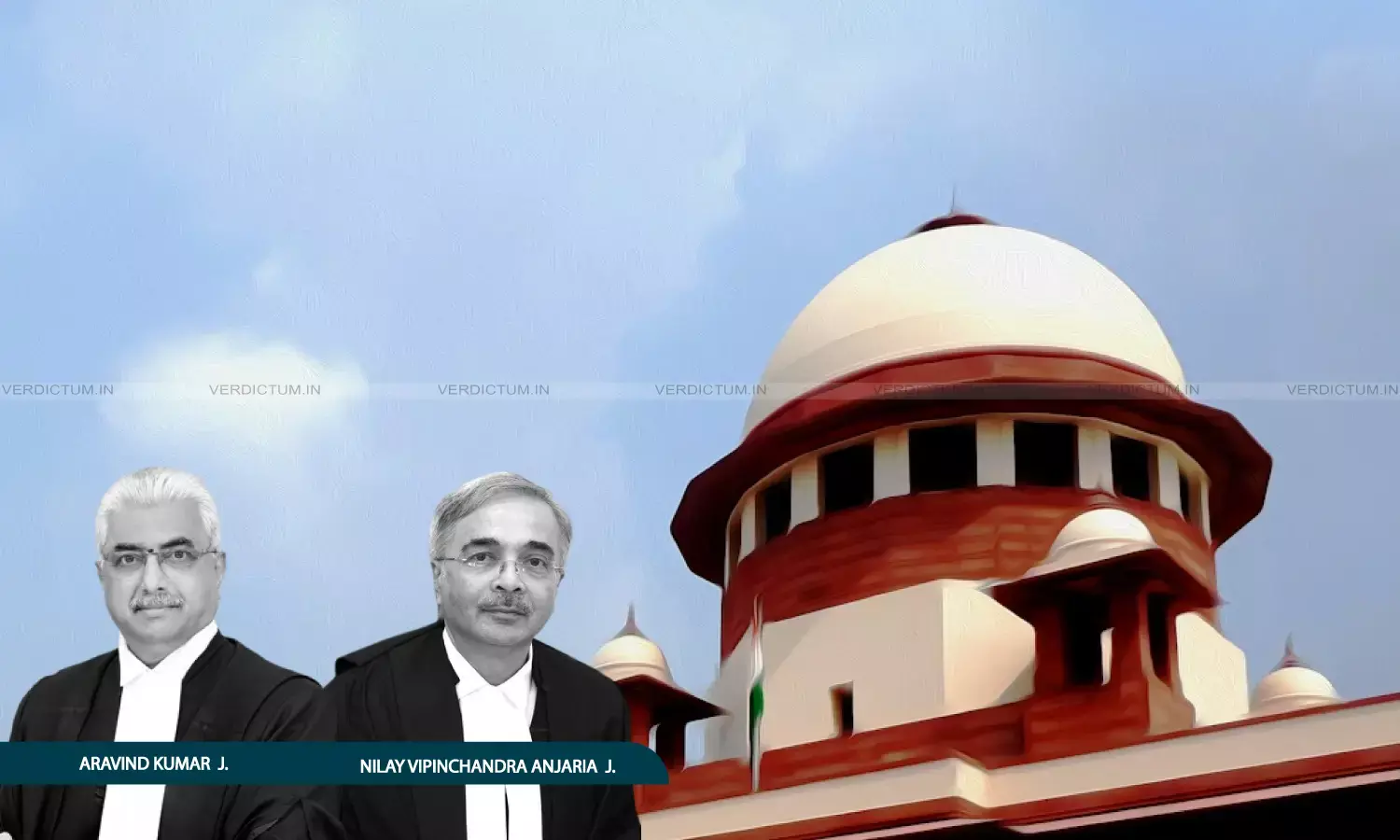
Justice Aravind Kumar, Justice N.V. Anjaria, Supreme Court
The Supreme Court has reiterated that a candidate placed in the wait list has no vested right to invariably claim appointment therefrom.
Two appeals were preferred by the original petitioner assailing the judgments and orders passed in the writ appeal and review petition passed by the Division Bench of the Kerala High Court, whereby the High Court had dismissed both the writ appeal and review petition and upheld the Single Bench's dismissal order.
The Bench of Justice Aravind Kumar and Justice NV Anjaria observed, “The rules of recruitment may provide the time stipulation about the validity and operation of the wait list. When the wait list or rank list kept alive for the purpose of making appointment therefrom by virtue of provision or stipulation, such mandate will have to be adhered to and a candidate placed next on merit in the Wait List or Rank List would be entitled to lodge his or her claim for appointment successfully to the vacancy created by virtue of none being appointed. From the survey of the decisions on the subject of operation of Wait List Or Rank List and the corresponding rights of the candidates enlisted therein, the law could be summarised to state that the wait list by itself is not a source of recruitment, and that generally a candidate placed in the wait list has no vested right to invariably claim appointment therefrom, however when the wait list is made valid for a stipulated period, it would operate for such Period…8. Again, in the present set of facts, the above proposition would hold true subject to operation of rule and policy of rotation as per Section 31(11).”
Senior Advocate Dr Mohan Gopal appeared for the Appellant, whereas Advocate Pranjal Kishore, appeared for the Respondent.
Background
The appellant, a Scheduled Caste candidate ranked second on a 2019 recruitment list, challenged Cochin University's refusal to appoint her as Associate Professor after the first-rank appointee resigned. Despite the rank list being valid for two years under Section 31(10) of the University Act, the University rejected her claim, initially citing the predecessor's "lien" and later arguing that communal rotation rules required the vacancy to be reserved for a Latin Catholic candidate.
After the High Court dismissed her petitions, ruling that communal rotation under Section 31(11) necessitated a fresh recruitment process, the appellant filed the present appeal. She contends that because the post was specifically notified for Scheduled Castes—after remaining vacant since 2005—she is entitled to the appointment while the rank list remains active, regardless of the University's shift in rotation categories.
Contention of the Parties
The Appellant submitted that as the second-ranked candidate, she had a legitimate right to the appointment once the first-ranked appointee resigned. She contended that since the post was specifically reserved for Scheduled Castes, the vacancy must be filled by the next eligible SC candidate from the active list to maintain the intended reservation.
The appellant further argued for a harmonious interpretation of Section 31, suggesting that the rule of communal rotation (sub-section 11) should remain in abeyance while a rank list is valid (sub-section 10). Citing legal precedents, counsel maintained that the University cannot use rotation rules to bypass a live waitlist, especially when the vacancy belongs to a category that has historically lacked representation.
Per Contra, the Respondent submitted that no candidate in the Wait List has any indefeasible right to seek appointment. It was submitted that the appellant did not have a vested right to be appointed from the Rank List even though the vacancy had arisen upon the departure of Dr Anitha. According to his submission, the University was justified in taking a stance that it was a fresh vacancy to be filled in by applying the communal rotation under Section 31(11) of the University Act.
Observation of the Court
The moot question for the Court’s consideration was whether, as per the provisions of Section 31(10) versus Section 31(11) of the University Act, when the Rank List is provided to be valid for two years, whether during such validity period when a vacancy arises, next candidate in the Rank List/Wait List can legitimately put forward his or her right to be appointed, or the University would justified in adverting to resort to rule of communal rotation during the currency of operative Rank List.
It was held, “It is correct that a waiting list is not a ready reservoir for the recruitment, but it is equally true that when it is made operative for a particular period under any provision, rule or circular, it has to be acted upon for the contingency when any of the selected candidate does not join or the appointee resigns. The waiting list is intended to pave way for the next ranked candidate to be appointed in such situation provided the vacancy occurs. In the present case, however the above dictum and the principles would have to be applied harmoniously with the rule 9 of rotation envisaged in Section 31(11) of the Act.”
The Court said, “At the cost of repetition, it is apt to note that the post called for was filled up but Dr. Anitha a Scheduled Caste candidate who worked for a period of more than one year viz., till she resigned on 30.03.2022, and on her resignation the vacancy of the said post having arisen, the mandate of sub-section (10) of section 31 prescribing that the waiting list would be in operation for a period of two years and simultaneously sub-section (11) of section 31 would be attracted and both these provisions have to be read harmoniously.”
It was held that the Respondent-University applied the communal rotation and assigned the vacancy to the turn of 8-LC/AI, that is, Latin Catholic/Anglo Indian Category and as the Petitioner did not belong to the said category, she was not selected.
Conclusion
The Court dismissed the appeals, and the impugned judgments and orders were set aside.
Cause Title: Radhika T. v. Cochin University and Science and Technology & Ors. [Neutral Citation:2025 INSC 1462]
Appearances:
Appellant: Senior Advocate Dr Mohan Gopal, AOR Divyanshu Rai, Advocates Sugandha Batra, Taruna, T Rajesh, Vansh Bhatnagar, Vishal Sharma and Shubh Gautam.
Respondents: Advocates Pranjal Kishore, Atul Shankar Vinod, Nagarjun Sahu, Dileep Pillai, Kannan Gopal Vinod and AOR M. P. Vinod.