Limitation Act Applies To RFCTLARR Act; Delay In Filing Appeals U/S 74 Can Be Condoned: Supreme Court
Holding that Section 74 of the 2013 land acquisition framework does not expressly exclude the operation of Sections 4 to 24 of the Limitation Act, 1963, the Supreme Court ruled that appellate proceedings before the High Court can draw upon the limitation regime under the 1963 Act.
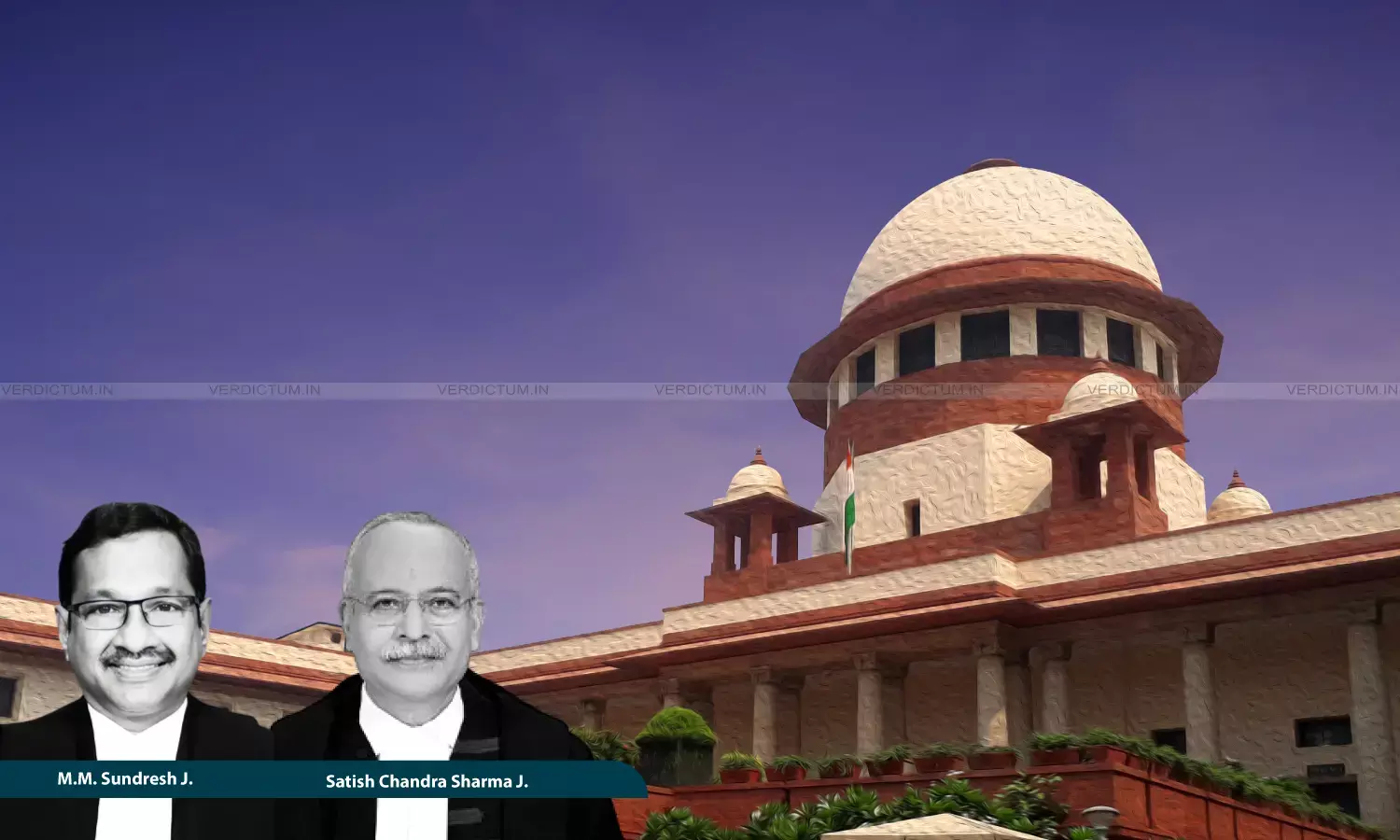
Justice M.M. Sundresh, Justice Satish Chandra Sharma, Supreme Court
The Supreme Court has held that the scheme of the Right to Fair Compensation and Transparency in Land Acquisition, Rehabilitation and Resettlement Act, 2013 does not expressly exclude the applicability of Sections 4 to 24 of the Limitation Act, 1963, and therefore the limitation framework under the 1963 Act continues to operate in appeals filed under Section 74.
The Court clarified that Section 74 prescribes only one period of limitation, and its proviso cannot be construed as creating an independent bar that eliminates the operation of the 1963 Act.
The Court was hearing a batch of civil appeals arising from High Court judgments dismissing first appeals filed under Section 74 of the 2013 Act as barred by limitation. The central issue concerned the interplay between Section 74 read with Section 103 of the 2013 Act and Sections 5 and 29(2) of the Limitation Act, 1963, and whether the special limitation structure under the 2013 Act excluded the general limitation framework.
A Bench of Justice M. M. Sundresh and Justice Satish Chandra Sharma, addressing the statutory scheme, observed: “Thus, we hold that the 1963 Act applies to the 2013 Act. Any interpretation to the contrary would result in a situation as if both Section 29(2) of the 1963 Act and Section 103 of the 2013 Act have vanished from the respective statutes, which is wholly impermissible in law.”
Background
The appeals arose from a series of High Court decisions rejecting first appeals under Section 74 of the 2013 Act on the ground that they were filed beyond the prescribed limitation period.
The appellants contended that the limitation provisions under the 1963 Act, including the power to condone delay, continued to apply in the absence of an express statutory exclusion.
The respondents maintained that the limitation framework under the 2013 Act constituted a complete code, implicitly excluding recourse to Section 5 of the 1963 Act.
Court’s Observation
The Supreme Court examined the structure of Section 74 of the 2013 Act, which provides 60 days for filing an appeal before the High Court, along with a proviso permitting filing within a further 60 days. The Court held that the proviso does not create a separate or extended limitation period but operates within the framework of the principal provision. A proviso, the Court explained, must be read in harmony with the main enactment and cannot be treated as an independent limitation code.
The Bench emphasised that Section 74, read as a whole, prescribes a single limitation structure and does not involve an express statutory exclusion of the Limitation Act. The absence of explicit language barring Sections 4 to 24 of the 1963 Act was treated as decisive, particularly in light of Section 29(2), which mandates that general limitation provisions apply to special laws unless expressly excluded.
The Court rejected the argument that Section 74 impliedly excludes Section 5 of the 1963 Act. It clarified that exclusion cannot be inferred merely because a statute prescribes a limitation period. Express exclusion requires clear legislative intent, which was not found in the text or scheme of the 2013 Act.
“Mere incorporation of a specific period of limitation under the special or local law does not amount to express exclusion of the 1963 Act. Rather, it must indicate that Sections 4 to 24 of the 1963 Act are excluded. As a matter of rule, the said words must be present in the special or local law. Otherwise, it would amount to nullifying Section 29(2) of the 1963 Act”, the Bench underscored.
Turning to Section 103 of the 2013 Act, which declares that its provisions are in addition to and not in derogation of existing laws, the Court held that this provision reinforces the legislative intent to permit borrowing from other statutory frameworks, including the Limitation Act. Interpreting Section 74 in isolation to exclude the 1963 Act would render Section 103 redundant, an outcome the Court held impermissible.
The Court further analysed the nature of appellate proceedings under Section 74, describing them as a continuation of the original proceedings before the statutory authority. In this context, the High Court’s procedural powers could legitimately draw from the limitation regime under the 1963 Act, particularly where no express exclusion exists.
The Bench also addressed the conceptual distinction between the computation of limitation and the extension of time. It clarified that Section 5 operates only after the limitation period is computed and does not itself prescribe limitation. Consequently, the availability of condonation mechanisms cannot be treated as inconsistent with a special limitation provision unless expressly barred.
“For example, when a party to a reference dies, and an application for bringing the legal representatives on record is filed belatedly, Section 5 of the 1963 Act would have to be pressed into service. Such a situation might also arise in appellate proceedings. To that extent, there is no bar”, the Bench explained,
The Court surveyed precedent interpreting Section 29(2) and reiterated that harmonious construction requires giving effect to both the special enactment and the general limitation framework. A piecemeal interpretation that nullifies statutory provisions by implication was held contrary to settled principles of statutory interpretation.
Applying these principles, the Court concluded that High Courts exercising jurisdiction under Section 74 are entitled to draw upon the limitation framework of the 1963 Act, including provisions governing extension of time, in the absence of express exclusion.
Conclusion
The Supreme Court held that Section 24(1)(a) of the 2013 land acquisition statute applies to all cases in which awards are passed after the commencement of the 2013 Act. In such situations, the award process must be governed by the provisions of the 2013 Act, save and except the components relating to rehabilitation and resettlement entitlements, which stand excluded from the immediate application contemplated under this provision.
The Court clarified that all first appeals arising from such awards are to be treated as appeals under Section 74 of the 2013 Act, and not under Section 54 of the 1894 Act. Interpreting the statutory framework harmoniously with the Limitation Act, the Court held that Section 74 of the 2013 Act does not exclude the application of Section 5 of the Limitation Act, 1963.
As a result, applications seeking condonation of delay in filing first appeals before the High Courts under Section 74 were directed to stand allowed.
In consequence, the Court set aside all impugned High Court judgments to the extent they held that Section 5 of the Limitation Act was inapplicable. The Bench further directed the respective State Governments to take necessary administrative measures and issue appropriate instructions to officers handling such appeals to ensure that appeals against post-2013 awards are filed in accordance with Section 74 of the 2013 Act.
The Court also emphasised that High Courts, while dealing with applications for condonation of delay under Section 74, should adopt a pragmatic rather than a pedantic approach, consistent with the statutory framework and the object of the legislation.
Accordingly, the appeals were disposed of in the above terms.
Cause Title: The Deputy Commissioner And Special Land Acquisition Officer v. M/S S.V. Global Mill Limited (Neutral Citation: 2026 INSC 138)
Appearances
Petitioners: Senior Advocate Sudhanshu S. Choudhari, along with Advocates Shirish K. Deshpande, AOR, Rucha Pravin Mandlik, Raghav Arora, Gautami Yadav, Paranjal Chaplangokar, Viraj Parakh, B.K. Shinde, Kailas More, and Others.
Respondents: Senior Advocate Nidhesh Gupta, along with Advocates Amit Sharma, AOR, Ambarish Kumar, Alok Kumar, Bikram Dwivedi, Vriti Gujral, and Jimut Baran Mohapatra, and Others.