

Disproportionate Assets Case Cannot Be Quashed For Delayed Sanction & Departmental Exoneration On Technical Grounds: Telangana High Court
Court held that individual liability under conduct regulations cannot be diluted by generalised administrative practices.

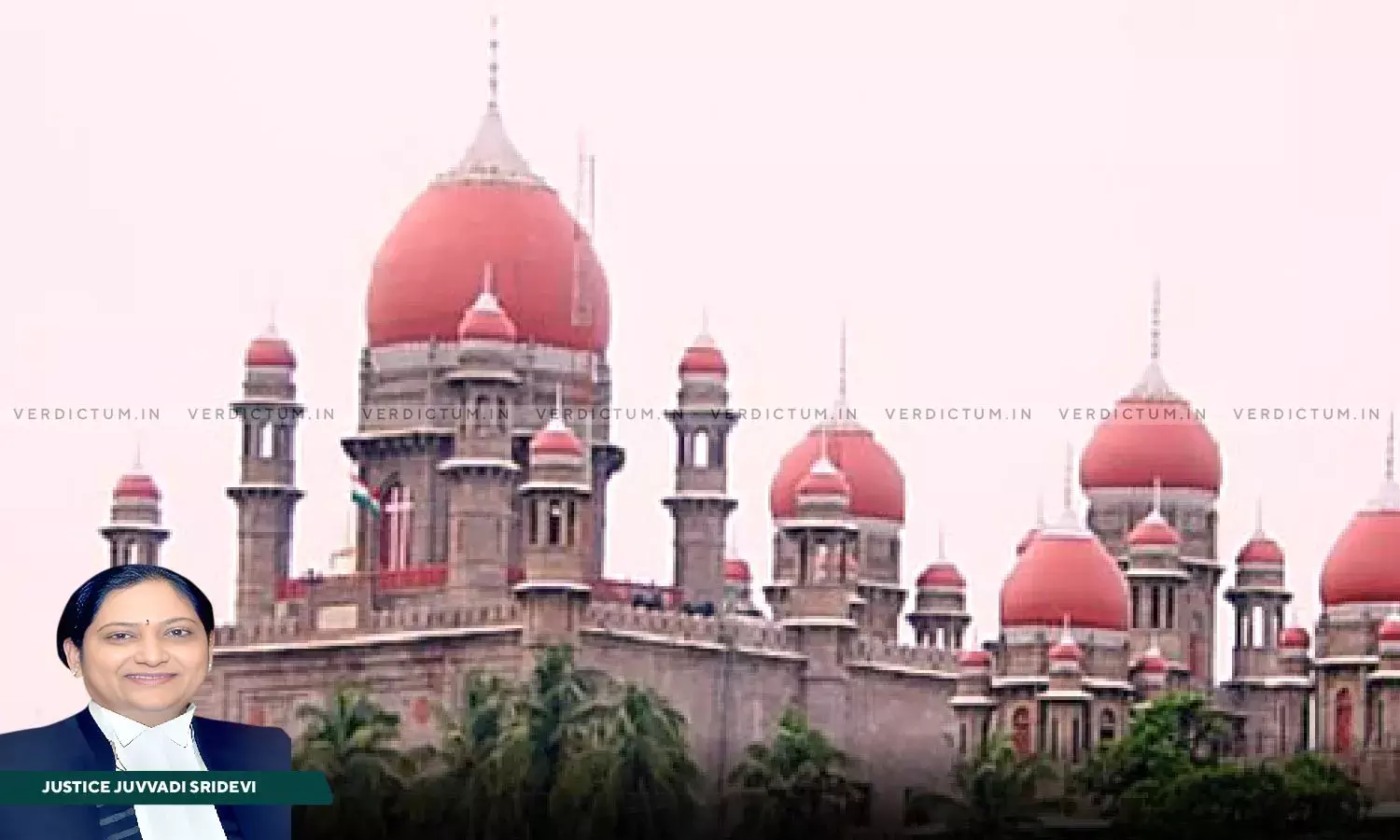
The Telangana High Court has held that administrative delays in granting prosecution sanction and a public servant's exoneration in departmental proceedings based on technicalities do not provide a legal basis to quash criminal proceedings for disproportionate assets. The Court clarified that while statutory timelines for sanction are ideally followed, the failure of an accused to invoke available legal remedies during the period of delay precludes them from later using that delay to invalidate the prosecution.
The Court held that individual liability under conduct regulations cannot be diluted by generalised administrative practices, and findings in a disciplinary inquiry do not bind a criminal court when the former did not consider the full extent of evidence collected during a specialised investigation.
Justice Juvvadi Sridevi, observed, “…It is well settled that departmental proceedings and criminal proceedings operate in distinct fields and findings in one do not automatically conclude the other, particularly when the standard of proof and the nature of evidence differ. The case on hand involves disputed questions of fact relating to acquisition of assets, sources of income and compliance of statutory requirements, which cannot be adjudicated at this stage in proceedings of this nature. The truth or otherwise of the allegations can only be determined upon appreciation of oral and documentary evidence during a full-fledged trial”.
C. Pratap Reddy, Senior Counsel appeared for the petitioner and Advocate T. Bala Mohan Reddy appeared for the respondent.
The matter originated from a 2010 investigation into one Dheeravathu Koteswara Rao, during which searches were conducted at the residence of the petitioner, Sri Azmeera Kailas, a colleague and friend of the primary accused.
Investigative analysis allegedly revealed that the petitioner, while serving as a public servant between 2002 and 2010, allegedly acquired assets including residential buildings and agricultural land valued at approximately ₹70.26 lakh. After accounting for his known income and expenditures, the Anti-Corruption Bureau (ACB) determined he possessed disproportionate assets worth ₹40,04,034 for which he could not satisfactorily account, leading to the registration of a formal case in 2011.
Following the registration of the crime, the petitioner submitted explanations regarding his assets in 2013 and 2014, but the investigation saw significant delays. The ACB submitted a final report seeking sanction in November 27, 2014 and sent nineteen follow-up letters over the next decade. Sanction was eventually accorded on October 15, 2024, after the petitioner had approached the High Court seeking to quash the proceedings due to the fourteen-year delay. Meanwhile, in 2025, a departmental inquiry concluded in the petitioner's favor, primarily because the inquiry officer noted that many other employees had similarly failed to submit property returns or seek prior permissions.
The Bench reasoned that the delay in sanction was purely administrative and not due to ACB negligence, noting that the petitioner failed to approach the court to expedite the process as permitted under the precedent set in Vijay Rajmohan v. Central Bureau of Investigation (Anti-Corruption Branch) (2023) 1 SCC 329.
Noting that the Inquiry Officer exonerated the petitioner, considering that many employees had similarly failed to submit APRs or obtain prior permission during 2002–2009, making selective action against the petitioner unjustified, the Bench observed, “…This Court is unable to approve such reasoning. The liability of a Government servant under the Conduct Regulations is individual in nature and noncompliance by others cannot be a valid ground to absolve the petitioner of his statutory obligations. The approach of the Inquiry Officer, therefore, suffers from a fundamental infirmity, as it shifts the focus from the petitioner’s conduct to a generalized administrative practice. It is, therefore evident that the petitioner was absolved of the charges on technical grounds alone and not on merits”.
“…The departmental proceedings appear to have been concluded without proper examination of such material, thereby rendering the findings incomplete. In that view of the matter, the exoneration of the petitioner cannot be said to be based on a comprehensive evaluation of all relevant facts and circumstances”, the Single Judge Bench further noted.
Accordingly, the Court dismissed the criminal petition, finding no grounds to quash the proceedings pending in the Court of the Principal Special Judge for SPE and ACB Cases, Hyderabad. However, noting that the crime dates back to 2011, the Court directed the trial court to conclude the proceedings as expeditiously as possible in accordance with the law, without being influenced by the observations made in the quash petition.
Cause Title: Sri Azmeera Kailas v. The State of Telangana Criminal Petition No.10711 of 2024
Appearances:
Petitioner: C. Pratap Reddy, Senior Counsel, C. Sunil Anand, Advocate.
Respondent: T. Bala Mohan Reddy, Special Public Prosecutor for ACB, Advocate.