

Wife’s Right To Permanent Alimony U/S 25 HMA Not Dependent On Her Children’s Majority Or Earning Capacity: Rajasthan High Court
The Court held that permanent alimony under Section 25 of the Hindu Marriage Act is an independent right of the spouse and cannot be denied merely because the children have attained majority or are earning.
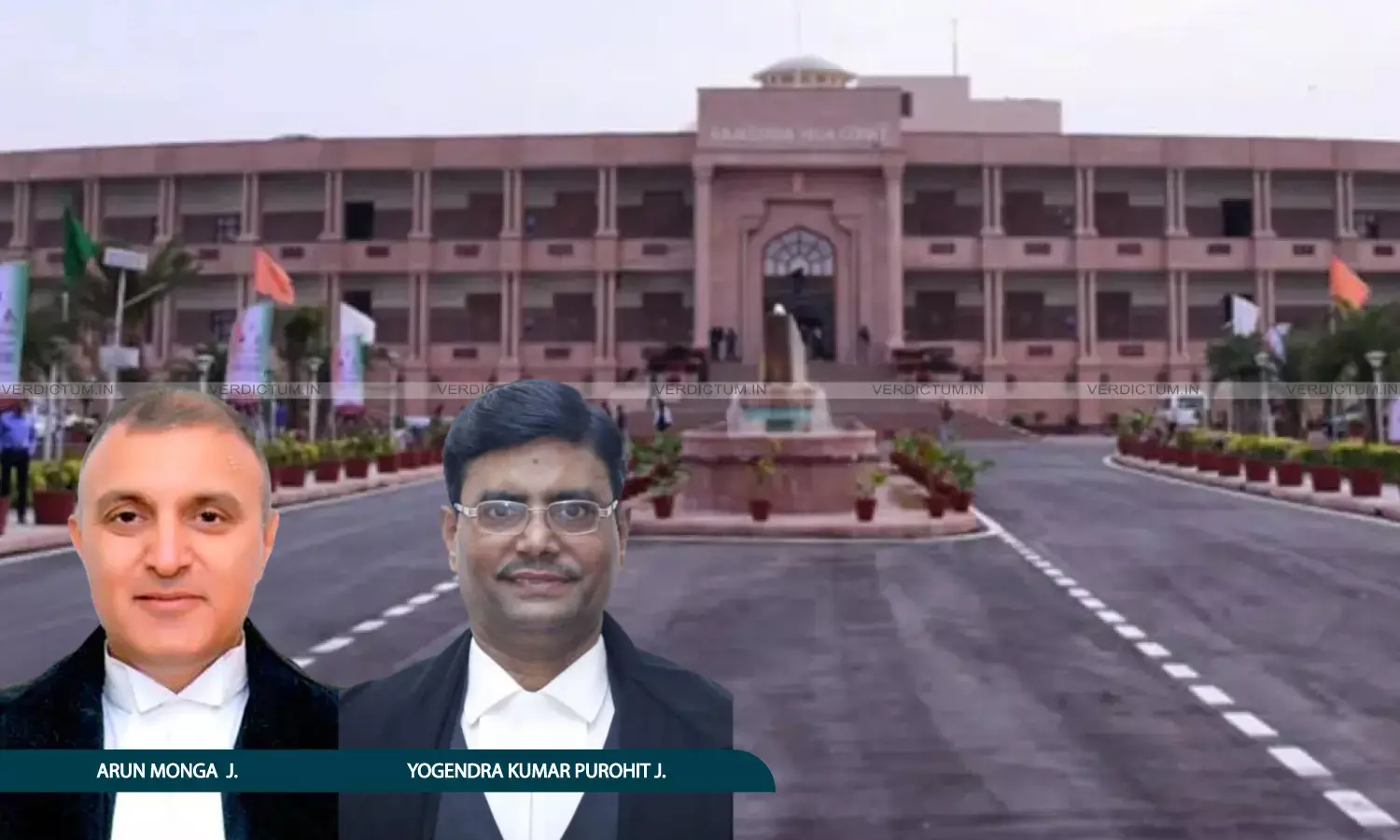
The Rajasthan High Court has held that the entitlement of a spouse to permanent alimony under Section 25 of the Hindu Marriage Act is not contingent upon the dependency or earning status of children, and remains an independent right arising from the dissolution of marriage.
The Court was hearing cross appeals filed by both spouses challenging the quantum of permanent alimony awarded by the Family Court, with the wife seeking enhancement and the husband contending that the amount awarded was excessive.
A Division Bench of Justice Arun Monga and Justice Yogendra Kumar Purohit observed: “The contention of the husband regarding the majority and earning capacity of the sons, though legally relevant, does not substantially dilute the wife’s entitlement under Section 25 of the Hindu Marriage Act. Permanent alimony is not contingent upon the dependency of children alone, but is a distinct and independent right of the spouse arising out of the dissolution of marriage. At best, this factor may have a bearing on quantum, but cannot negate entitlement”.
Advocate Nitin Trivedi represented the appellant, while Advocates Yogesh Sharma & Deepesh Birla represented the respondent.
Background
The wife alleged prolonged cruelty, dowry-related harassment, and eventual ouster from the matrimonial home, asserting that she had since been residing separately and bearing responsibilities of maintaining herself and the children. She claimed the absence of independent income and sought substantial permanent alimony, having regard to the financial capacity of the husband.
The husband denied the allegations and contended that the wife was financially independent and capable of maintaining herself. He further argued that both sons had attained majority and were earning, and therefore, the burden of maintenance ought not to be placed upon him.
The Family Court, upon appreciation of evidence, dissolved the marriage and awarded ₹25 lakhs as permanent alimony, which came to be challenged by both sides.
Court’s Observation
The High Court began by reiterating that Section 25 of the Hindu Marriage Act is an equitable provision aimed at securing financial stability and dignified sustenance for the economically weaker spouse. It was observed that the provision is not confined to bare subsistence but extends to ensuring a standard of living commensurate with that enjoyed during the marriage.
The Court undertook a detailed assessment of the financial capacity of the husband, noting that he was employed as a Specialist Medical Officer with a stable monthly income in the range of ₹2 lakhs, along with ownership of immovable assets and long-term financial security arising from government service.
While examining the contention of the husband regarding the majority and earning status of the sons, the Court held that such a factor, though legally relevant, does not defeat the claim of the wife. It observed. The Court emphasised that permanent alimony is a right that flows from the dissolution of marriage and is not dependent on whether children are dependent upon the spouse seeking maintenance.
At the same time, the Court also rejected the husband’s plea that the wife was financially independent, noting that no cogent evidence had been placed on record to establish her present earning capacity or financial stability. It was observed that past qualifications or prior professional engagement cannot, by themselves, establish present self-sufficiency.
The Court further highlighted that the wife did not possess independent residential accommodation, whereas the husband owned immovable properties, and held that securing a reasonable residence is an essential component of maintenance.
“Equally significant is the fact that the wife does not possess any independent residential accommodation, whereas the husband admittedly owns immovable property. The right of a divorced wife to secure a reasonable residence is now a well-recognised facet of maintenance jurisprudence. The amount awarded must, therefore, be sufficient to enable her to secure at least a modest dwelling and ensure long-term financial security”, the Bench remarked.
Balancing the competing claims, the Court also declined to accept the wife’s claim for ₹2 crores as permanent alimony, holding that such a claim was disproportionate and not supported by reliable evidence regarding the husband’s alleged higher income, while stating that "what is required is a balanced, realistic, and equitable determination, which neither unduly burdens the husband nor leaves the wife in a state of financial vulnerability".
Conclusion
The High Court held that the grant of permanent alimony in favour of the wife was justified, but the quantum awarded by the Family Court was inadequate in light of the husband’s financial capacity and the wife’s economic vulnerability.
Accordingly, the Court enhanced the permanent alimony from ₹25,00,000/- to ₹40,00,000/-, holding that such amount would strike a balance between the financial capacity of the husband and the need to ensure long-term financial security and dignity of the wife.
Cause Title: SK v. NS (Neutral Citation: 2026:RJ-JD:9372-DB)
Click here to read/download Judgment