

Reservation Benefits Granted In One State Cannot Be Extended To Reserved Category Candidates Belonging To Another State: Rajasthan High Court
The Court held that reservation classifications are intrinsically linked to State-specific socio-economic realities and cannot be transposed across State boundaries for the purpose of availing benefits.
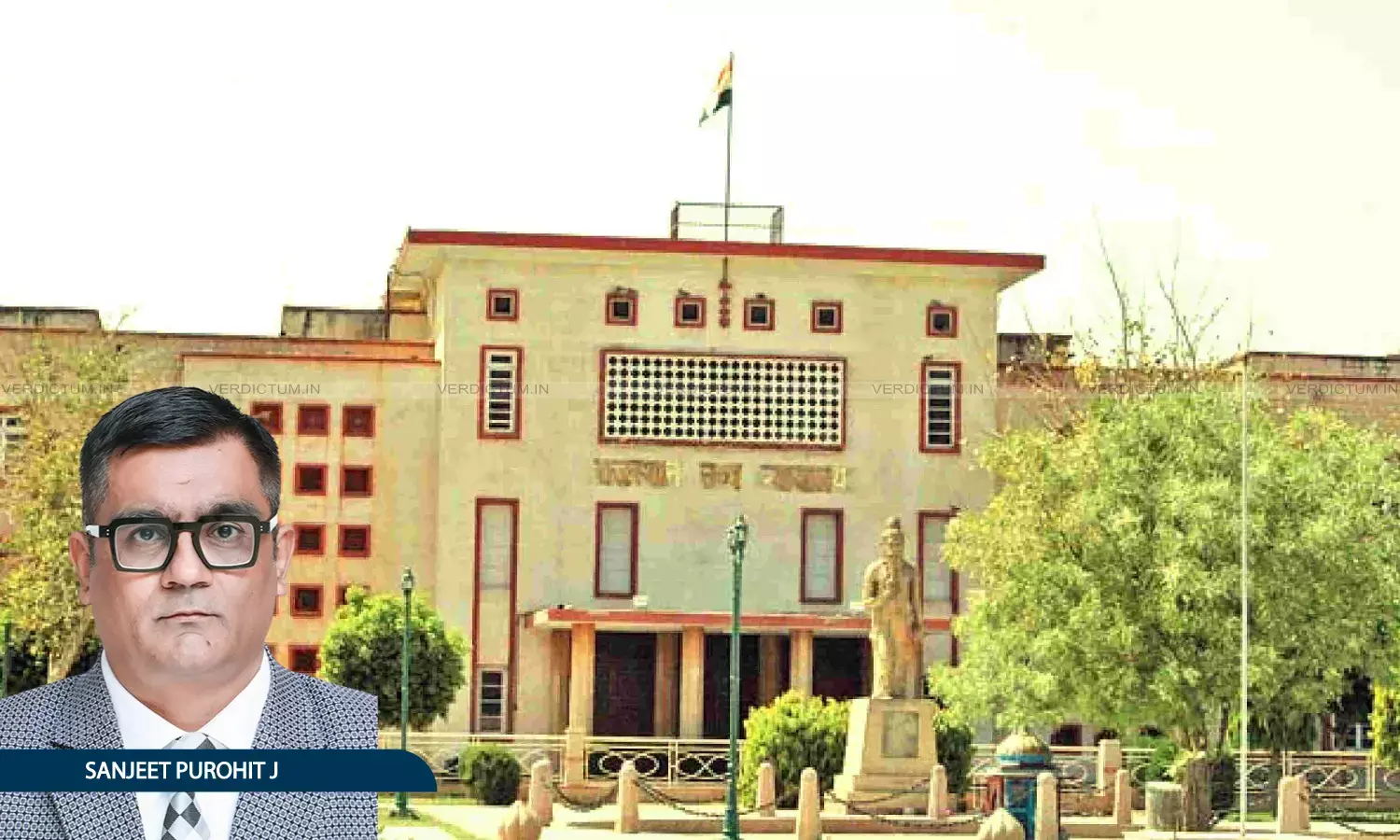
The Rajasthan High Court held that candidates belonging to reserved categories in one State cannot claim reservation benefits in another State, as such classifications are rooted in distinct regional realities and policy considerations.
The Court was hearing a writ petition challenging the decision of the NEET PG Counselling Board, Rajasthan, whereby candidates belonging to reserved categories from other States were treated as unreserved candidates for State quota admissions and denied the benefit of reduced qualifying percentile.
A Single Bench of Justice Sanjeet Purohit observed: “On a conjoint reading of the constitutional scheme discussed above, the statutory scheme of the Act of 2008, as well as the provisions of PGMER-2023, it becomes evident that castes, races and tribes are classified as SCs, STs, BCs, SBCs or OBCs in relation to each individual state. Such classification and notification are based on the unique socio-economic and cultural realities of that specific region, and the corresponding policy decisions governing the reservation are necessarily informed by these State-specific considerations. It cannot be assumed, nor is it capable of empirical determination, that backward classes across different States share identical or even comparable social realities”.
A necessary corollary of this position, the Bench added, is that the benefits of reservation are confined to categories notified in relation to a particular State and cannot be extended to members who are recognised as belonging to a reserved category in another State”.
Senior Advocate M.S. Singhvi appeared for the petitioner, assisted by Advocate Hemant Ballani, and Additional Advocate General Vigyan Shah, along with Advocate Milap Chopra, appeared for the respondents.
Background
The petitioner, a federation of private medical and dental colleges in Rajasthan, challenged the decision of the State counselling authorities denying reserved category benefits to candidates belonging to other States during NEET PG counselling for the academic year 2025–26.
It was contended that despite the lowering of the qualifying percentile to fill vacant postgraduate medical seats, candidates from reserved categories of other States were not permitted to avail such relaxation for admission under the State quota. Instead, they were treated as general category candidates.
The petitioner argued that such a denial defeated the purpose of reducing qualifying marks and resulted in seats remaining vacant. It further contended that the decision effectively created a regime of domicile-based reservation and violated constitutional principles.
On the other hand, the State defended its policy by relying on the constitutional scheme, the Rajasthan Reservation Act, 2008, and the Postgraduate Medical Education Regulations, 2023, asserting that reservation is inherently State-specific and cannot be extended across State lines.
Court’s Observation
The Court undertook a detailed analysis of the constitutional provisions governing reservation, particularly Articles 341, 342, and 342A, which define Scheduled Castes, Scheduled Tribes, and backward classes “in relation to” a particular State.
It was observed that these provisions make it clear that identification of backward classes is territorially anchored and varies across States based on local socio-economic and cultural conditions.
The Court emphasised: “Such classification and notification are based on the unique socio-economic and cultural realities of that specific region… It cannot be assumed… that backward classes across different States share identical or even comparable social realities.”
Relying on precedents such as Marri Chandra Shekhar Rao v. Seth G.S. Medical College (1990) 3 SCC 130 and Bir Singh v. Delhi Jal Board (2018) 10 SCC 312, the Court reiterated that reservation benefits are confined to the geographical limits of the State for which such categories are notified.
It further held: “a person belonging to a Scheduled Caste in one State cannot be deemed to be a Scheduled Caste… in relation to any other State… the benefits of reservation… stand confined to the geographical territories of a State…”
Addressing the argument of “100% domicile reservation,” the Court clarified that the impugned policy did not bar participation of out-of-State candidates altogether. Rather, it only restricted them from claiming reserved category benefits, while permitting them to compete for unreserved seats based on general category criteria.
The Court also rejected the contention that unfilled reserved seats could be claimed by out-of-State candidates using relaxed criteria, holding that once seats are treated as unreserved, they must be filled strictly in accordance with general category standards.
On the issue of vacant seats, the Court observed that while filling all seats is desirable, it cannot be achieved by compromising statutory norms or constitutional principles governing reservation and merit.
Conclusion
The Court upheld the decision of the Rajasthan NEET PG Counselling Board and dismissed the challenge, holding that denial of reservation benefits to candidates belonging to reserved categories of other States is legally valid and consistent with the constitutional scheme.
It concluded that reservation benefits are inherently State-specific and cannot be extended across State boundaries, and that such a restriction does not violate constitutional guarantees.
Cause Title: Federation of Private Medical and Dental College of Rajasthan v. Chairman, NEET PG Medical & Dental Admission Board & Ors.
