

It Was His Personal Revenge, Not Social Revenge: Punjab & Haryana High Court Commutes Death Sentence Of Man Convicted For Beheading His Brother Over Property Dispute
The High Court also noted that there is no allegation of convict’s violent behavior in the prison.
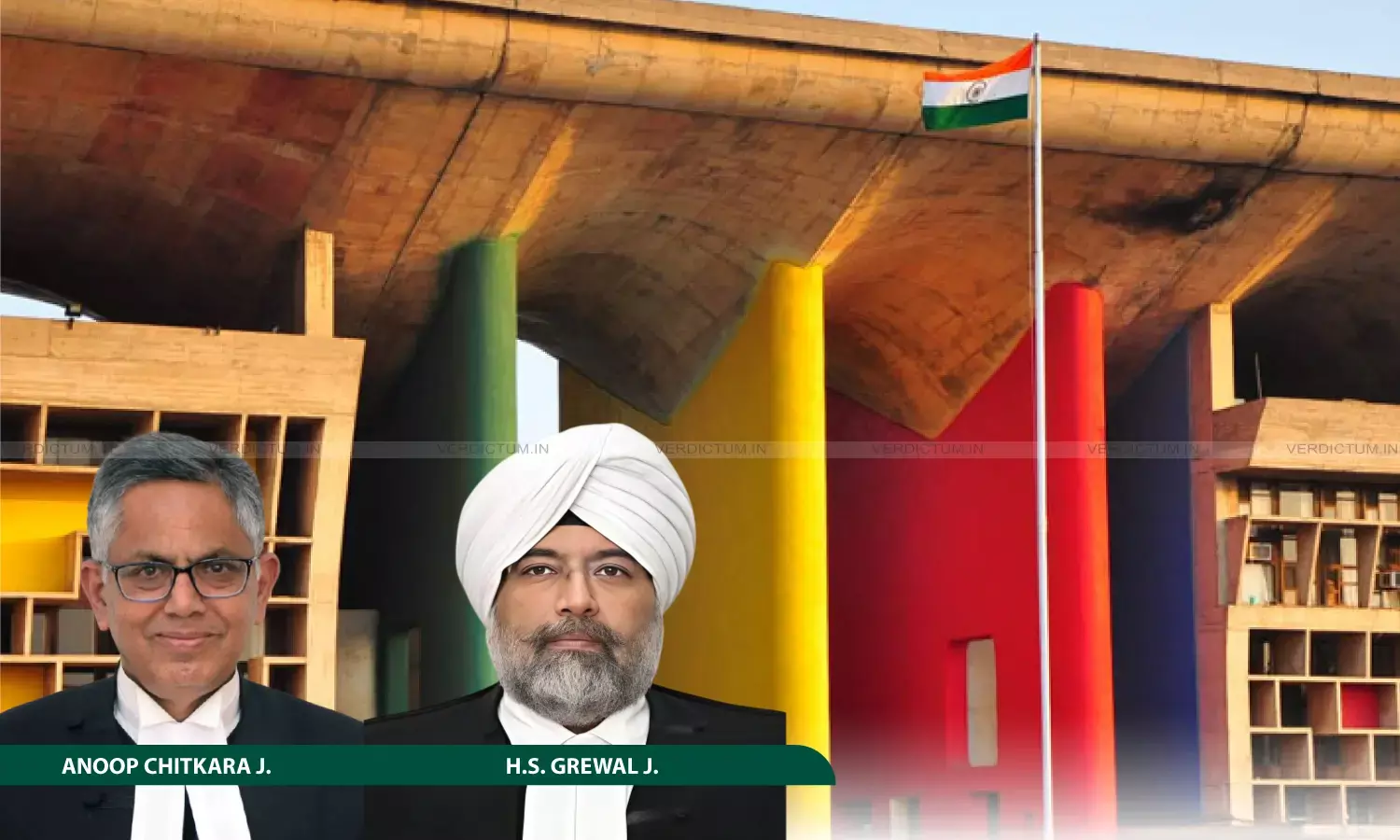
Justice Anoop Chitkara, Justice H.S. Grewal, Punjab & Haryana High Court
The Punjab and Haryana High Court has commuted the death sentence of a man who was convicted for beheading his younger brother over a property dispute in the year 2020.
Seeking confirmation of the death sentence, the Trial Court had sent the Reference to the High Court under Section 407 of the Bharatiya Nagarik Suraksha Sanhita, 2023 (BNSS) and challenging the conviction, the convict came up before the Court by filing a Criminal Appeal under Section 415(2) of BNSS.
A Division Bench comprising Justice Anoop Chitkara and Justice H.S. Grewal observed, “There is also no evidence on record to suggest that the appellant would be a menace and threat to the harmonious and peaceful co-existence of the society. In our opinion, the mitigating factors that would not justify the imposition of a capital sentence are that the motive for killing his brother was a property dispute, and it was the convict’s personal revenge, not social revenge. Further, there is no allegation of convict’s violent behavior in the prison(s). These factors, coupled with the applicant’s age being over 60 years, would not justify the imposition of capital punishment.”
The Bench ordered that the default sentence for the non-payment of fine, wherever imposed, shall be converted from ‘Rigorous Imprisonment’ to ‘Simple Imprisonment’.
Addl. AG Rahul Mohan represented the State, while Advocate H.S. Deol was appointed as the Amicus Curiae for the Convict.
Case Background
As per the prosecution case, the deceased aged 40 years was one of the five siblings of whom he was the youngest, and the convict was placed in the middle. The deceased’s marriage broke ten years prior to 2020, and a divorce had also taken place. Around 3-4 years before 2020, due to an accident, he had become physically challenged and was on a wheelchair. He lived in a 173-square-yard house, which his mother had bequeathed to him in 2013 through a registered Will. Feeling unhappy about the transfer of the property, the elder brother i.e., the convict, allegedly harbored a deep-seated grudge against the deceased and even threatened to kill him. About 6-7 days prior to the incident, the deceased had told his sister on a phone call that convict was threatening to kill him and Surjeet (brother).
In the morning of the incident, Surjeet called his sister and informed that when he went to the deceased’s house, the door was found closed and none responded to his shouts. He also told her that on previous night, when he was present at the deceased’s house, the convict had come there on his motorcycle, and he had started consuming liquor in the front room, and at that time, he was wearing only a vest and an underwear. On this, the sister went to the deceased’s house and Surjeet was standing outside. After that, Surjeet, with the help of neighbours, opened the door, and on entering the house, they found the decapitated dead body of the deceased lying in the courtyard with blood all over, and his severed head was absent from the crime scene. Resultantly, an FIR was registered and the convict was arrested. The Sessions Judge held the convict guilty under Sections 457, 506, 302, and 201 of the Indian Penal Code, 1860 (IPC) and imposed death penalty on him. Hence, the case was before the High Court.
Reasoning
The High Court in view of the above facts, said, “Another relevant fact is that the accused Ashok had absconded. If someone’s sibling dies or has an untimely tragic death as shocking as that in the present case, then normal human behavior dictates that in usual course of events, unless the siblings have completely severed their ties, the siblings who live nearby would be grief-stricken and would immediately reach the abode of the deceased or attempt to be present with the deceased at the earliest, and any contrary behavior would indicate something suspicious.”
The Court held that it is established beyond a reasonable doubt that the convict had murdered his brother and, after that, had carried away the severed head, leaving behind the decapitated body.
“As a result, the judgment of conviction under §§302 and 201 IPC calls for no interference, except for the sentence part. However, there is no evidence for the conviction of an offence punishable under § 457 IPC, as there is no evidence that he had trespassed in his brother’s house. The motive was murder and not theft, and the accused was not charged under §404 IPC for misappropriation of the property of the deceased. Further, there is no evidence of an offence punishable under §506 IPC, as Deepak had never filed a complaint regarding the previous threats, nor did any witness state having seen the fact of such threats. Accordingly, the appellant is acquitted of the charges under §§457 and 506 of the IPC. Furthermore, the sentence under §201 IPC is reduced, but the fine amount is enhanced”, it noted.
Amicus Curiae had submitted that she had interviewed the convict in jail and, in her opinion, the convict is suffering from physical as well as psychological health issues and he is suffering from a cardiovascular disease, and after the pronouncement of the death sentence, he has severe sleep disruptions and is undertaking psychological treatment.
“Given the above, the death sentence awarded by the trial Court to the appellant under §302 IPC is commuted and altered to life imprisonment with the stipulation that the convict Ashok Kumar shall not be released on remission or otherwise, unless he has undergone 20 years of actual sentence in prison or in custody, and the fine amount is enhanced to Rs. 5,00,000/-”, held the Court.
The Court clarified that in case the convict suffers from any mental or health issues, then during that time, he may be kept out of prison in some other facility, subject to and in terms of the opinion of the Doctors and the Subject Specialists, and the period spent for this term shall be considered as if he had served his actual sentence.
Conclusion
“Fine, if recovered, to be paid as compensation to the victim’s children and their family members in equal shares; and in their absence, to the siblings, other than the convict, in equal shares. All the substantive sentences awarded to the appellant shall run concurrently. … In the light of the judicial precedents mentioned above, the sentences in default of fine shall run consecutively”, it added.
The Court concluded that the Trial Court shall return the cash and jewellery to the legitimate claimant and order the destruction of all other case property in accordance with rules, notifications, and office orders, if any, after six months.
Accordingly, the High Court commuted the death sentence to life imprisonment with the clarification that the convict shall not be released from prison until he has completed 20 years of the actual custody, in prison or otherwise.
Cause Title- State of Haryana v. Ashok Kumar (Neutral Citation: 2025:PHHC:177102)
Appearance:
Appellant: Addl. AG Rahul Mohan, DAGs Karan Sharma, Shiva Khurmi, and AAG Yuvraj Shandilya.
Respondent: Amicus Curiae H.S. Deol, Advocates Harvinder Singh Maan, Gurdeep Kaur, Harnoor Singh Sidhu, and Kirandeep Kaur.
