

Sunglasses Are Distinct from Spectacles, Punjab & Haryana High Court Classifies Them As Residuary Items For Taxation
The Court said that sunglasses have been correctly held to be a residuary item because they did not fall under any specified Schedule, thus, exigible to tax at the rate of 12.50%.

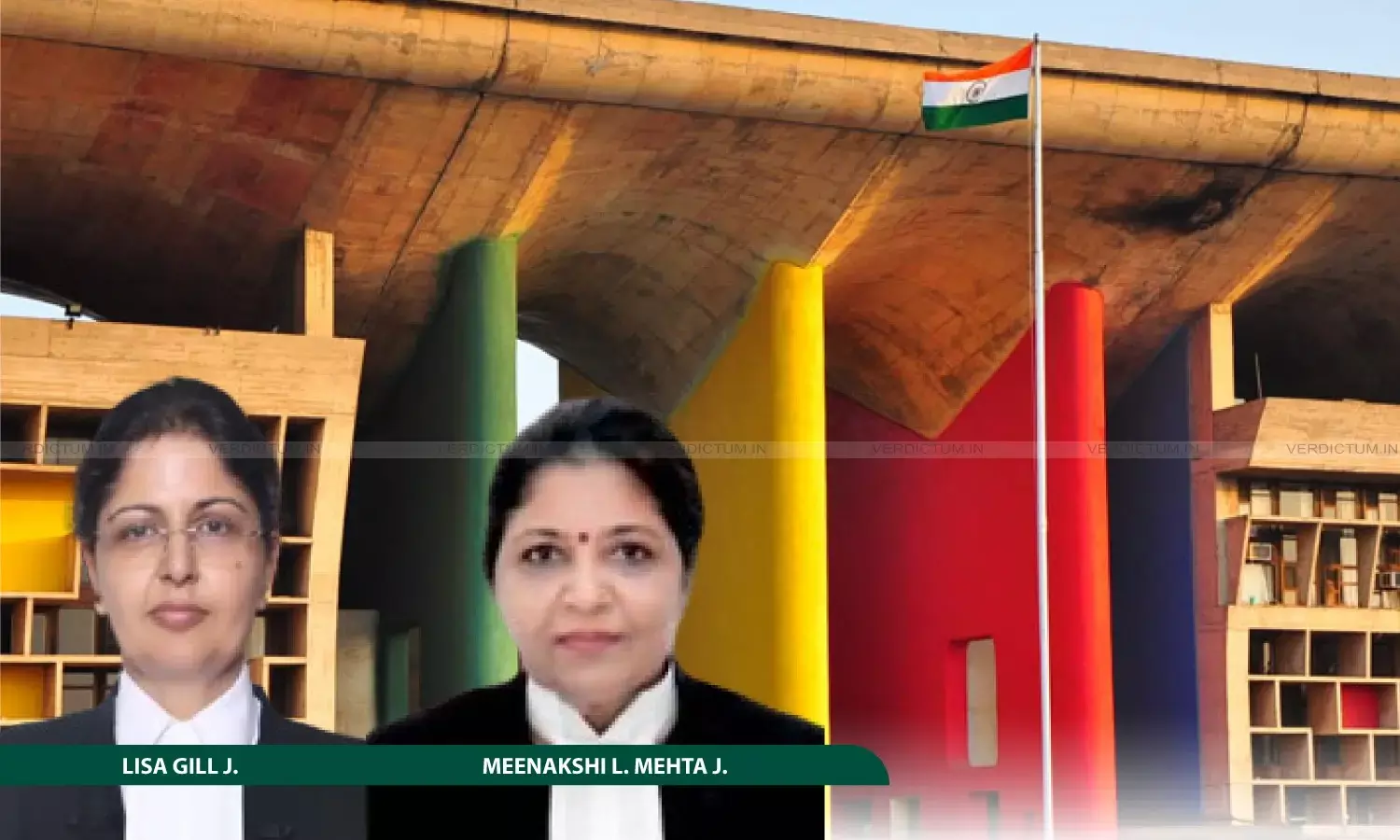
The Punjab and Haryana High Court has observed that sunglasses are a distinct commodity, which is not covered under the Punjab Value Added Tax Act, 2005.
The Court held that the factum of an amendment being brought about in the PVAT Act to include sunglasses in the entry whereby spectacles, goggles or sunglasses, parts and components thereof, contact lenses and lens cleaners all made exigible to 8.5% tax, in fact proves the point that goggles or sunglasses cannot be made or read to be a part of ‘spectacles’.
The Division Bench of Justice Lisa Gill and Justice Meenakshi Mehta observed, “In our considered opinion, in the given factual matrix, sunglasses and spectacles are indeed different products. It cannot be held that ‘spectacles’ is a term broad enough to include ‘sunglasses’, therefore entailing taxation of sunglasses under the entry relatable to spectacles and not under the residual entry. In all fairness, we also take note of the argument raised by learned counsel for appellants that in certain areas, specially snow clad terrains, it is impossible to venture out without proper sunglasses/goggles. In this respect argument of learned counsel for the State of Haryana to the extent that no such terrain is present in the State in question, therefore, issue does not arise in the given factual matrix, has merit. Similarly argument that photochromatic lens are an example of the blurred distinction between the terms in question, is devoid of any merit. Once such a ‘lens’ is for corrective vision, it is admittedly exigible to tax as applicable to spectacles. Therefore, sunglasses are indeed a distinct commodity, which is not covered under Entry 110 of Schedule B of PVAT Act and Entry 100-E Schedule-C of HVAT Act.”
Advocates Sandeep Goyal appeared on behalf of the Appellant, whereas DAG Mamta Singla Talwar, Addl. AG Saurabh Kapoor appeared for the Respondents.
Facts of the case
Various appeals were filed for consideration of the Court that whether in the facts and circumstances, item in question i.e. sunglasses sold by assessee falls under entry 110 of Schedule-B, attached to Punjab Value Added Tax Act, 2005 in the case pertaining to the State of Punjab and under entry 100-E of Schedule-C attached to Haryana Value Added Tax Act, 2003 in respect to appeals pertaining to State of Haryana (both the entries are para materia) and hence, taxable at the rate applicable to said Schedule(s) from time to time?
Contentions of the parties
The plea of Appellants was that the item ‘sunglasses’ fall under the definition of ‘spectacles’, hence are taxable at the rate as applicable to spectacles under the relevant entries (Entry 110 of Schedule-B of PVAT Act in respect to State of Punjab and entry 100-E of Schedule-C of HVAT Act) and that sunglasses can thus not be taxed at the rate applicable to unclassified items under the residual entry.
The Appellants argued that the word ‘spectacles’ is in fact a broad term, which would include not only glasses/spectacles meant for vision correction, but would also include sunglasses, which are meant for protection from the glare of the sun, etc. It was vehemently argued that with the change in technology, the difference between protective and corrective spectacles has diminished, in fact, almost erased. While giving an example of photochromic lenses, it was submitted that the distinction between prescription glasses and sunglasses is completely blurred. It was vociferously argued that the term used in the HVAT Act is “Chashme”, therefore, in common parlance, it would include “Dhoop Ka Chashma” or “Nazar Ka Chashma”, i.e. sunglasses or vision corrective glasses, respectively.
The Respondents refuted the arguments as raised on behalf of the appellants. It was submitted that even applying the common parlance test, it is apparent that the term spectacles or “Chashme” or ‘Ainak’ are popularly understood as vision correction glasses and not sunglasses.
Observations of the Court
The Court said, “Entire controversy revolves around the issue as to whether sunglasses can be classified as spectacles, parts and components thereof. Learned counsel for appellants have vehemently argued that ‘spectacles’ is a broad and a generic term, clearly including within its ambit sunglasses as well, irrespective of whether primary purpose is vision correction or vision protection. Popular meaning and parlance would include sunglasses in the genus of spectacles. It is a settled position that an entry in taxation matters may be either illustrative and an inclusive entry or a restrictive and exhaustive entry. Entry at Srl. No.110 of Schedule B of PVAT Act as it stood before the amendment in 2011, clearly reads as ‘spectacles, parts and components thereof, contact lens and lens cleaner’. This entry is clearly an exhaustive and restrictive entry. Plain language used in the statute is clear and unambiguous and calls for no addition, substitution or reading of any other words into it.”
The Court relied on judgment of the Rajasthan High Court in RayBan Sun Optics India Ltd. vs. Deputy Commissioner (Appeals), Commercial Tax Department, 2013(10) TMI 1332, and said, “In the case of RayBan Sun Optics (supra) definition of the term spectacles in Oxford English dictionary, Dorland's illustrated medical dictionary, Webster’s dictionary and thesaurus of English language was considered and it was concluded that an analysis of definitions therein reveal that emphasis has been either to assist vision or to correct certain defects of vision or to aid vision or correct defects of vision as primary function, use and purport of the term ‘spectacles’. Argument raised by petitioners therein as is argument raised in present appeals in respect to the Harmonized System of Nomenclature (HSN), Rajasthan High Court in the case of RayBan Sun Optic’s case (supra) was negated.”
Conclusion
“Therefore, in this given situation, sunglasses have been correctly held to be a residuary item because it did not fall under any specified Schedule, thus, exigible to tax at the rate of 12.50%. Inclusion of sunglasses in the said entry at a later stage does not buttress the case of appellants as had been argued and is in fact to the contrary.” the Court ordered.
Accordingly, the Court disposed of the petition.
Cause Title: M/S Himalaya Optical Centre (P) Ltd. v. The State of Punjab [Neutral Citation: 2025:PHHC:171770-DB]
Appearances:
Appellants: Advocates Sandeep Goyal and Prakyat J.S.
Respondents: Advocate Suresh Kumar Yadav, DAG Mamta Singla Talwar, Saurabh Kapoor, Addl. A.G., Punjab.