Sealed Cover Procedure Cannot Be Invoked At Investigation Stage To Withhold Candidate’s Results Without Charge Sheet: Patna High Court
The Court held that the sealed cover doctrine can be invoked only upon formal initiation of prosecution through a charge sheet, and not at the stage of investigation, and that denial of appointment based on mere pendency of a criminal case violates settled legal principles.
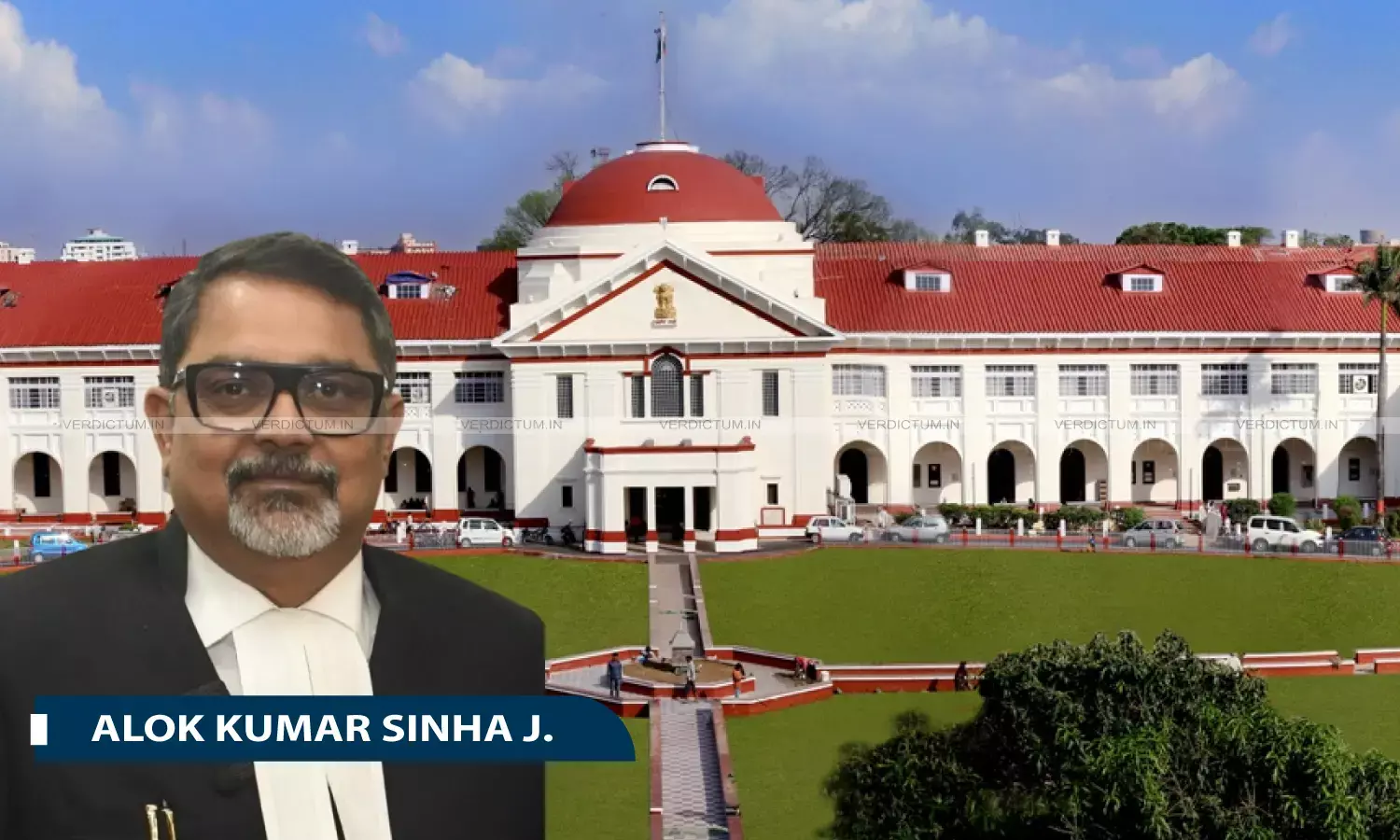
Justice Alok Kumar Sinha, Patna High Court
The Patna High Court has held that the invocation of the sealed cover procedure in the absence of a charge sheet is legally unsustainable and that withholding the result and consequential appointment of candidates based on mere pendency of a criminal case is arbitrary and contrary to law.
The Court was hearing a writ petition challenging the action of the Bihar Public Service Commission in withholding the results and appointment of candidates by affixing a “star mark” against their names on account of their implication in a criminal case relating to alleged examination irregularities.
A Bench of Justice Alok Kumar Sinha observed: “… on the relevant date when the impugned action was taken, and the rights of the petitioners were affected, there was no charge sheet in existence so as to justify recourse to the 'sealed cover procedure’, … the said doctrine can be pressed into service only upon formal initiation of prosecution, and not at a stage when the matter is merely under investigation”.
Advocate Awadhesh Kumar Mishra appeared for the petitioners, while Senior Advocate Vishwanath Prasad Sinha represented the respondents.
Background
The petitioners had applied pursuant to a recruitment advertisement issued by the Bihar Public Service Commission for appointment to teaching posts and participated in the selection process, including a re-examination conducted after cancellation of an earlier test due to question paper leakage.
It was their case that they had successfully qualified for the examination and secured marks above the prescribed cut-off. However, upon publication of the result, their names were marked with a “star”, and their results were kept in abeyance, with a stipulation that their candidature would be considered only after conclusion of the criminal proceedings in which they had been named.
The respondents justified the action because the petitioners were implicated in a case involving alleged examination malpractice, and, based on governmental advice, their results had been kept in a sealed envelope so as to maintain the integrity of the recruitment process.
Court’s Observation
The Court framed two questions for consideration, namely, whether the invocation of the sealed cover procedure was legally sustainable in the absence of formal charges, and whether mere pendency of a criminal case could justify denial or deferment of appointment.
While dealing with the first issue, the Court examined the settled principles governing the sealed cover doctrine and referred to Union of India v. K.V. Jankiraman (1991). It reiterated that the doctrine is not to be applied mechanically and can be invoked only upon formal initiation of disciplinary or criminal proceedings.
The Court noted that “the sealed cover procedure is to be resorted to only after the charge-memo/charge-sheet is issued… The pendency of preliminary investigation prior to that stage will not be sufficient…”
Applying this principle, the Court found that on the date when the results were published, and the impugned action was taken, no charge sheet had been filed against the petitioners, and the charge sheet came to be filed only subsequently. It was observed that the distinction between mere implication in an FIR and formal initiation of prosecution is substantive, as the latter represents crystallisation of allegations into charges warranting adjudication.
The Court held that “in the absence of a formally framed charge by a competent court at the relevant stage, the invocation of the sealed cover doctrine by the respondents cannot be said to be legally sustainable. The action, thus, travels beyond the permissible limits laid down by the Hon’ble Supreme Court and is liable to be held arbitrary to that extent”.
While addressing the second issue, the Court examined whether mere pendency of a criminal case, without adjudication of guilt, could justify denial of appointment. It reiterated that public employment is governed by constitutional guarantees under Articles 14 and 16, and that a candidate who has successfully qualified acquires a legitimate expectation of appointment, subject to eligibility in accordance with law.
Relying on Joginder Singh v. Union Territory of Chandigarh (2014), the Court observed that mere involvement in a criminal case cannot operate as a disqualification in the absence of adjudication of guilt. It further held that “the presumption of innocence… continues to operate in favour of the petitioners unless and until proven otherwise. To deny them appointment at this stage would amount to inflicting a civil consequence on the basis of unproven allegations.”
The Court also noted that the respondents had adopted a uniform approach in treating all candidates named in the FIR alike, without any individualised assessment of their role or the stage of proceedings, which was contrary to the requirement of fairness and reasonableness in public employment.
“This Court is also conscious of the nature of allegations and the seriousness of the offence as projected by the Economic Offence Unit. However, the seriousness of allegations cannot override settled legal principles. The employer is certainly entitled to take an appropriate view in cases where guilt stands established or where the conduct of the candidate is demonstrably such as to render him unsuitable for public employment. But such a conclusion must be based on objective material of a conclusive nature, and not on mere pendency of proceedings”, the Court concluded.
Conclusion
The High Court held that the action of the respondents in invoking the sealed cover procedure in the absence of a charge sheet was arbitrary and legally untenable, and that mere pendency of a criminal case cannot justify withholding of results or denial of appointment to candidates who have otherwise qualified on merit.
The writ petition was accordingly allowed. The Court directed the Bihar Public Service Commission to verify whether the petitioners had successfully qualified for the examination and, if so, to declare their results and forward recommendations within a stipulated period.
It was further directed that upon such recommendation, the State authorities shall issue appointment letters, while clarifying that such appointments would remain subject to the outcome of the pending criminal proceedings.
Cause Title: Monu Kumar & Ors. v. State of Bihar & Ors. (Neutral Citation: 2026:PATHC:30182)
Appearances
Petitioners: Advocates Awadhesh Kumar Mishra, Shivani Mishra, Pragati Singh, Shashank Shekhar & Vidhi Shree
Respondents: SC-4 Arvind Ujjwal; Advocate Vikash Kumar; Senior Advocate Vishwanath Prasad Sinha with Advocate Vijay Anand