

Alleged Delinquency Could Be Driven By Probabilities Of Case & It Need Not Be Proved By Strict Proof Of Evidence: Madras High Court
The Madras High Court was considering a writ petition seeking the quashing of the order of the Central Administrative Tribunal passed in an Original Application.

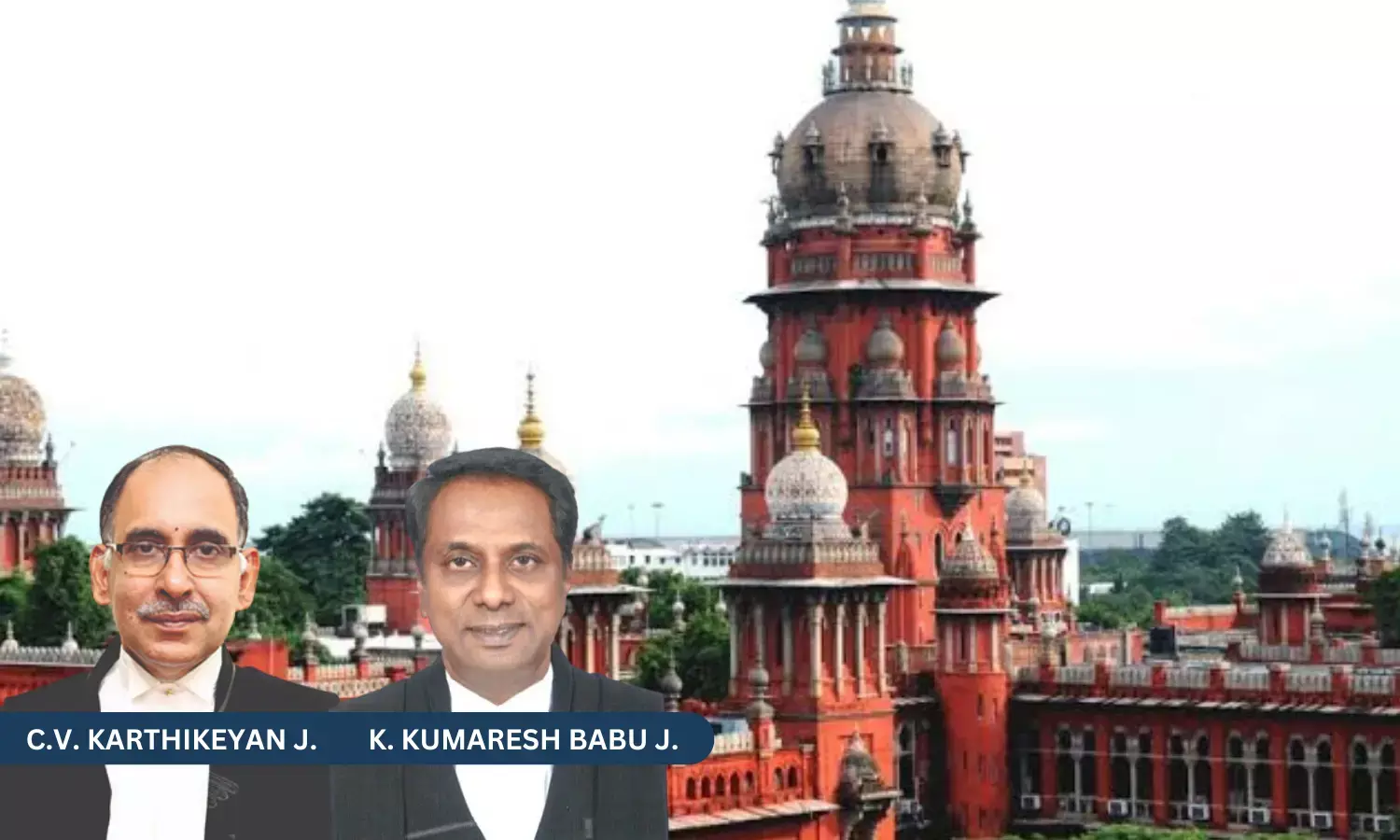
Justice C.V. Karthikeyan, Justice K. Kumaresh Babu, Madras High Court
While modifying the punishment imposed upon an Enquiry cum Reservation Clerk of the Railways, the Madras High Court has held that alleged delinquency need not be proved by strict proof of evidence and it is enough if such delinquency is driven by probabilities of the case.
The High Court was considering a writ petition seeking the quashing of the order of the Central Administrative Tribunal passed in an Original Application.
The Division Bench of Justice C.V. Karthikeyan and Justice K. Kumaresh Babu held,“The sequence of events would drive home the probability of the delinquency that has been committed by the first respondent. It is the service law jurisprudence that the alleged delinquency need not be proved by strict proof of evidence and that it is enough that such delinquency could be driven by probabilities of the case.”
ASGI AR.L.Sundaresan represented the Petitioner while Advocate L.Chandrakumar represented the Respondent.
Factual Background
As per the petitioners, the first respondent was appointed as Enquiry cum Reservation Clerk in the year 2006 and was working under the pay band of Rs.5200-20200 to the grade pay of Rs.2,800. In 2020, information was received that some of the Enquiry-cum-Reservation clerks were accepting the bunches of applications from touts and generating tickets, over-looking the priority of passengers waiting in the queue. A preventive check was conducted and the first respondent was found to have accepted 8 reservation applications from a single person and had generated 8 Tatkal tickets for the same person over-looking the passengers who stood in the queue.
Even though the tickets had been generated, no cash was collected and there was a shortage of Rs.18,051. The respondent was thus claimed to have contravened the provisions of the Railway Service Conduct Rules. After a full-fledged enquiry, he was also imposed with a punishment of a reduction of pay in two stages for a period of 40 months. On an Appeal filed by the first respondent, the punishment was modified to the reduction of pay by two stages for six years from the date of imposition of penalty, after which the seniority and grade pay would be restored with normal increments. Being aggrieved, he approached the Central Administrative Tribunal. The matter was remitted with a direction to issue a fresh charge sheet.
Reasoning
On a perusal of the facts of the case, the Bench noted that the first respondent had generated tickets based on reservation forms without being handed over to him across the counter, and such reservation forms had been collected by him in advance before the start of his duty. The Bench held that he had violated the norms for the issuance of tickets. On these admitted facts, the Bench stated that there was no necessity to examine any independent witness.
The Bench was of the view that, in all probabilities, the delinquency committed by the first respondent had been proved, and the Bench also did not find any procedural violations to hold that the disciplinary proceeding stood vitiated.
The Bench noted that the disciplinary authority had imposed a punishment of a reduction in pay from Rs 10410 to Rs 9640 in the present pay band and to remain constant for a period of 40 months with cumulative effect from the date of issue of the order. However, the Appellate Authority had modified the punishment to a reduction of pay by two stages for six years from the date of imposition of penalty, after which his seniority, Grade and pay would also stand restored, including the normal increments during the period of punishment; however, the Grade Pay was directed to remain constant.
Considering the delinquency committed by the first respondent, which was proved in all probabilities, the Bench held that the nature of modified punishment as imposed by the Appellate Authority could be sustained with the modification only in respect of the period alone, and the said period can be modified to three years instead of six years.
Thus, allowing the Writ Petition, the Bench imposed the punishment as ordered by the Appellate Authority with the aforementioned modification.
Cause Title: Union of India v. B.Shankar Kumar (Case No.: Writ Petition No.22359 of 2024)
Appearance
Appellant: ASGI AR.L.Sundaresan, Advocate AR.Sakthivel
Respondent: Advocate L.Chandrakumar