

Can’t Infer Contributory Negligence Merely Because Deceased Driver Didn't Wear Helmet: Madras High Court Upholds MACT Award
The appellant had preferred the appeal before the Madras High Court challenging the award of the Motor Accident Claims Tribunal on the ground of negligence.

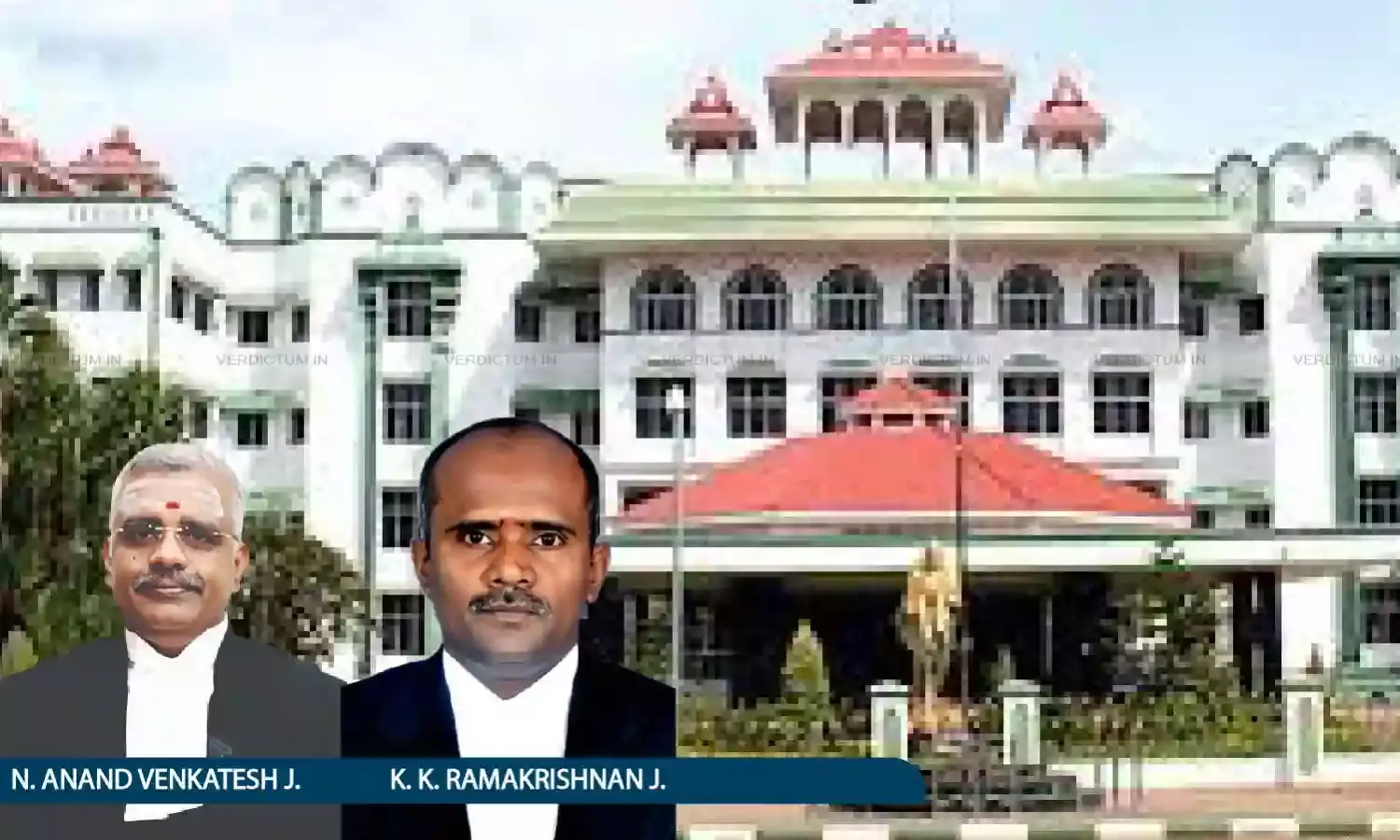
Justice N. Anand Venkatesh, Justice K. K. Ramakrishnan, Madras High Court
The Madras High Court has held that the question of apportioning contributory negligence on the sole ground of non-wearing of a helmet does not arise in the absence of any evidence to establish negligent riding on the part of the deceased.
The appellant had preferred the appeal before the High Court challenging the award of the Motor Accident Claims Tribunal on the ground of negligence.
The Division Bench of Justice N. Anand Venkatesh and Justice K. K. Ramakrishnan held, “In the absence of any evidence to establish negligent riding on the part of the deceased, the question of apportioning contributory negligence on the sole ground of non-wearing of a helmet does not stand to reason. Even in cases where fatal head injuries are sustained, the same cannot automatically lead to an inference of contributory negligence. Therefore, the Tribunal has taken a balanced view in fixing 7% contributory negligence on the deceased.”
“In the absence of any evidence to establish negligent riding on the part of the deceased, the question of apportioning contributory negligence on the sole ground of non-wearing of a helmet does not stand to reason. Even in cases where fatal head injuries are sustained, the same cannot automatically lead to an inference of contributory negligence”, it added.
Advocate S.Micheal Heldon Kumar represented the Appellant, while Advocate M.Manivelpandian represented the Respondent.
Factual Background
The case, as set up by the claimant, was that the victim, while riding his two-wheeler, was hit by a bus belonging to the appellant, Tamil Nadu State Transport Corporation, which came from the opposite direction in a rash and negligent manner. Due to the impact, the victim sustained grievous injuries, which resulted in his death. The dependents of the deceased filed a claim petition seeking compensation of Rs 80,00,000. The appellant Transport Corporation filed a counter statement denying the manner of the accident, negligence on the part of its driver, and also disputing the quantum of compensation claimed.
Considering the fact that the deceased was not wearing a helmet at the time of the accident, the Tribunal fixed 7% contributory negligence on the deceased and 93% on the driver of the appellant Corporation. The Tribunal granted a compensation of Rs 28,85,790.
Arguments
It was the case of the appellant that the deceased was not wearing a helmet at the time of the accident and, having sustained fatal head injuries, a proportionate deduction ought to be made towards contributory negligence on account of violation of the statutory provisions under the Motor Vehicles Act.
Reasoning
The Bench, at the outset, reaffirmed that mere violation of statutory provisions, such as non-wearing of a helmet, does not ipso facto confer a right upon the tortfeasor to plead contributory negligence, unless it is established that such violation had a direct nexus with the occurrence of the accident.
The Bench thus stated, “It is also pertinent to note that the object of wearing a helmet is primarily a safety measure intended to minimize or prevent the severity of head injuries. It does not, in any manner, prevent the happening of the accident. Therefore, the non wearing of a helmet cannot be construed as a causative factor for the accident itself. Though in certain earlier decisions, this Court have, in peculiar factual circumstances, applied a limited deduction towards contributory negligence on account of non-wearing of a helmet, in view of subsequent development of law by the Hon’ble Supreme Court that mere violation provision of the Motor Vehicles Act, 1988, without anything more, cannot lead to a conclusion of contributory negligence, unless it is established that his very act of riding along with two others, contributed either to the accident or to the serious impact upon the victim.”
Reaffirming that there must either be a causal connection between the violation and the accident or a causal connection between the violation and the impact of the hit upon the victim, the Bench clarified that such an approach cannot be adopted universally. “The determinative factor remains whether there was any negligence in the manner of driving on the part of the deceased contributing to the accident”, it added.
As per the Bench, the Tribunal had taken a balanced view in fixing 7% contributory negligence on the deceased. In the absence of any material to show that the deceased contributed to the cause of the accident, the Bench held that the enhancement of the percentage of contributory negligence, as sought by the appellant, was not warranted.
Dealing with the issue of quantum of maintenance, the Bench noted that the deceased, aged 41 years, was engaged in wood contract business at the time of the accident. On a perusal of the facts of the case, the Bench held that there was no infirmity in fixing the monthly income of the deceased at Rs 18,000 and awarding Rs.28,85,790 as total compensation.
Thus, finding no merit in the appeal, the Bench dismissed the same.
Cause Title: The Managing Director v. Mariyammal (Case No.: C.M.A.(MD).No.445 of 202)