

Exercise Of Inherent Powers Under Section 151 CPC Cannot Extend To Granting Relief Not Claimed: Madras High Court
The High Court held that while civil courts possess limited power to mould or modify reliefs, such authority does not extend to granting a substantive relief which has not been prayed for.
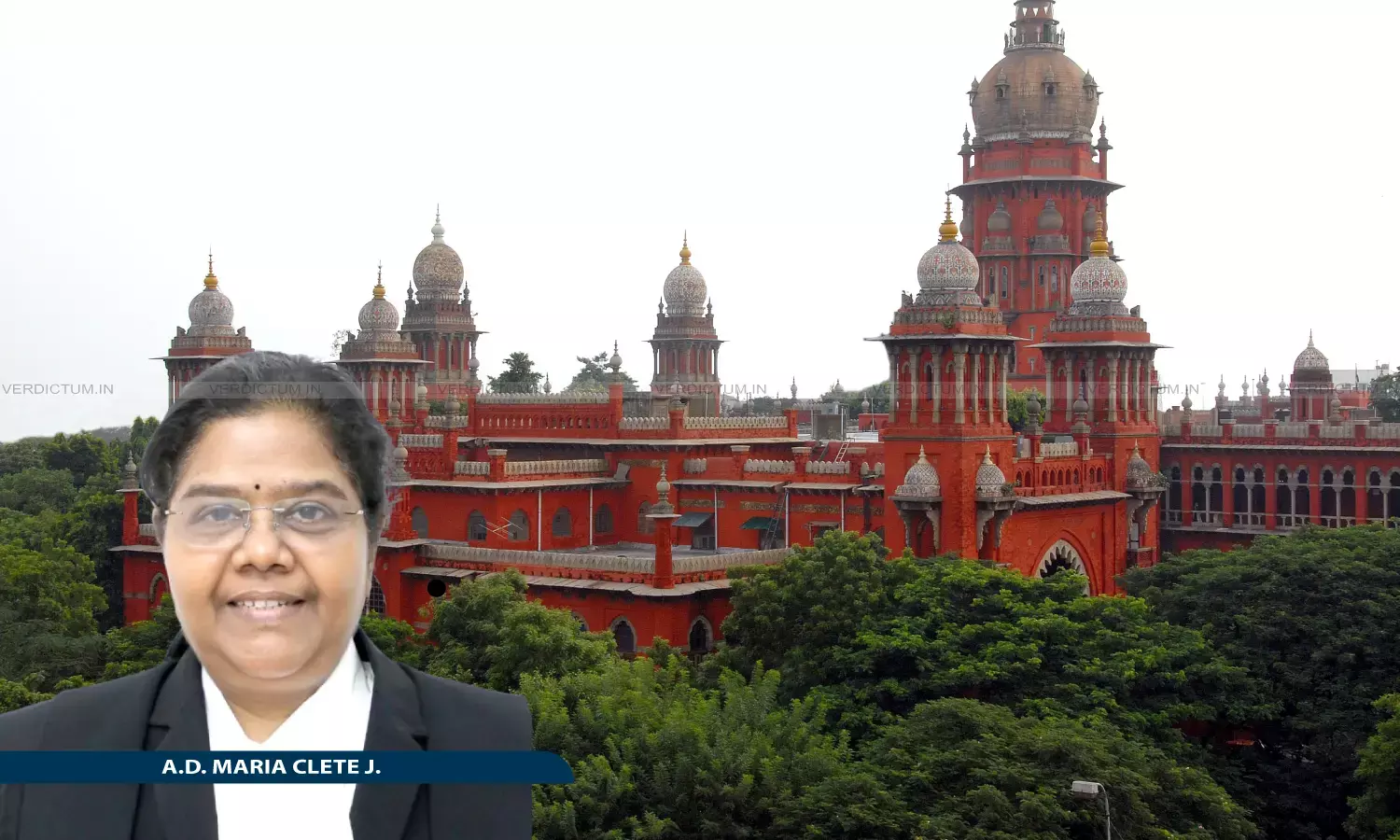
Justice A.D. Maria Clete, Madras High Court
The Madras High Court held that a civil court cannot invoke its inherent powers under Section 151 of the Code of Civil Procedure, 1908, to grant a relief which has not been specifically claimed by a party in its pleadings, even if such relief appears equitable or consequential.
The Court was hearing a first appeal arising from a decree passed by the I Additional District Court, Salem, wherein the trial court, while declaring certain property transactions void, directed the plaintiff to pay a sum of money to a defendant who had not sought such relief by way of pleadings or counter-claim.
A Bench of Justice A.D. Maria Clete, while examining the scope of a civil court’s power to mould relief, observed: “It is no doubt true that, in appropriate cases, a civil court may mould or modify the relief sought, either by granting a lesser relief than that prayed for or by exercising its inherent powers under Section 151 CPC. However, such power does not extend to granting a relief which has not been prayed for at all”.
Senior Advocate T. Murugamanickam represented the appellant, while Advocate C. Jagadish represented the respondents.
Background
The suit was instituted by the plaintiff seeking a declaration that a sale deed and a connected agreement of sale executed in respect of her property were null and void. The plaintiff contended that the documents had been brought into existence through the misuse of a power of attorney and were intended solely to secure a loan transaction.
The defendants contested the suit, asserting that the transactions were genuine, supported by consideration, and executed with the plaintiff’s knowledge and consent. No counter-claim or independent plea seeking recovery of money was raised by any of the defendants.
The trial court decreed the suit by declaring the impugned documents void. However, while doing so, it also directed the plaintiff to pay a sum of ₹5,00,000 with interest to one of the defendants, despite the absence of any pleading, prayer, or payment of court fee in support of such relief.
Aggrieved by the decree, the third defendant preferred the present appeal.
Court’s Observation
The High Court examined the scope of a civil court’s power to mould or modify reliefs and noted that such power is circumscribed by the pleadings of the parties. It observed that although courts may, in appropriate cases, grant a lesser relief than what is prayed for, or exercise inherent powers under Section 151 CPC, such powers do not extend to granting a relief that has not been claimed at all.
The Court held that granting relief beyond the pleadings violates the settled principle that a court cannot travel “ultra petita”. It observed that “while a court may mould relief, it cannot confer a substantive benefit upon a party who has not sought such relief through pleadings”.
The High Court further noted that the defendant in whose favour the money decree was granted had neither pleaded indebtedness nor sought recovery by way of a counter-claim. The Court held that “the trial Court, without adverting to these fundamental aspects, mechanically granted a money decree as though it possessed unbridled authority to do so”.
On the merits of the declaration granted by the trial court, the High Court found no infirmity. It was observed that the evidence on record supported the plaintiff’s case that the impugned sale deed and agreement had been executed under suspicious circumstances and did not reflect a genuine transfer of title.
While stating that “the doctrine of alternative remedy merely regulates the maintainability of proceedings and the discretion of the Court in entertaining a claim”, the Bench concluded that “the trial Court, in granting a money decree in favour of the second defendant despite the absence of any pleading or counter-claim, acted in derogation of the settled principle, judex ne eat ultra petita partium”.
Conclusion
The Madras High Court upheld the trial court’s decree declaring the impugned sale deed and agreement of sale as null and void.
However, it set aside the direction requiring the plaintiff to pay ₹5,00,000 with interest to the defendant, holding that the grant of such relief without any pleading or prayer amounted to a jurisdictional error.
The appeal was dismissed, subject to the above modification.
Cause Title: Thangapandiyan v. Jayalakshmi & Ors.
Appearances
Appellant: T. Murugamanickam, Senior Advocate
Respondents: Advocate C. Jagadish
