

S. 106 Evidence Act | Husband And Wife Cannot Be Assumed To Be Seen Together Always: Madras HC Acquits Wife In Murder Case
Court says burden cannot shift to wife merely because parties are husband and wife; prosecution must first establish foundational facts before drawing adverse inference

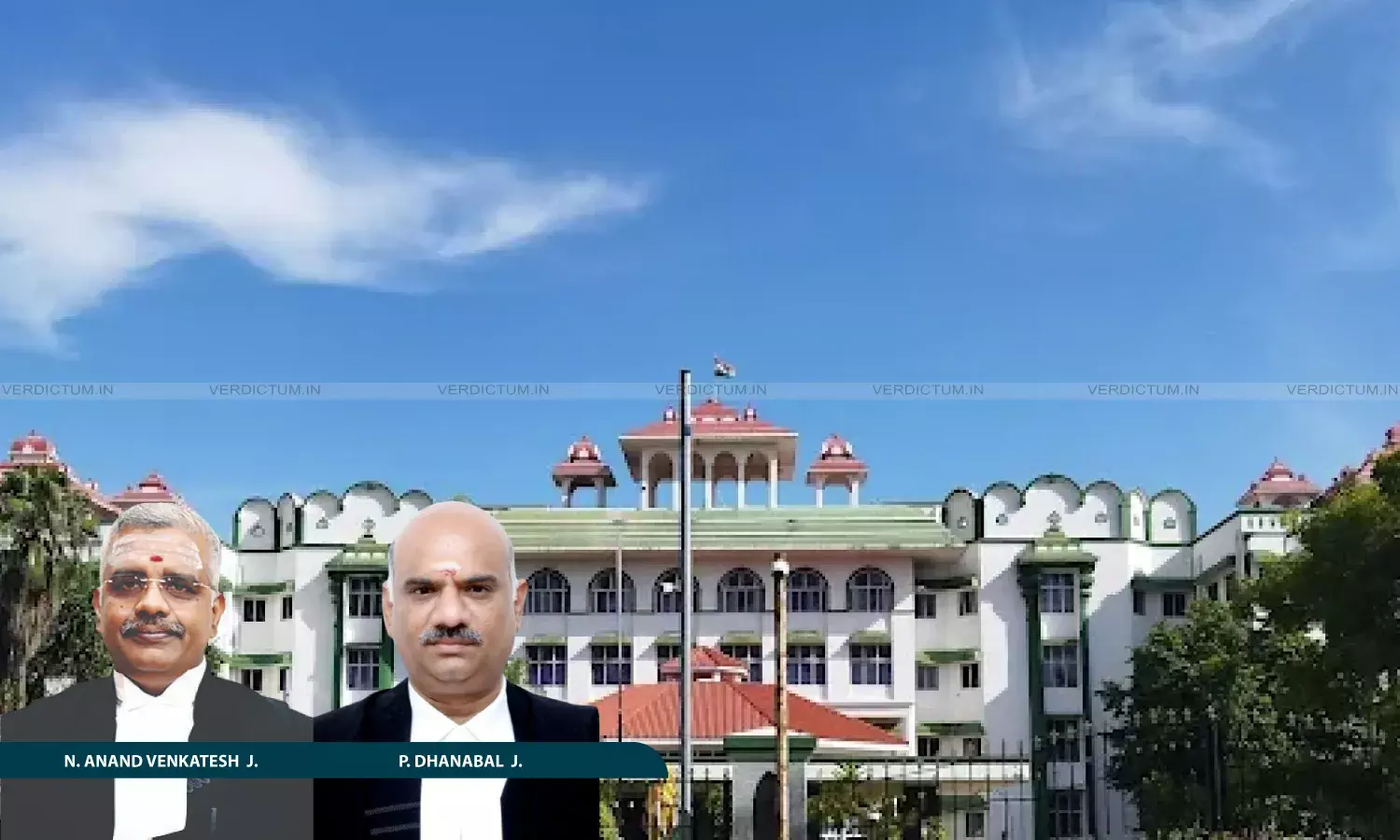
The Madras High Court, Madurai Bench has set aside the conviction of a woman accused of murdering her husband, holding that the prosecution cannot rely on Section 106 of the Indian Evidence Act, 1872 to shift the burden onto the accused unless the foundational facts, particularly the “last seen together” circumstance, are first established.
The Court further observed that merely because the accused was the wife of the deceased, it cannot be presumed that she was necessarily present with him at the time of the incident. Such an assumption, the Court said, cannot replace proof required in criminal law.
Justice N. Anand Venkatesh and Justice P. Dhanabal observed, “Just because A1 happened to be the wife of the deceased, it cannot be assumed that she will always be present with the deceased inside the house. Some witness had to necessarily speak about her presence in the house prior to the incident or atleast the previous day, since the incident is said to have taken place early in the morning at 2.00 a.m. If this foundational fact is not established, Section 106 of the Act will not come into play.”
“In the case on hand, there is no material available to establish the fact that A1 and the deceased were last seen together before the incident. In such an event, an adverse inference cannot be drawn against A1 and Section 106 of the Act cannot be resorted to. Just because the parties happened to be husband and wife, the Court cannot assume that they will always be seen together. Even in such a relationship, it is not a question of assumption and in law, it is a question of fact. Therefore, even in a case involving husband and wife, factually the prosecution has to prove by letting in evidence to the effect that they were last seen together”, the Bench further noted.
The Bench thus allowed the criminal appeal filed by the accused, who had been convicted by the Additional District and Sessions Judge, Virudhunagar, under Section 302 IPC and was sentenced to life imprisonment.
Advocate M. Jothibasu appeared for the appellant and A. Thiruvadikumar, Additional Public Prosecutor appeared for the respondent.
According to the prosecution, the accused-wife allegedly killed her husband in the early hours of 29-09-2017, by dropping a grinding stone on his head while he was asleep. The alleged motive was that the deceased had discovered her illicit relationship with another man and had confronted them about it. The police registered an FIR and filed a charge sheet for offences under Section 302 IPC and related provisions.
Thereafter, during the trial, the prosecution examined 22 witnesses, however, several key witnesses including the father of the deceased, turned hostile. The trial court nevertheless convicted her primarily on circumstantial evidence, relying on the theory that since the incident occurred inside the house where the couple lived, the accused had a duty to explain the circumstances of death.
The Court found serious gaps in the prosecution’s case as it noted that the evidence of the witnesses did not establish that the accused and the deceased were last seen together before the incident. The Court observed that the prosecution had proved only the motive and certain aspects of the accused’s conduct after the incident, which by themselves were insufficient to complete the chain of circumstances.
Therefore, while setting aside the trial court’s judgment, acquitted the appellant of all charges, directing that she be released.
Cause Title: Selvi v. The State [Neutral Citation: 2026:MHC:961]
Appearances:
Appellant: M. Jothibasu, Advocate.
Respondent: A. Thiruvadikumar Additional Public Prosecutor.