

Madras High Court: Registration Of Will Can’t Be Considered As Proof; But Presumption Could Be Drawn About Its Genuinity
The Madras High Court reiterated that when the Will is a registered document, it creates a presumption regarding genuineness thereof.
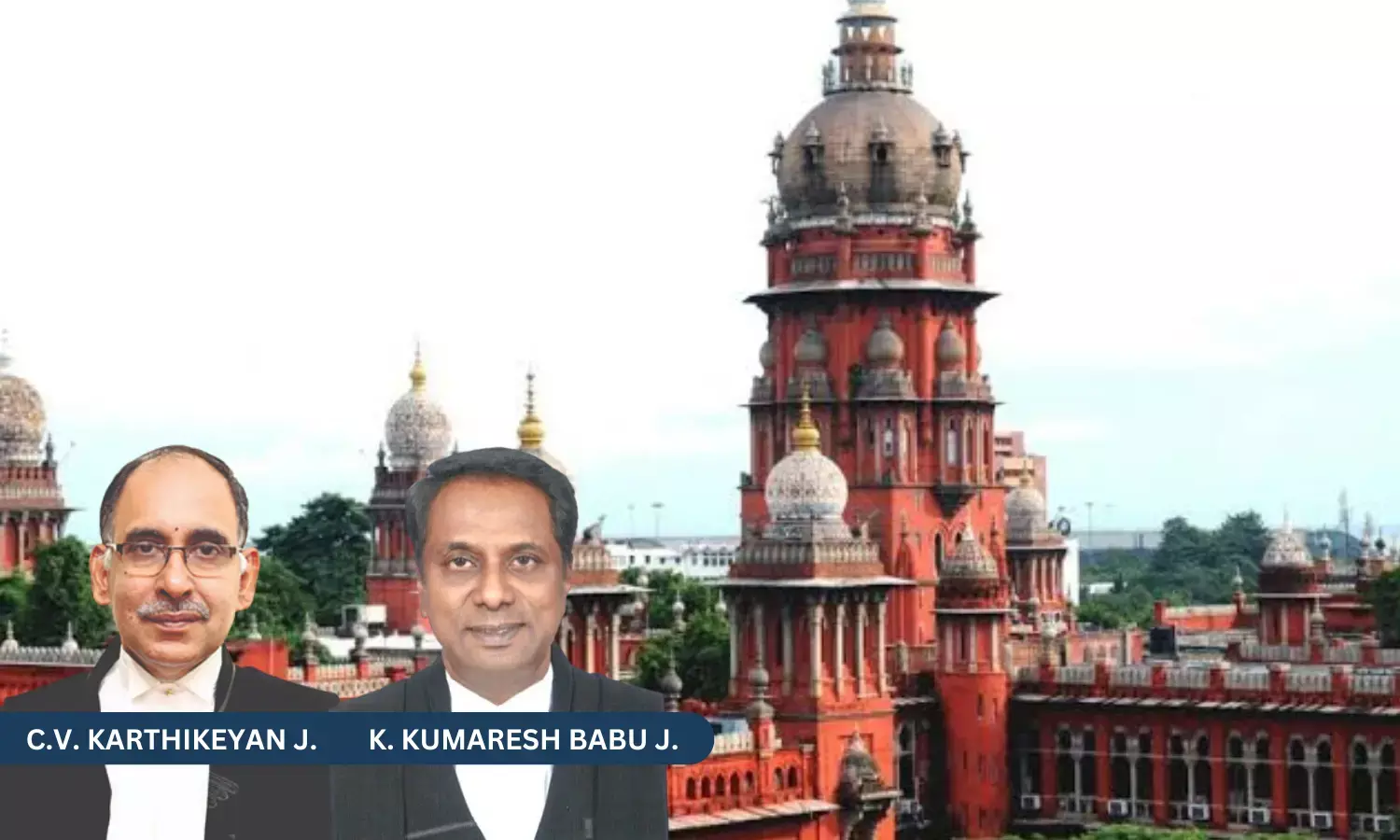
Justice C.V. Karthikeyan, Justice K. Kumaresh Babu, Madras High Court
The Madras High Court has explained that even though registration of a Will cannot be considered as proof of the Will, still a presumption could be drawn about the genuinity of the Will.
The Court was hearing an Appeal filed under Order XLI Rule 1 read with Section 96 of the Civil Procedure Code, 1908 (CPC), challenging the Judgment of the Additional District Judge.
A Division Bench of Justice C.V. Karthikeyan and Justice K. Kumaresh Babu observed, “Both DW-2 and DW-3 also stated that they had affixed the signatures under the instructions of the testator. We therefore hold that there has been compliance of the stipulations required under Section 63(c) of the Act. The witnesses had also spoken about the execution of the Will. … The additional factor to be considered is that the Will, Ex.B-1 is a registered Will. Even though registration of a Will cannot be considered as proof of the Will, still a presumption could be drawn about the genuinity of the Will.”
The Bench reiterated that when the Will is a registered document, it creates a presumption regarding genuineness thereof.
Advocate T.S. Baskaran represented the Appellants, while Advocates D. Baskar and R. Gururaj represented the Respondents.
Facts of the Case
During the pendency of the Appeal, the First Appellant died and his legal representatives were brought on record as third to sixth Appellants. The First and Second Appellants were the brothers of the First and Second Respondents. The said Respondents had filed a suit seeking partition and separate possession of their ½ share in the suit schedule property. The suit schedule property was land and building measuring 3150 square feet.
By Judgment, a preliminary decree was passed granting partition of the suit schedule properties. Questioning that Judgment and Preliminary decree, the Defendants had approached the High Court. It was a suit filed by two sisters against their two brothers seeking partition and separate possession of one property left behind by their father and claiming an undivided 1/4th share each in the said property. The said property was a residential house. They claimed that their father died intestate.
Reasoning
The High Court in the above context of the case, said, “In the instant case, though the evidence of DW-2 cannot be said to inspire confidence to the fullest extent, still the witness had denied the suggestion that the signature in Ex.B-1 was not that of Subramania Mudaliar. It must again be kept in mind that during the cross examination, two separate Wills namely Ex.A-1 and Ex.B-1 executed by Subramania Mudaliar were shown to the witness and they were asked to identify the signatures alternatively in both the Wills. Moreover nearly 8 years and above have crossed by the time, the witnesses were cross examined.”
The Court was of the view that some leverage should be granted to the witnesses for not remembering minute details surrounding the execution of the Will.
“DW-3 had also spoken about the execution of the Will. DW-4 had very specifically stated that he had prepared the Will under the directions of Subramania Mudaliar”, it added.
The Court referred to the case of Metpalli Lasum Bai (since dead) and Others v. Metapalli Muthaih (D) by LRs. (Civil Appeal No. 5921 of 2015), in which it was held that, as the Will is a registered document, the burden would lie on the party, who disputed its existence, to establish that, it was not executed in the manner as alleged or that there were suspicious circumstances which made the same doubtful.
“In the instant case, except for stating that there was an earlier Will in the year 1997 about which there was no mention in the plaint and which will the plaintiffs had not also marked during their evidence, no other suspicious circumstances had been raised by the respondents. They claimed that they have been disinherited by Ex.B-1 but a reading of Ex.B-1 shows that the testator had also stated that both the respondents are married and provided for sufficiently and there was no reason to beaqueath any portion of the property to them”, it noted.
Conclusion
The Court further remarked that having filed a suit claiming their father died intestate, and still producing Will claimed to have been executed by the father would only show that the Respondents/Plaintiffs have approached the Court with unclean hands, which also would non-suit them for the relief sought for
“In view of the above reasons, we hold that the learned Trial Judge had misdirected himself regarding the evidence adduced relating to the proof of the Will and should have taken a considered view of the evidence adduced by DW-2, DW-3 and DW-4 and should not have rejected Ex.B-1 as not having been proved in manner known to law”, it concluded.
Accordingly, the High Court allowed the Appeal and set aside the impugned Judgment.
Cause Title- Paneerselvam @ Nellappan (died) & Ors. v. Amsavalli (Case Number: A.S.No. 521 of 2011)
