

Crime Remaining ‘Undetected’ Due To Inaction Of Investigating Machinery Violates Article 21: Madras High Court Issues Directions
The Madras High Court said that the duty of the State to investigate crimes effectively is not a matter of grace or convenience.
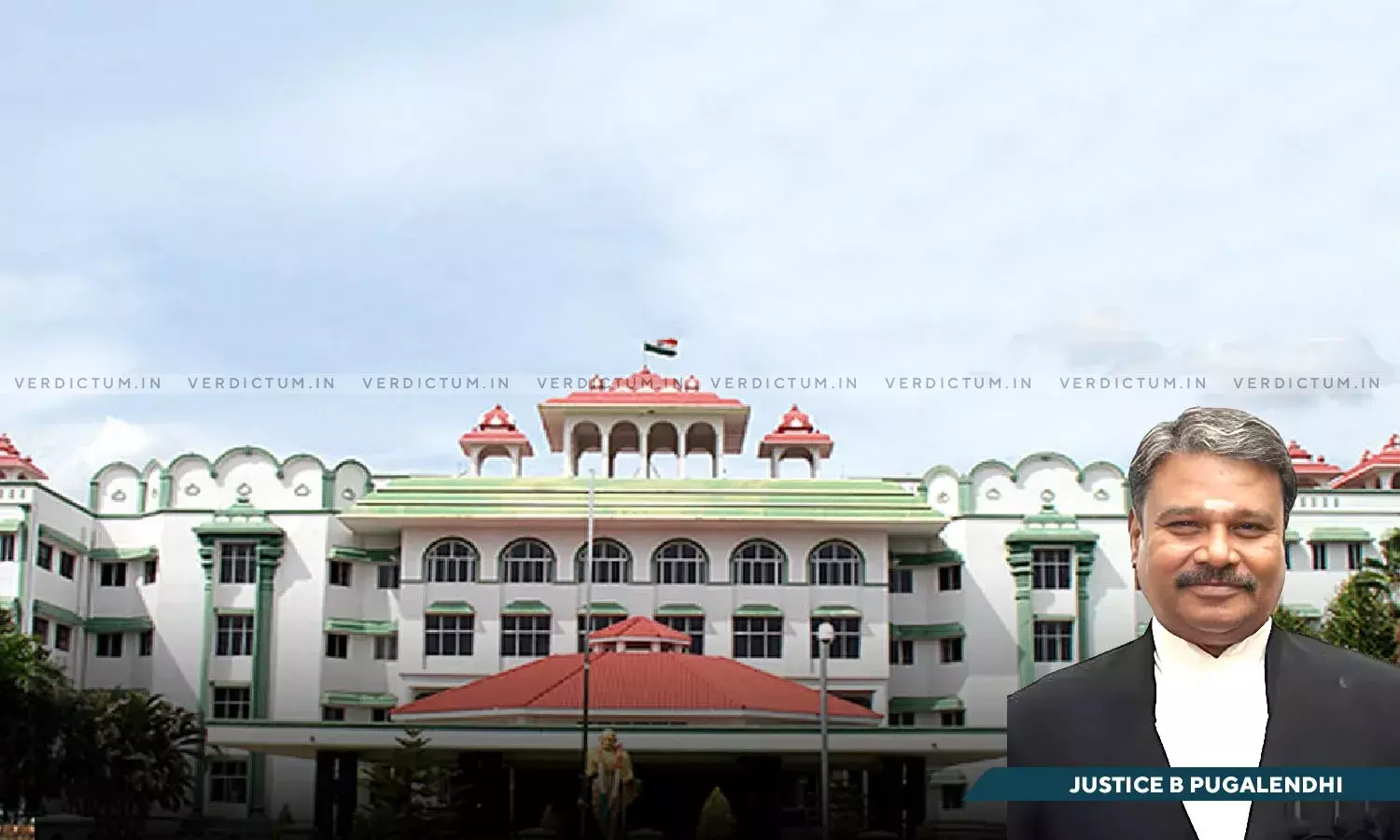
Justice B. Pugalendhi, Madras High Court, Madurai Bench
The Madras High Court held that when a crime remains ‘undetected’ due to lapses or inaction of the investigating machinery and the victim is left without recovery for years, it amounts to violation of Article 21 of the Constitution.
The Madurai Bench was deciding a batch of Criminal Original Petitions seeking appropriate directions to the police either to conduct further investigation, or to transfer the investigation to another agency, or to file the final report within a time frame fixed by the Court, in respect of cases which have been reported as ‘Undetected’.
A Single Bench of Justice B. Pugalendhi observed, “… when a crime remains “undetected” due to lapses or inaction of the investigating machinery, and the victim is left without recovery or closure for years, it constitutes a violation of Article 21. The Court, as guardian of fundamental rights, must step in to provide limited monetary relief as a measure of public law compensation. This power flows from the same constitutional foundation that empowers the State to prosecute offences in the name of the public. The object of such compensation is not to punish individual officers or to substitute civil damages, but to recognise the failure of the system as a whole and to impose corrective responsibility upon the State. It also serves as a reminder that justice delayed or denied at the investigative stage is as grave a violation as any miscarriage at the trial stage.”
The Bench said that the duty of the State to investigate crimes effectively is not a matter of grace or convenience; it is an integral part of the constitutional guarantee under Article 21 of the Constitution of India.
Advocate S. Vashik Ali represented the Petitioner, while Additional Public Prosecutor (APP) T. Senthil Kumar represented the Respondents.
Brief Facts
In the lead case, the Petitioner was the Complainant in a crime registered for the offences under Sections 380, 454, and 457 of the Indian Penal Code, 1860 (IPC) in June 2022. The Petitioner had gone to attend a function at Pallathur and thereafter to Neyveli to stay with her husband. On June 1, 2022, she was informed that her house had been broken open. Upon returning, she found that jewels weighing 67 sovereigns and cash of Rs. 1,57,800/- were stolen. It was the Petitioner’s grievance that despite production of CCTV footage showing five unidentified persons breaking into her residence, no meaningful investigation has been conducted and no final report has been filed even after more than three years.
The APP submitted that the final report has been filed as ‘Undetected’, as no usable fingerprints were obtained and that the suspects traced to Maharashtra could not be apprehended. All the cases before the High Court raised a larger question about the manner in which investigations into property offences are conducted and the legal consequences of the State’s failure to effectively discharge this responsibility. Though each case involved an individual complaint of theft or house-breaking, together they highlighted a systemic concern — “when the State, having assumed the exclusive authority to investigate and prosecute criminal offences, fails to identify the offender and closes the matter as “undetected”, what becomes of the victim’s right to justice?”
Court’s Observations
The High Court in the above regard, noted, “In the early stages of human civilisation, the enforcement of criminal law was a private affair. The responsibility of protecting oneself and avenging a wrong rested solely with the individual or the community. As society evolved into an organised political State governed by law, the power to investigate, prosecute and punish offences was taken away from private citizens and vested in the State. This transformation was not merely administrative, but moral and constitutional in nature. It embodied the principle that crime is not only an offence against an individual but also an offence against the peace and order of society.”
The Court added that once this collective responsibility was assumed, the State became the guardian of public safety and the custodian of justice and every First Information Report (FIR) registered under the criminal law is, therefore, not a dispute between two private individuals but an assertion that the sovereign authority of law has been violated.
“The prosecution of offences in the name of the State is thus an acknowledgment of this constitutional arrangement — that it is the State’s solemn duty to ensure that wrongdoers are identified and victims are not left remediless. … The right to life and personal liberty includes within its scope the right to live with dignity, security and protection of one’s property. When an individual reports the commission of a cognizable offence, he is exercising his fundamental right to seek protection from the State”, it remarked.
The Court said that the State has a non-delegable duty to respond through a fair, competent and diligent investigation and the obligation of the police to continue investigation until the offender is brought to book is already a settled position of law.
“… the issue before this Court does not end with the procedural compliance by the police. The question that necessarily arises is —what is the position of the victim when the offender remains untraced and the crime continues to remain undetected for years together? The obligation of the State is not confined to bringing the offender to justice. It also extends to ensuring that the victim, who has suffered loss or injury, receives appropriate relief. However, the status report is silent in this regard”, it added.
The Court observed that there is no prohibition on the exercise of the powers of the High Court under Article 226 while dealing with matters under its criminal jurisdiction.
“Hence, this Court in exercise of the power of the judicial review under Article 226 and inherent jurisdiction under Section 482 CrPC can direct the payment of compensation so that the ends of justice is secured and the constitutional rights of the victims of crime are being protected”, it further said.
The Court also remarked that in these cases, the victims have waited for years without any progress or information and their stolen properties represent not only material loss but also a deep sense of helplessness against the machinery that was expected to protect them.
“The State, having failed in its duty to investigate and prosecute effectively, cannot now disclaim responsibility for the consequences of that failure. … The materials before this Court show that in each of these cases the investigation has been perfunctory and the petitioners, who are victims of theft, have been left without remedy. They have endured years of uncertainty and distress. The pattern of neglect disclosed in the records reveals failure of the State to perform its constitutional duty of protection”, it added.
Conclusion and Directions
Furthermore, the Court held that the Petitioners are entitled to compensation and that systemic directions must be issued to prevent recurrence of such failures.
The Court, therefore, issued the following directions –
i) The Home Department of the State shall pay monetary compensation equivalent to 30% of the value of the property reported stolen in each of these cases to the respective Petitioners within twelve weeks.
ii) This payment shall be recoverable from the Petitioners if the offender is subsequently identified and the property recovered.
iii) The Director General of Police shall implement the recommendations of the Committee headed by the ADGP, State Crime Records Bureau, Chennai.
iv) The State Crime Records Bureau shall review undetected cases on a quarterly basis to identify trends and issue advisories to field units.
v) The Director General of Police shall issue a circular reaffirming that filing an undetected report does not terminate investigation and that such cases must be periodically reviewed.
vi) The Director General of Police (Training) shall design refresher courses for investigating officers on evidence preservation, forensic procedures and victim communication.
vii) Further, the State can also consider setting up of a Special Investigation Team of experts in each District by picking and choosing eminent officers in order to investigate cases classified as “undetected” for more than 5 years. This Team must be provided with more infrastructure, more powers and also more pay. On the identification of the accused, the State can consider rewarding the officers involved to encourage them.
“Insofar as the individual relief sought for by the petitioners is concerned, the Investigating Officer concerned shall pursue the investigation with due diligence. It is open to the supervisory authorities to review the progress of investigation, and, if circumstances so warrant, to entrust the matter to a higher or specialised agency for proper and effective investigation”, it concluded.
Accordingly, the High Court disposed of the Petitions and issued necessary directions.
Cause Title- Vallikannu v. The District Superintendent of Police & Anr. (Neutral Citation: 2025:MHC:2688)
