

Theatrical Rights Don’t Include Satellite Telecast: Madras High Court Dismisses Copyright Claims Over Telugu Dubbed ‘Roja’
The Court reiterated that the film producer is the first owner of copyright under Section 17 and may independently assign theatrical, satellite and dubbing rights.

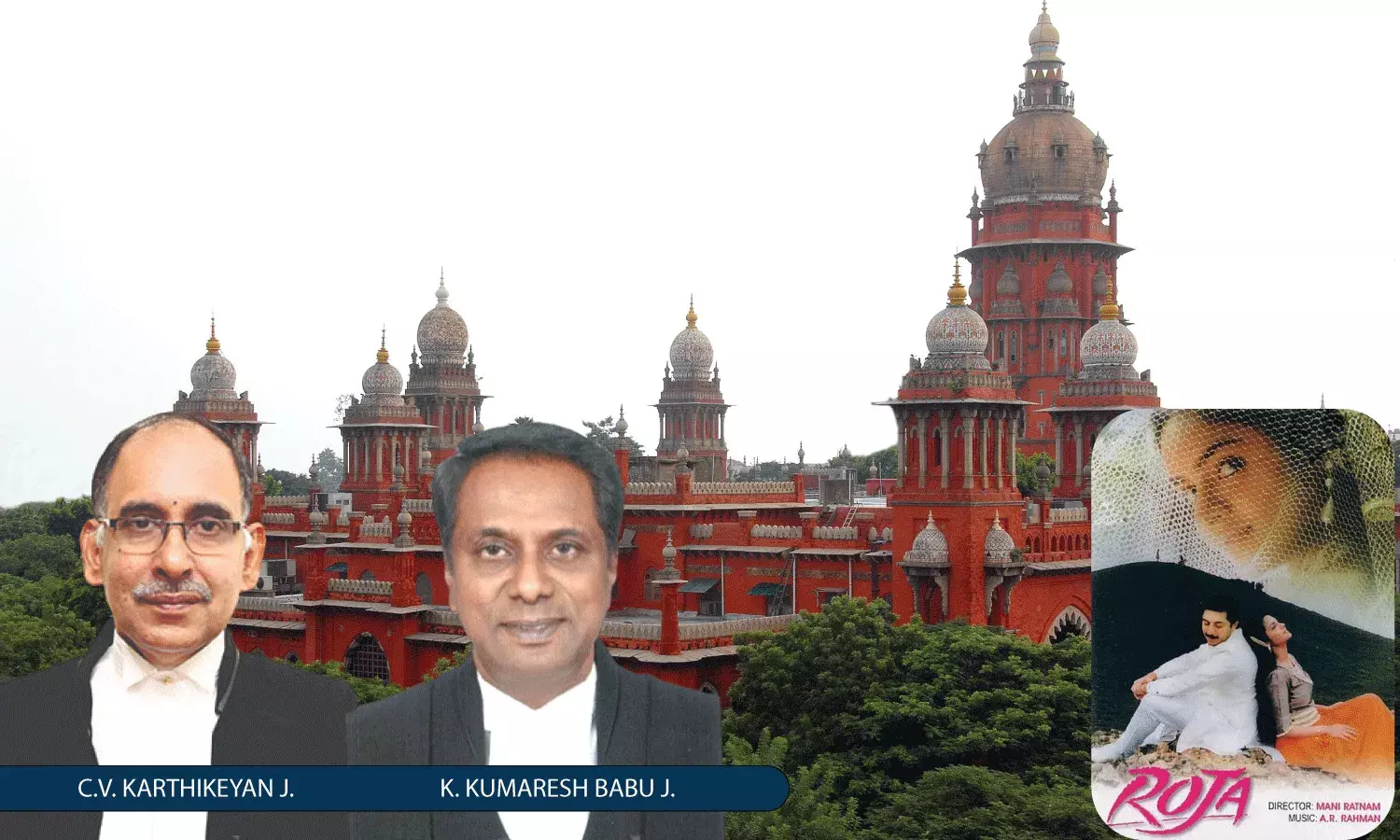
The Madras High Court has reaffirmed that the assignment of theatrical rights in a dubbed film does not automatically include satellite broadcasting rights, dismissing two appeals filed by Lahari Recording Co. Pvt. Ltd. over the alleged unauthorized satellite telecast of the Telugu dubbed version of the Tamil film Roja.
The Bench noted that under Section 17 of the Copyright Act, 1957, the producer of a cinematograph film is considered the first owner of the copyright and can assign different components of that copyright independently. The Court further observed that theatrical exhibition and satellite broadcasting are distinct and separately assignable rights in a cinematograph film. Therefore, the producer was entitled to grant satellite rights to another party without infringing the plaintiff’s contractual rights.
The Bench upheld the judgment of a Single Judge noting that the plaintiff, which had obtained rights only to dub the film into Telugu and exploit it theatrically in specified territories, could not restrain the defendants from exercising satellite television rights separately assigned by the original producer.
Justice C.V. Karthikeyan and Justice K. Kumaresh Babu observed, “Under Section 17 of the Copyright Act, 1957, the person at whose instance for valuable consideration the cinemascope film is made is deemed to be the first owner of the copyright. In common parlance, such individual is called the producer of the film. It is at the instance of the producer for valuable consideration that any movie is made. As the first owner of the copyright, the producer has a right to assign the copyright either wholly or in parts. At the time when the Tamil film Roja had been released, there were two separate and distinct rights which could be assigned by the first owner of the copyright namely, exhibition of the movie in theatres and exhibition of the movie via satellite television. The producer can also assign the right to dub / remake of the movie in any other language and even for the dubbed versions, independently theatrical and satellite rights could be assigned to different individuals”.
N. Surya Senthil, Partner, M/s. Surana and Surana appeared for the appellant and P.R. Raman, Senior Counsel appeared for the respondent.
In the matter, Lahari Recording Co. had entered into an agreement dated 16-06-1992 with Kavithalayaa Productions Pvt. Ltd., the producer of the Tamil film Roja directed by Mani Ratnam.
Under the agreement, Lahari was granted exclusive rights to dub or remake the film into Telugu and exploit the dubbed version in certain territories including Andhra Pradesh and parts of Orissa for 25 years, after paying ₹34.5 lakh as consideration.
The company subsequently dubbed the film into Telugu and released it in certain regions. However, it later learned that Jain Television intended to telecast the Telugu version of the film through its satellite network in 06-12-1994. Alleging that it held exclusive rights over the Telugu version, Lahari filed a suit seeking a permanent injunction to restrain the telecast.
In a separate suit, the company also sought ₹1 crore in damages, claiming that the telecast had infringed its copyright in the dubbed version of the film.
Now, the defendants argued that Lahari had only acquired theatrical rights to the Telugu dubbed version and that satellite broadcasting rights had never been assigned to it. They contended that the producer, as the original copyright holder, retained the power to assign different rights separately and had subsequently granted satellite rights to another entity.
The Bench noted that the agreement relied upon by Lahari clearly limited its rights to dubbing the film into Telugu and exploiting the dubbed version primarily through theatrical exhibition within specified territories. Satellite broadcasting rights were not part of that assignment.
“In view of the fact that satellite rights had not been granted, the appellant can never seek any relief restraining exploitation of the satellite rights by the 1st respondent to whom such rights had been specifically given by the producer of the movie / 2nd respondent. The arguments of the learned counsel for the appellant that under Section 13(1)(b) of the Copyright Act, 1957 the word 'original' had been omitted with respect to cinematograph films, would not take the appellant anywhere. The appellant’s rights are restricted only to the right granted by the first owner of the copyright, namely the 2nd respondent. The appellant cannot seek to expand that right any further”, the Bench noted.
The Court, thus, concluded that there was no copyright infringement, and consequently, the claims for injunction and ₹1 crore damages were rejected. Accordingly, dismissed the appeals and upheld the earlier judgment dismissing the suits with costs.
Cause Title: Lahari Recording Co. P. Ltd. v. Jain Television & Ors. (Mala Publicity Service P Ltd) [Neutral Citation: 2026:MHC:942]
Appearances:
Appellant: N. Surya Senthil For M/s. Surana and Surana, Advocate.
Respondents: S. Vijayaraghavan, P.R. Raman, Senior Counsel, A.Umasankar, Kumarapal R. Chopra, Advocates.