

Additional Intake Cannot Be Denied Solely On Unsubstantiated Need Assessment: Madras High Court Directs BCI To Reconsider Applications By Law Colleges
Approval for additional intake must be determined after inspection of infrastructural and instructional facilities

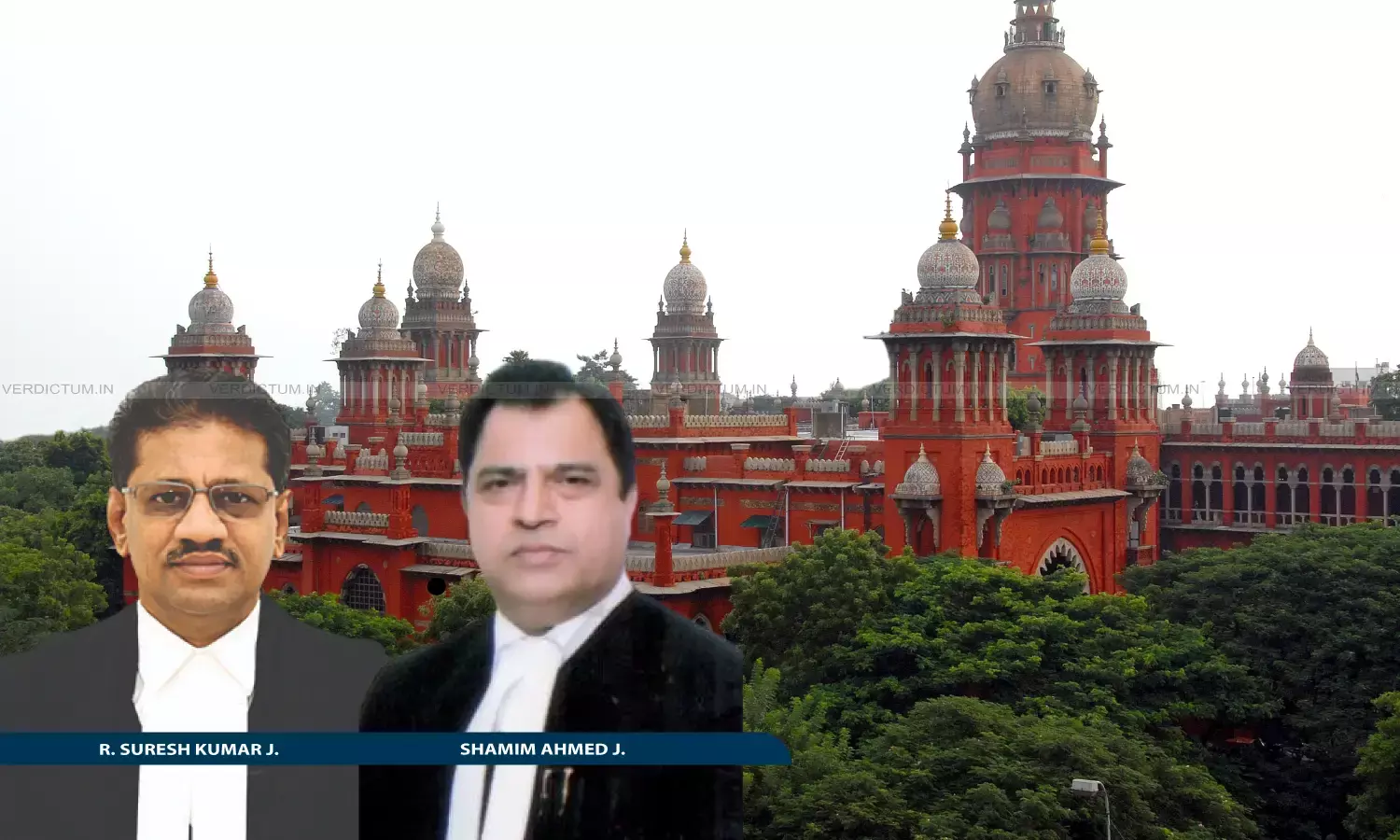
The Madras High Court has directed the Bar Council of India (BCI) to process within three weeks the applications filed by nine existing law colleges in Tamil Nadu seeking approval for additional intake for the academic year 2025–26, holding that such applications cannot be rejected or returned solely on the basis of a blanket moratorium or an unsupported “need-basis” policy.
The Court held that once the earlier three-year moratorium imposed by the BCI stood replaced by a subsequent Resolution, there could be no impediment to considering applications of existing institutions on their individual merits. It clarified that approval for additional intake must be determined after inspection and verification of infrastructural and instructional facilities, and not on generalized policy assertions lacking empirical backing.
A Division Bench comprising Justice R. Suresh Kumar and Justice Shamim Ahmed delivered a common order in a batch of writ petitions led by KMC College of Law, concerning nine existing law colleges affiliated to the Tamil Nadu Dr. Ambedkar Law University.
“…since all these writ petitioners are existing CLEs and they made applications only seeking approval for starting additional intake in the existing Courses alone, the moratorium or need-basis decision would not apply to these cases. When that being the position, there could be no impediment for the BCI to process these applications and to take a decision on meritbasis”, the bench observed.
On BCI’s submissions that there are records to show or data to establish that no new CLEs are required in some of the areas, the bench observed, “Insofar as this data is concerned, the same is not available as part of the policy decision reflected in the Resolution dated 11.01.2026. However, if such a decision is taken by the BCI to put a ban on CLEs to be established hereinafter on the basis of such data, where, on need-basis, there is no further need to establish any new Institution, additional intake or additional course, such a drastic decision could be taken by the BCI supported by data and in the absence of any such data being filed before this Court for judicial scrutiny, we do not wish to comment on the decision taken by the BCI on the arena of need-basis”.
Dakshayani Reddy, Senior Counsel appeared for the petitioner and A. Selvendran, Special Government Pleader appeared for the respondent.
The petitioners, all existing Centres for Legal Education (CLE) had applied for approval to commence additional sections in the three-year LL.B. and five-year integrated B.A., LL.B. courses for the academic year 2025–26.
They had obtained No Objection Certificates from the State Government and consent of affiliation from the University, and had paid processing fees of ₹6,50,000 to the Bar Council of India.
However, citing a three-year moratorium notified on 13-08-2025, the BCI returned seven applications along with fees and kept two pending.
During the proceedings, the Court sought clarification on the interplay between the moratorium provisions and the exception clauses permitting processing of applications in certain cases. Subsequently, the BCI informed the Court that by a Resolution dated 11-01-2026, it had replaced the earlier moratorium policy and proposed to process pending applications through Inspection Permission Committees headed by former High Court judges.
The Bench after examining the revised policy, noted that the earlier three-year moratorium stood withdrawn. It held that insofar as the petitioners being existing Centres for Legal Education were concerned, there could be no blanket impediment to processing applications for additional intake. The Court further observed that the “need-basis” theory reflected in the policy was unsupported by any data placed before the Court and could not justify refusal to consider applications.
“…It is pertinent to point out here that, merit-basis means, if an application is submitted by any existing CLE seeking approval for such additional intake, for having such additional intake, whether necessary infrastructural and institutional facilities have been established and on verification of the same by conducting an inspection, the BCI could come to a conclusion if such Institution could be granted such approval for additional intake. Such a decision could be taken by the BCI only on individual application on the merits of each of such applications, therefore, there could not be any uniform decision to be taken in this regard”, the bench noted in the judgment.
Accordingly, the Court directed the BCI to process all applications within three weeks. Seven institutions whose applications had been returned were permitted to resubmit them within three days.
The BCI was granted liberty to conduct inspections and was directed to place the applications before its next meeting for consideration strictly on merit, uninfluenced by the earlier moratorium or unsupported need-based criteria.
Cause Title: KMC College of Law & Ors v. The State of Tamil Nadu & Ors. W.P.Nos.48845 of 2025 & batch
Appearances:
Petitioner: Dakshayani Reddy, Senior Counsel, M. Ravi.
Respondent: A. Selvendran, Special Government Pleader, S. R. Raghunathan Standing Counsel, S. Siva Shanmugam, Standing Counsel.
Click here to read/download the Order