

Governor Bound By Cabinet Advice On Premature Release Of Convict Prisoners; Can't Take Different View: Madras High Court
The Court clarified that under Article 161 of the Constitution, the Governor cannot exercise independent discretion to reject the remission of convict prisoners once recommended by the Council of Ministers.

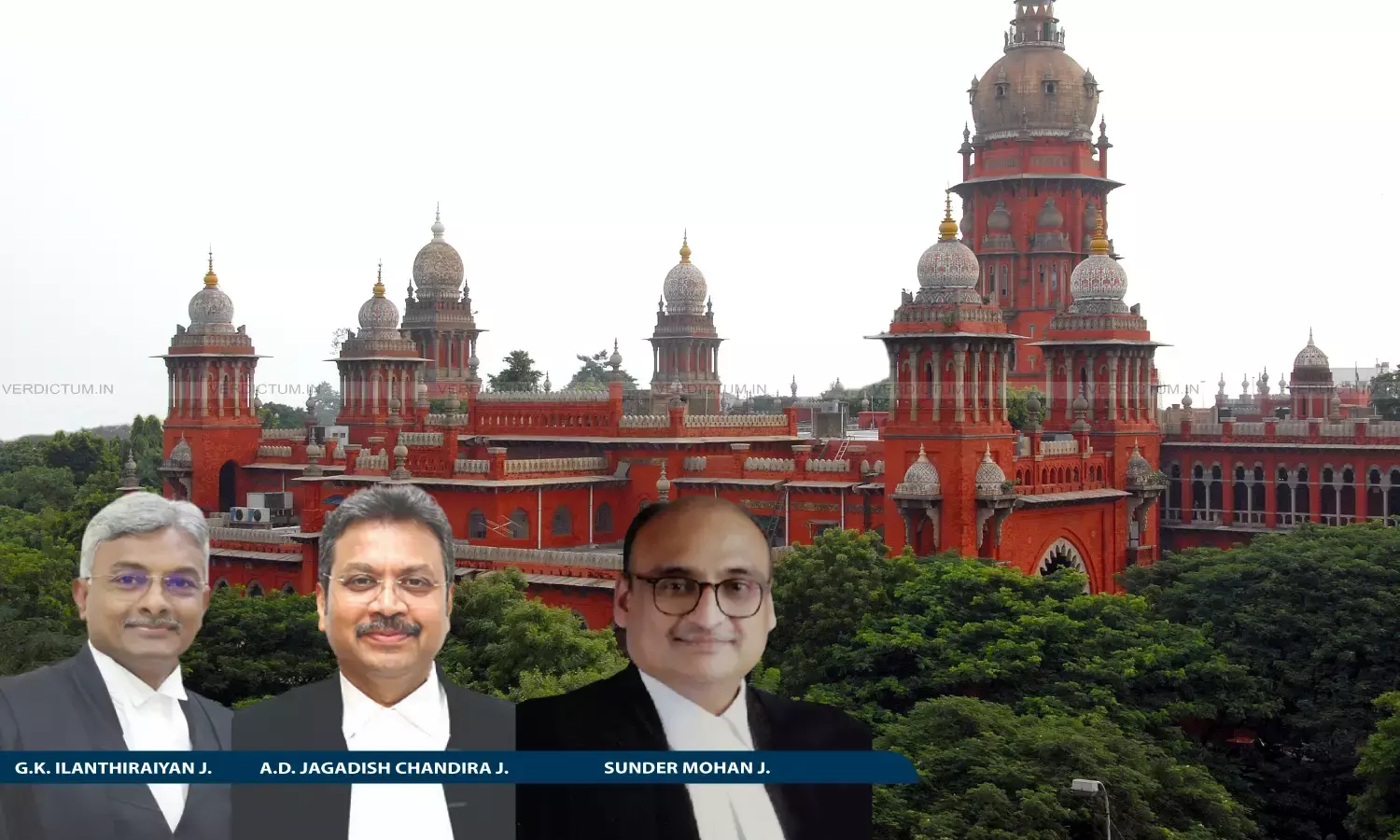
The Madras High Court held that the Governor of a State remained strictly bound by the aid and advice of the Council of Ministers regarding the premature release and remission of life convicts.
While resolving a conflict between prior Division Bench rulings, the Court emphasized that the constitutional power vested under Article 161 did not grant the Governor the discretion to take a view contrary to the Cabinet's recommendation, regardless of personal preference.
The Full Bench of Justice A.D. Jagadish Chandira, Justice G.K. Ilanthiraiyan and Justice Sunder Mohan observed, “In the light of the above discussion, this Court answers both the issues under reference cumulatively by holding that while exercising powers under Article 161 of the Constitution of India in matters relating to remission and premature release of convict prisoners, the Hon’ble Governor is bound by the advice of the Council of Ministers regardless of whether the Hon’ble Governor likes that advice or not and under no circumstance, the Hon’ble Governor can exercise discretion to take a different view from the one taken by the Council of Ministers.”
Advocates M. Mohamed Saifulla and D. Mario Johnson appeared for the Petitioners, while State Public Prosecutor Hasan Mohamed Jinnah appeared for the Respondents.
Previously, the High Court had referred to a Larger Bench the question of whether the Governor is bound by the advice of the Council of Ministers when deciding on remission and premature release of convicts, or whether discretion can be exercised in such cases.
Factual Background
Several petitioners, who were convict prisoners or their representatives, filed writ petitions under Article 226 of the Constitution of India. They sought a writ of certiorarified mandamus to quash various Government Orders (G.O.) that rejected their requests for premature release. The petitioners claimed eligibility for premature release under various government schemes, specifically G.O. (Ms.) No. 488 and G.O. (Ms.) No. 430. While these cases were being heard, a Division Bench of the High Court noted a conflict between two previous Division Bench decisions—Veera Bharathi v. State [W.P. No.14908 of 2024] and Murugan @ Thirumalai Murugan v. State [W.P.(MD). No.13468 of 2024]—regarding the Governor's authority in such matters. Consequently, the matter was referred to a Full Bench for an authoritative pronouncement.
Contention of the Parties
The petitioners contended that their cases for premature release were duly considered and recommended by the State Cabinet. They argued that once the State Cabinet recommended their release, the Governor was bound by the advice of the Council of Ministers. They further maintained that the Governor's subsequent rejection of their premature release by acting in his own discretion was unsustainable in law.
The State submitted the issues framed regarding the Governor's discretionary powers. The core of the legal isuue centred on whether the Governor could legally deviate from the Cabinet's advice in matters of remission and release.
Observations of the Court
The Full Bench was constituted to decide the issues as follows: i. Whether His Excellency the Governor is bound by the advice given by the Council of Ministers in matters relating to remission and premature release?; ii. If he is so bound, under what circumstances does the Governor have the discretion to take a view different from that taken by the Council of Ministers?
The Court observed that there was an apparent dichotomy in the views taken by different Division Benches of the same High Court concerning the Governor's role in premature release.
“On hearing the submissions of both sides and having perused the authorities cited at the bar, this Court finds that the ruling in Perarivalan, supra, has merely reiterated the position of law laid down in the Constitution Bench ruling in Maru Ram, supra, and therefore, it is well settled that the Governor is bound by the advice given by the Council of Ministers in matters relating to remission and premature release, which are indeed powers exercised by him by virtue of Article 161 of the Constitution of India”, the Court said.
The Court recognized the need for a definitive legal stance on whether the Governor is strictly bound by the advice of the Council of Ministers regarding remission and premature release.
It observed, “Further, it is also notable that the Division Bench of this Court in Murugan @ Thirumalai Murugan, supra, which had held that the ruling in M.P. Special Police Establishment, supra, permits the Governor to act in his own discretion in exercise of powers under Article 161 of the Constitution of India, when on facts, bias becomes apparent or the decision of the Council of Ministers is shown to be irrational and based on the non-consideration of relevant factors, had thereafter, in two other occasions in Vanaraj, supra and S. Kumar @ Pushpakumar, supra, followed the ruling in Perarivalan, supra and held that the advice of the Council of Ministers was clearly binding on the Governor. Therefore, it is clear that the ruling in Murugan @ Thirumalai Murugan, supra, is per incuriam to the limited extent that it holds that the ruling in M.P. Special Police Establishment, supra, permits the Governor to act in his own discretion in exercise of powers under Article 161 of the Constitution of India.”
The Court further noted that it must be determined under what specific circumstances, if any, the Governor has the discretion to take a view different from the one recommended by the Council of Ministers.
Accordingly, the Court directed the Registry to place all the above cases before the Bench having a roster for independent consideration.
Cause Title: Eswaran v. State and other connected matters [W.P. No.31478 of 2024]
Appearances:
Petitioner: Advocate M. Mohamed Saifulla, Advocate D. Mario Johnson, Advocate R. Sankarasubbu, Advocate S. Nadhiya, Advocate M. Murugesan, Advocate M. Madhumitha, Advocate S. Arivazhagan, Advocate S. Manoharan, Advocate M. Radhakrishnan, Advocate P. Pugalenthi.
Respondents: State Public Prosecutor Hasan Mohamed Jinnah, Additional Public Prosecutor E. Raj Thilak, Government Advocate S. Santhosh, Advocate V. Sumi Arnica, Advocate S. Arun Pandi, Advocate A. Mohammed Imran.